Time sharing economy lived up to its name







Perhaps there is no term as popular, yet controversial, as "sharing economy" to be the buzzword for 2017 in China. Just as the first sentence in A Tale of Two Cities by Charles Dickens, "It was the best of times, it was the worst of times", for the sharing economy in 2017.
The sharing economy has gained widespread popularity not only because of the capital invested in its projects but also because of the support it has got from the authorities. According to State Information Center's China Sharing Economy Development Report 2017, the trade volume of the sharing economy reached 3.45 trillion yuan ($532 billion) in 2016; and it is expected to maintain a 40 percent growth rate in the coming few years. It was even written into the 2016 and 2017 Government Work Report.
But the development trend of the sharing economy suddenly hit the brakes in the latter half of last year, even if temporarily. According to incomplete statistics, last year 27 sharing economy startups went out of business, including seven shared bicycle enterprises, seven shared power bank enterprises, four shared clothes enterprises, and three shared toy enterprises and three shared automobile enterprises. In addition, one-third of the failed sharing economy companies lasted less than one year, prompting the media to call it "the crematorium of startups", and many people to question the existing model of the sharing economy.
Ideally the sharing economy should be about pareto improvement: a neoclassical economic concept, which means an action taken in an economy that harms no one and helps at least one person. In other words, it means people and enterprises sharing idle resources through information and communications technologies to increase the utilization efficiency and reduce costs of individuals as well as society as a whole.
But the existing sharing economy business model deviated from this win-win principle. No wonder many question whether its existing business model can even be called "sharing". Take shared bikes, the most popular sharing economy business in China, as an example. Instead of using existing idle resources, shared bike companies produced and purchased huge numbers of new bicycles to put them into the market. Their business model is based on customers paying the lease for the bikes owned by the companies. Such a business model should be called "lease economy" rather than sharing economy, not least because it has created as many problems for society as the benefits it has offered.
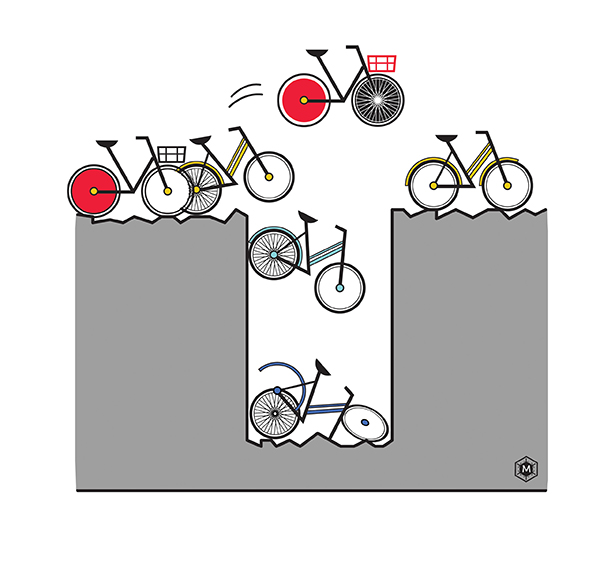
According to the SIC statistics, till July last year, about 16 million shared bicycles were in operation nationwide, which have caused many urban problems such as illegal parking and inappropriate scrap disposal, because more than the needed numbers of bicycles were introduced to cities. Many media reports said that hundreds of thousands of scrapped shared bikes had piled up in the suburbs, which they called the "graveyard of shared bikes".
Although many major cities have required companies to stop launching new shared bikes, the companies ignored the regulations to introduce new bikes to compete with rival companies and grab a bigger share of the market.
The pseudo-sharing economy failed to activate idle resources to increase efficiency, and instead caused social chaos and tremendous waste of resources. Their economic endeavors can hardly be described as sharing economy, which is supposed to improve social welfare. It is more like naked competition to acquire market monopoly.
Worse, shared bike companies can embezzle customers' deposit. In September 2017, Kuqi, a shared bike company operating in more than 10 cities, pocketed several hundred million yuan of customers' deposit and unilaterally blocked the deposit refund channel online and offline. Such scandals undermine the development of the sharing economy.
But despite the sharing economy facing great challenges, it still has great potential to develop into a successful, win-win business model. In fact, the current chaos offers a great opportunity to reshuffle the industry, and revert to the socially and economically beneficial-for-all business model of the sharing economy. Only by following a good business and sustainable development model can the sharing economy benefit society.
The author is a writer with China Daily.