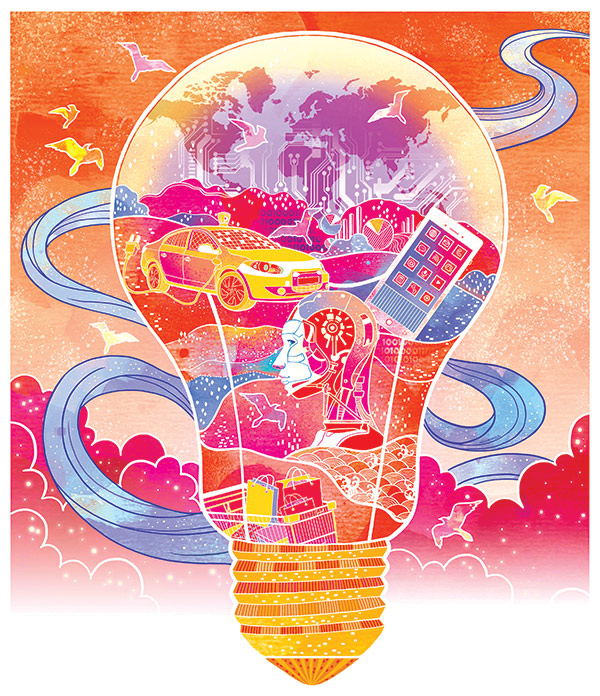
Nothing put-on about coming AI boom







Internet, cloud computing, big data and artificial intelligence will transform lives
The term "artificial intelligence" is often associated with driverless cars and highly sophisticated machines that can outsmart even the best of human minds in complicated tasks, such as the strategy board game Go.
But the Chinese experience suggests that technologies as such are innovated not just for these attention-grabbing examples, but to make substantial improvements in day-to-day life.
In his address to the 19th National Congress of the Communist Party of China, General Secretary Xi Jinping called for more efforts to foster new areas of growth through further integration of the internet, big data and artificial intelligence with the real economy.
China will advance supply-side structural reform next year, with more efforts to improve the quality of economic growth, promote innovation and foster new growth drivers, according to a statement released after the annual Central Economic Work Conference last week.
In the country's campaign for high-quality development, the innovation-oriented digital economy and new technologies are certain to play a key role.
The digital economy-which features the use of the internet, cloud computing, big data and artificial intelligence into a variety of sectors-will contribute to 70 percent of newly added economic output this year.
"The digital economy will be key to helping China become a leading industrial power and enter the 'fourth industrial revolution'," said Tencent Chairman Pony Ma.
On the retail front, AI is playing a less visible albeit vital role in changing online shopping experiences by using algorithms to track, analyze and satisfy the specific needs of each and every consumer.
Online shoppers these days can often find similar alternatives appearing on their screens after searching for a particular product. Virtual shop fronts could also display different products, based on each customer's buying habits and preferences.
"All of this is made possible with the application of AI," said Wang Xin, a partner covering the technology industry at global consultancy Roland Berger. "The computer learns to recognize patterns in the data and builds up a base of experiences that can be applied to solve problems in new situations."
Beyond generating big numbers in online transaction volume, Chinese e-commerce players are also striving to reshape the manufacturing process based on personalized needs and revamping physical retailing using novel technologies.
By acquiring stakes in brick-and-mortar malls, data-rich companies such as Alibaba, JD and Tencent help retailers merge online and offline resources with the aid of AI, big data and cloud computing technologies.
Thousands of labels are being converted into "intelligent retail outlets". Through an interconnected system, they allow shoppers to track product availability at other locations in real time and get timely delivery while choosing to pay with their smartphone.
Because technologies track your preferences and streamline production processes, customers stand to enjoy perks from smart lipstick recommendations to ordering tailor-made outfits.
"Since the introduction of these high-tech gadgets, we've seen customer traffic flow grow 20 percent in the November promotion season from the annual average," said Chen Xiaodong, CEO of InTime Retail, a leading shopping mall chain.
"The whole new retail development is helping to improve efficiencies in the retail infrastructure and greater engagement with consumers, especially reaching into the rural market," said Matthew Crabbe, Asia-Pacific research director of consultancy Mintel.
A case in point is that hundreds of thousands of "mom-and-pop" convenience stores across the country's counties and villages have undergone a digital makeover: they include data analytics from stocking shelves to running the register in a bid to precisely predict sales and manage inventory.
On the payment front, mobile wallets, initially designed to facilitate online transactions, have now penetrated public services and wealth management, streamlining administration and enhancing efficiency.
The Chinese people are also conferring internet business models and know-hows to foreign players. From Southeast Asia to North America, consumers celebrate online shopping sprees, swipe virtual credit cards and ride shared bikes backed by mobile payment technologies.
But more importantly, financial technology should be given full play to energize the real economy, especially in promoting inclusive finance through cost reduction and revamping of traditional models of the financial services, said Liu Guoqiang, assistant governor of the People's Bank of China, the central bank.
Search engine Baidu Inc has stepped into the online finance arena by offering loans to credible businesses who advertise on its site, and adopting artificial intelligence into client sorting and assessment, said Zhu Guang, the company's senior vice-president.
"We've lent 5 million yuan ($760,850) to help a hairy crab farmer extend retail networks in Beijing and Shanghai, and he said he earned an extra margin of over 100 million yuan, thanks to the timely financial injection (from us)," he said.
JD's online finance arm JD Finance offers peasants a tailored and periodic release of loans to avoid idle cash, based on a quantitative model that tracks the entire process of agricultural production.
"No collaterals is needed, as data analytics would step in to monitor credit history, word-of-mouth appraisal and real-time business operations," said Chen Shengqiang, CEO of JD Finance. He said the firm also utilizes internet of things technologies to predict and prevent epidemic situations of livestock and offer distant diagnosis, he noted.
Apart from subtle enhancements in life, new technologies and services have taken on more enterprising undertakings.
China unveiled a three-year plan in December to boost the application of AI in the automobile, robotics, healthcare and other sectors, in its latest push to upgrade the country's real economy.
The plan, published by the Ministry of Industry and Information Technology, said China, aims to build a globally competitive smart internet-connected car industry by 2020, with breakthroughs in self-driving platforms.
AI-enabled service robots will also be widely used in China within three years, with focus on robots that can help seniors and children. Also, the country aims to accelerate the use of AI-enabled systems to assist doctors in medical cases.
China's manufacturing sector has also embraced cloud computing and AI, giving initiatives such as "Made in China 2025" real meaning. Major cloud operators including Tencent Cloud are building industrial big data platforms for Chinese manufacturers that can connect their facilities globally.
Using predictive analysis, such platforms can detect, avert or tackle glitches in real time, improving efficiency.
An indigenous navigation satellite system is crucial to such development. China's BeiDou now covers the entire Asia-Pacific region, enabling wider applications in logistics, aviation, precision farming and other industries that demand high-accuracy positioning.
BeiDou accounted for about 70 percent of the nation's market share of chips, equipment, software, algorithms and other services directly related to satellite navigation in 2016.
China plans to expand the BeiDou network to cover countries and regions involved in the Belt and Road Initiative by the end of 2018.