Cross-Straits discord may continue next year







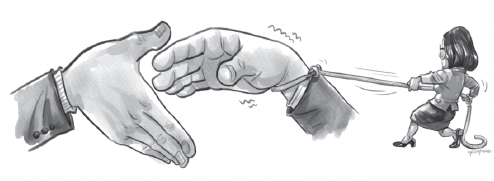
Official exchanges between the Chinese mainland and Taiwan have remained frozen since Taiwan leader Tsai Ing-wen refused to recognize the 1992 Consensus after taking office in May 2016. And there is no sign of official talks resuming any time soon, as Tsai seeks to ally with the United States and Japan, instead of taking steps to improve cross-Straits ties.
Tsai has made few achievements in the one and a half years since assuming office, as she has been busy trying to "de-Sinicize" the island's institutions and political landscape, and her administration's ambivalence on the one-China policy has further strained cross-Straits ties.
Besides, Tsai is taking measures to shift the island's trade and economic relations away from the mainland to other economies, including some in Southeast Asia. In December 2016, she broke precedent by talking to then US president-elect Donald Trump on the phone, pushing cross-Straits ties to a new low.
Tsai's political moves have provoked conflicts across the island's social and economic divides. Her administrative decisions, including pension reform for public employees and "forward-looking" infrastructure development plan have angered Taiwan residents. And her halfhearted pursuit of transitional justice for indigenous people and judicial reform has led to disputes.
As the leader of the Democratic Progressive Party, Tsai has widened the divide between the island's political parties thanks to her aggressive and irrational decisions. By making the rabidly "pro-independence" Lai Ching-te the leader of the "legislative yuan", Tsai has created new challenges for herself. Moreover, the DPP leaders and secessionist forces are using the fear of "Japanization" and the false lure of "Taiwan independence" to mislead Taiwan residents, causing more damage to cross-Straits relations.
However, people-to-people, trade and cultural exchanges continue despite the absence of official communication between the two sides of the Straits, as political parties and social groups on both sides that adhere to the one-China principle intensify their fight against separatist forces on the island amid the controversial political moves of Tsai.
Earlier this year, the island's administration released the amendment draft to the "Act Governing Relations between the People of the Taiwan Area and the Mainland Area", which aims to restrict the involvement of retired or former government officials and senior security officers in cross-Straits exchanges and thus reduce the channels to improve relations between the two sides.
In contrast, after the 19th National Congress of the Communist Party of China, the "Lu Li'an phenomenon", named after the Taiwan-born academic who was a delegate to the 19th Party Congress, has inspired an increasing number of young Taiwan compatriots to join the CPC and/or work on the mainland. Reiterating the basic policy on Taiwan, the 19th Party Congress said the mainland will continue to push for peaceful national reunification.
First, Beijing is determined to subdue the separatist forces on the island by refusing to hold talks with "independence-leaning" parties. Second, the mainland will continue to promote people-to-people exchanges with Taiwan residents, social organizations and politicians that adhere to the one-China policy, in order to build a common political foundation for peaceful national reunification. Third, the mainland welcomes Taiwan compatriots to study, work, set up businesses and/or settle down on the mainland, and may even offer them some favorable policies. And fourth, the mainland will explore ways to consolidate the historical and cultural bonds with Taiwan compatriots.
Next year will see Tsai face her "mid-term exam" in the form of local elections, commonly known as the nine-in-one elections that, according to many, should be a bellwether for the 2020 general election.
If the DPP continues to be equivocal on the 1992 Consensus and maintain its hostile attitude toward the mainland, by following the strategic path of the US and Japan, it will further deteriorate cross-Straits ties. The fact, however, remains that cross-Straits ties can still be mended if Tsai and her administration change their policies.
The author is a professor at the Institute of Taiwan Studies of Beijing Union University.