Physicists invite aid from China








Gravitational wave detector can solve 'puzzles of the universe'
The world's top scientists in the detection and research of gravitational waves, a field that will open a new window of study of the universe, welcomed Chinese colleagues to participate in their international collaboration.
The current second-generation detectors of the Laser Interferometer Gravitational-Wave Observatory, a collaborative project, has over 1,000 researchers from more than 20 countries working on it, and China can certainly play a role in the next generation that is in a concept stage, said Barry Clark Barish during an exclusive interview with China Daily on Sunday in Shanghai.
LIGO detected gravitational waves for the first time in history in September 2015.
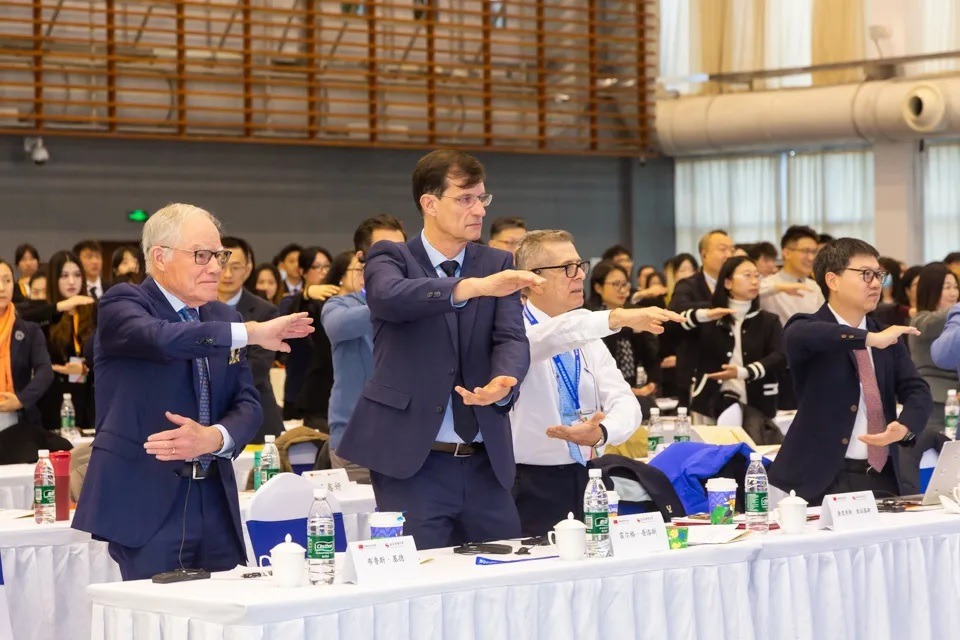
"We hope one of the detectors of the next generation will be built in China by Chinese scientists," said Barish, who was attending the Fudan Science and Innovation Forum 2017 in Shanghai.
Barish fostered collaboration between research parties that eventually enabled the detection of gravitational waves, a feat LIGO accomplished, for the first time in history.
Barish, together with Rainer Weiss, inventor of the laser interferometer gravitational-wave detector, the foundation for LIGO, and Kip Stephen Thorne, who created programs modeling gravitational waves and developed analysis methods, won the 2017 Fudan-Zhongzhi Science Award. The three US scientists were selected for the award founded by Fudan University and Zhongzhi Enterprise Group for their contributions to the observation and research of gravitational waves.
They also received the 2017 Nobel Prize in physics.
The current generation of detectors consist of two gigantic, identical interferometers - devices that merge two or more sources of light - in Hanford, Washington, and Livingston, Louisiana. The next generation, with which scientists hope to explore "the science of the whole universe and (solve) the puzzles of where the black holes begin in the early beginning of the universe", will probably have more instruments that are up to 10 times the size of the current ones.
"China should become part of the international study project that will be dramatically different," Weiss said.
Several industries in China, including high-level construction and laser research, will be further boosted if the country participates in the research, Barish said.
"Also, LIGO has the world's biggest high-vacuum system. This can be challenging as you have to learn how to make it high-vacuum, but also cheap enough to make the huge project affordable," he said.
Barish said there are a few Chinese scientists involved in the science and data analysis in LIGO, but no Chinese involved in the actual experimental instrument so far. He believed China's notable breakthroughs in quantum communication and quantum computation as well as artificial intelligence will contribute to the research of gravitational waves.
"AI can help in running the sensitive instrument and doing data analysis," Barish said.
"We analyze data and look at some sources of gravitational waves predetermined by our existing understanding of what might give gravitational waves. But AI renders the possibility of looking at the data and finding a very different source from what we are looking for," he said.
Scientists said that detectable gravitational waves are caused by violent events in the universe - colliding black holes, exploding stars, and even the birth of the universe itself. Detecting and analyzing the information carried by gravitational waves allows humans to observe the universe in a way never before possible and that may usher in cutting-edge research in physics, astronomy and astrophysics.
zhouwenting@chinadaily.com.cn




- Former senior official of Ningxia sentenced to death
- Development program narrows urban-rural gap in Guangdong
- Wuxi Winter Bazaar creates cross-cultural gathering
- Expressway service area featuring a natural hot spring to open soon in Guangdong
- Former Ningxia political advisor sentenced to death for bribery
- Former senior official of Jiangxi expelled from CPC