



China builds on global lead in green buildings







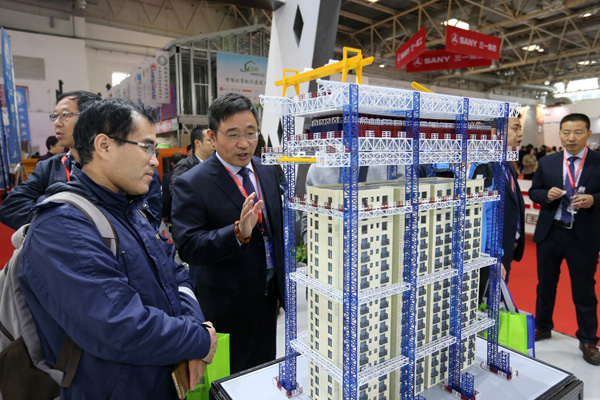
China is making rapid progress in green buildings and appears set to cement its place among the world's top markets for cost-effective and environment-friendly structures, according to an industry report.
The 2017 China Green Building Report by CBRE Research said the green building concept has been accepted by more and more property developers and local governments in China.
This has already made China the world's second-largest market for LEED-certified projects, trailing only the United States. LEED stands for Leadership in Energy and Environmental Design, the world's most widely used green building rating system.
Latest data suggest there are over 520 million square meters of green building space in 336 Chinese cities.
Including LEED-certified projects, accredited green building space would total over 600 million sq m.
LEED aims to help building owners and operators be environmentally responsible and use resources efficiently. It includes a set of rating systems for the design, construction, operation, and maintenance of green buildings, homes and neighborhoods.
As of August 2017, LEED-certified space in Beijing, Shanghai, Guangzhou and Shenzhen totaled 23 million sq m, accounting for 51 percent of all certified area in China, a 1 percent increase from 2014.
To date, 54 cities are covered by LEED's footprint in China. Beijing is the first Chinese city to have more than 10 million sq m of LEED-certified green building space.
It is followed by Shanghai (8.34 million sq m), Chongqing (4.12 million sq m), Shenzhen (2.64 million sq m) and Wuhan of Hubei province (2.5 million sq m).
Other cities in the list are Guangzhou of Guangdong province (2.31 million sq m), Chengdu of Sichuan province (2.08 million sq m), Hangzhou of Zhejiang province (1.72 million sq m), Tianjin (1.72 million sq m), Suzhou of Jiangsu province (1.71 million sq m), Nanjing of Jiangsu province (1. 24 million sq m), and Shenyang of Liaoning province (1.06 million sq m).
"Such growth in green building development is closely associated with the policy support from the Chinese government and market motivation," said Stephen Tam, senior director of asset services with CBRE Greater China.
In March, the Ministry of Housing and Urban-Rural Development released the 13th Five-Year Plan (2016-20) on green building development. The plan envisions a period of acceleration of "quantity and quality" for green buildings in China.
At least 50 percent of all newly constructed buildings should be certified as green buildings by 2020, it said.
In the early stages, LEED certification was adopted and promoted by only Hong Kong developers and foreign enterprises from relatively mature economies.
In recent years, however, an increasing number of local developers have begun to adopt the standard for their new projects.
Currently, about 62 percent of all newly built prime office buildings are LEED-certified, according to CBRE data.
Major Chinese developers including Soho China, Excellence Group, Sino Ocean Group and Ping An actively engage in developing green office buildings.
Higher rents, energy and water efficiency, better air quality, sustainability, lower operation cost, a high-quality work environment-all these factors have facilitated overall comfort and driven demand for green office space in China, said Tam.
In the past four quarters, the average occupancy rate of LEED projects in China was 81.7 percent, which is 1.5 percent higher than that of traditional offices.
Average occupancy of premium LEED projects in China was 86.7 percent, 10 percent higher than that of traditional offices.
Office buildings are the main property type seeking LEED certification in China. As of June, a total of 148 LEED-certified projects in 17 major cities had accumulated more than 10 million sq m.
In this context, Shanghai, Beijing, Chengdu, and Shenzhen had each averaged more than 1 million sq m.
LEED certification for prime office buildings has been gaining traction ever since its introduction in the Chinese market, with a market adoption rate of roughly 1 percent in 2008 to its current rate of 13 percent.
Over the years, LEED certification of Grade A office buildings has definitely become much more common. In the first half of this year, the total Grade A office space in 17 major cities was 37 million sq m, of which 8.5 million had been LEED-certified, an adoption rate of 23 percent.
Although China has seen its certified green building proportion account for 11 percent of all existing projects, the nation is still lagging behind the international standards of 35 percent, and the top three countries are India (68 percent), Sweden (67 percent), and the US (41 percent).
"Compared to newly constructed projects, existing projects which receive the LEED certification are stronger exemplifications of the certification's benefits of achieving higher rent levels, lower energy consumption, lower vacancy rates, and an overall improved environment for tenants," said Tam.
There are more than tens of trillions of sq m of existing commercial property supply in China and this figure is continuously growing at a rapid rate, reflecting large opportunities for greening the existing stock.
However, according to survey results published in the World Green Buildings Trends 2016, this could be a relatively slow process.
Only 19 percent of landlords in China have expressed plans for implementing green building standards to their existing projects.
This is much lower than the global average of 37 percent, ranking last amongst the 13 surveyed markets.
- Beijing pledges timely replacement of removed signs and billboards
- China transferring high-quality industrial capacity to Pakistan through economic corridor building
- China faces green vehicle battery challenge
- China to promote building a community of shared future for mankind: Xi
- Chinese company starts building housing project in Maldives




















