Tycoons should be wary of sensitive comments







"It is painful to earn (only) 2 billion yuan ($302 million) a month," sighed Jack Ma, president of Alibaba, China's e-commerce giant, at a gathering of entrepreneurs in Hangzhou, his hometown in Zhejiang province, last week.
Wang Jianlin, the billionaire president of Wanda Group, said something similar while explaining how to start a business in an interview during a recent TV program. Wang said: "Set a small and achievable target for yourself first, for instance, to earn 100 million yuan."
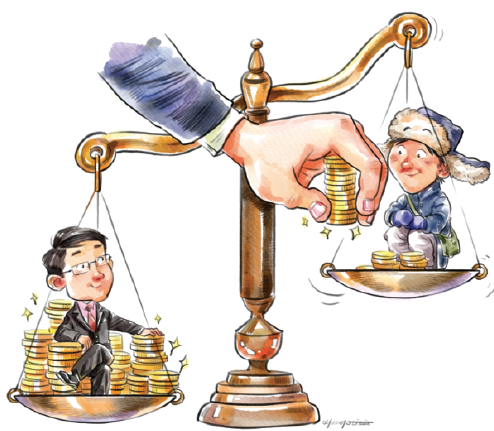
The heated public debate, including banters and jokes, which Ma's remark has sparked, is understandable, because despite entering the new era of the socialism with Chinese characteristics, as the 19th National Congress of the Communist Party of China declared, China has not been able to bridge the wealth gap.
That's why when Liu Qiangdong, founder and president of jd.com, a competitor of Alibaba, urged the rich to help the other people to increase their incomes at the 4th World Internet Conference in Wuzhen, Zhejiang province, on Monday, the common people felt they are being represented in the opinion market dominated by tycoons and celebrities.
Liu seems more conversant than Ma and Wang in public discourse, although he rephrased what Deng Xiaoping had reiterated 25 years ago. During his "Southern Tour" in 1992, Deng said let some people get rich first, and then the rich can lead the others to realize common prosperity. The saying has been widely used to explain the logic of replacing the planned economy with market economy. But it has seldom been mentioned in the official discourse, especially in recent times when the wealth gap has widened.
China has lifted more than 800 million people out of poverty since the late 1970s, an achievement that has no parallel in world history. But that has not prevented the income gap from widening. By the end of last year, 3.62 million families on the Chinese mainland had an asset of $1 million or more, according to Hurun Wealth Report. The rocketing housing prices, the roller-coaster stock market, the booming internet economy and corruption have given rise to a fast growing upper class.
The Gini coefficient, which measures the fairness of social wealth distribution-0 representing perfect equality and 1 maximal inequality, with 0.4 being the warning line-has been a sensitive issue in China. The last official figure, 0.474, was released in 2012, while a Peking University study said the poorest 25 percent population holding just 1 percent of the national wealth, and the richest 1 percent possessing one-third.
Since the income disparity issue remains to be fully resolved, tycoons such as Ma and Liu should weigh the repercussions of any public statement they make. The government has realized the importance of bridging the wealth gap to ensure social stability, because it is vital to the promotion of the rule of law and development of socialism with Chinese characteristics in the new era.
Of course, the government will not use a shock therapy-by forcibly taking from the rich to help the poor-to bridge the wealth gap. True entrepreneurship is an important source of social vitality, innovation and wealth. Besides, the private sector creates 80 percent of the jobs in the country.
China will always adhere to its people-centered development strategy, making the cake bigger so that all could share it. For instance, the income tax reform still has a long way to go before becoming an effective tool that can be used to narrow the wealth gap.
After absolute poverty is eliminated by 2020, according to China's goal, the time will be right to address the income gap, because by then the authorities will have more resources, tools and wisdom, as Deng anticipated, to solve the problem.
The author is a writer with China Daily. liyang@chinadaily.com.cn