China in the fast lane on Digital Silk Road







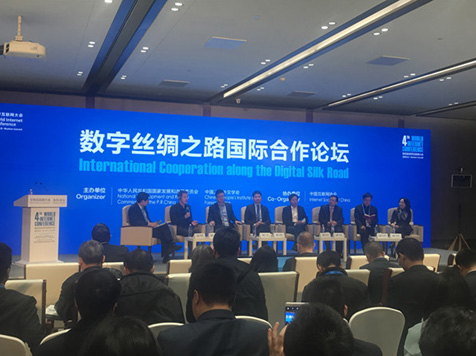 |
| The International Cooperation Along the Digital Silk Road Forum is held in Wuzhen, Zhejiang province on Dec 4, 2017, the second day of the 4th World Internet Conference. [Photo by Xiang Wenjian/chinadaily.com.cn] |
The ancient Silk Road was a trade route that for centuries connected East and West. In this technological era, it is being revived via synergized government development strategies, interconnected smart cities, and cross-border e-commerce.
The International Cooperation Along the Digital Silk Road Forum was held on Day 2 of the 4th World Internet Conference in Wuzhen, East China's Zhejiang province, with Chinese government officials, overseas dignitaries and tech heavyweights discussing the challenges and solutions for the digital future.
Hosted by Lin Nianxiu, minister of the National Development and Reform Commission of China, the first discussion centered on how countries can work together to collaborate in terms of digital development and policy strategy.
"Digital is the new driving force of the Chinese economy and growth," Lin said. "It is a great opportunity for countries to work together with a new ecological development mentality."
Former French prime minister, Dominique de Villepin, said the digital economy has created "growth, empowerment, and development", and that 2017 is the first time in history in which more than half of the people in the world have access to the internet, compared with less than 20 percent just 10 years ago.
Such worldwide access has allowed China to exploit its advantages in the digital economy on the global market
"There has been a technological shift from the West to the East with the rise of internet champions in China as an alternative to the US monopoly," de Villepin said. "Then we have the opportunity to expand the internet far beyond the borders with the aim of sharing growth and development through international partnerships."
The former French prime minister suggested a Paris-style climate agreement to build a framework by which countries can work together on internet governance, security and development issues.
"The growing commitment of China in the digital economy is a chance for both the region and the world - it is a chance for regional development as the Chinese authorities have proven their willingness to position China as a cyber power expanding internet services from Asia to Europe and Africa along the Digital Silk Road," de Villepin said.
Cooperation on the Digital Silk Road has benefited the economy in Malaysia, according to Wee KaSioog, deputy president of the Malaysian Chinese Association, who cited the country's establishment of the world's first Digital Free Trade Zone outside of China, in cooperation with Alibaba.
Developing inter-connected smart cities
To connect the nodes along the Digital Silk Road, smart cities play a key role – collecting all varieties of electronic data via sensors so that assets and resources can be managed more efficiently.
Peter Young, international partnerships manager at Future Cities Catapult, said that competition and openness was key to trying to build a successful smart city.
"We take the data from the city authorities, from the water systems, energy systems, transport systems, and make that open so that different companies can start to use that to produce new applications to solve city problems," Young said.
The problems faced by many cities wanting to become smart cities is making sure that all the infrastructure, networks and management are in place. For many older cities this is expensive and involves replacing entire systems and ways of management.
That will not be a problem for Neom in Saudi Arabia. The city, which is yet to be built, will install smart city infrastructure from the ground up and serve as an example for all others that follow.
Mohammed Al-Meshekah, deputy minister of the Ministry of Communications and Information Technology in Saudi Arabia, said that the $500-billion city on the Red Sea coast will be entirely focused around information communication technology.
Trading places in e-commerce
The third session of the Digital Silk Road Forum turned to the role that cross-border e-commerce plays in promoting international cooperation.
RJ Pittman, chief product officer for internet retailer eBay, remarked that the company's first ever online transaction was a cross-border trade back in 1995.
But just because a cross-border e-commerce platform is developed doesn't mean that there will be instant success. Liu Qiangdong, founder of JD.com, said that competition in Europe and the US is fierce and that selling products from that market to that market is nearly impossible.
"Instead we can bring Chinese brands overseas in big batches, such as Huawei and Xiaomi," Liu said. "Through this way, I believe in the future we will be able to compete in the US and in the European market."
Brand building is also key to attracting overseas customers. Xiaomi struggled on the international market for a long time before it became a success. Lei Jun, founder of the company, said that it had lost almost $1 billion before it decided to focus on a single overseas market to build overseas brand allegiance.
"We entered the Indian market and after three years we became number one," Lei said. "We can use the Digital Silk Road as a sample market to enter Europe and the US."
Lei said that Chinese brands have to build themselves up gradually so that they can become international brands, starting in the markets closer to home. India is an ideal market for Chinese companies, according to Lei, with more than 60 percent of all products sold in India coming from China.
"We want to transplant Chinese business models and ideas into other countries," Lei said.