



Wuzhen: A water town like no other







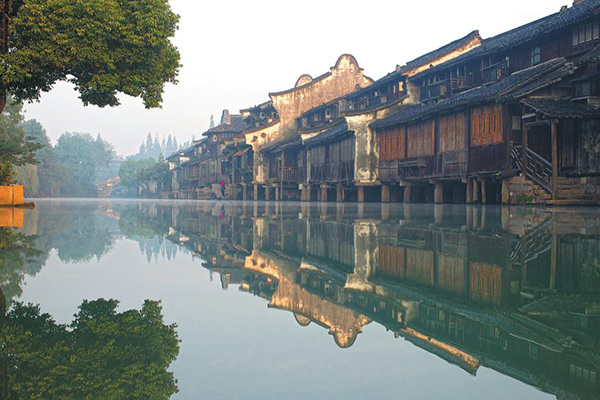 |
| Wuzhen, an ancient river town in Tongxiang city, Zhejiang province, has become the permanent and beautiful home of the World Internet Conference, also known as the Wuzhen Summit, since 2014. Photo by Gao Erqiang / China Daily |
Unlike its counterparts, the riverside tourist attraction has harmoniously interwoven the old and new and offers a tastefully curated selection of goods and services for both residents and visitors. Alywin Chew reports.
I've been to a number of well-known ancient towns in China over the past two years, but the only things I remember now are the stench of stinky tofu and the overwhelming amount of tourist kitsch on display.
I thought I had seen them all. I thought all ancient towns were the same.
That was until this trip to Wuzhen.
Make no mistake about it - Wuzhen is without doubt a tourist destination where commercialization makes no attempt to hide itself.
If you're heading to this famous water town thinking it is a place that has yet to be touched by the blight of modernity, you're going to be sorely disappointed.
Here, just like all the other ancient towns in China, you will find restaurants, cafes, bars and gift shops. There is even free Wi-Fi that can be accessed from almost every corner of this water town (this is, after all, the home of the World Internet Conference).
But unlike its counterparts, this tourist attraction stands out because it is a supremely well-organized entity that offers a tastefully curated selection of goods and services. Almost every stall here is unique, selling items that you would not find in another part of the heritage site.
I have never fully toured an old town because I was always jaded by the ubiquity of tourist kitsch. This refreshing selection of lifestyle amenities in Wuzhen, however, compelled me to explore every nook and cranny.
Another thing that struck me about Wuzhen is the impeccable harmony between old and new. While some might argue that gentrification robs heritage architecture of its soul, I believe that modern elements can, to a certain extent, facilitate an appreciation of the past.
Having modern comforts such as hot showers, flush toilets and plush beds don't necessarily dilute the old world experience.
Rather, they can help city dwellers who are unaccustomed to the ways of the old world feel comfortable in austere living conditions, which in turn allows them to appreciate the environment better.
Case in point: during a recent trip to the Himalayas, I spent one night in the town of Dugla shivering in my sleep. The temperature had dipped below zero and my room had nothing more than a hard bed and a blanket. I was desperate to get out of the place as soon as possible, not explore it.
 |
| Wuzhen, an ancient river town in Tongxiang city, Zhejiang province, has become the permanent and beautiful home of the World Internet Conference, also known as the Wuzhen Summit, since 2014. Photo by Gao Erqiang / China Daily |
As such, having such shops in old towns helps draw the crowds, which in turn generates tourism dollars that could be channeled into the preservation of these historic structures.
Of course, gentrification has to be implemented judiciously, else an ancient dwelling might just end up becoming a paradise of kitsch.
Wuzhen, to me, has achieved this balance between old and new with a certain level of panache.
I found that the contemporary Chinese style furnishings and interior decor in many of the shops dovetail perfectly with the brick facades, wooden structures and stone bridges to create a setting that makes one feel as if they are suspended in a time vacuum between old and new China.
Wuzhen appeared a little unreal to me. I felt as if I was in an elaborate movie set, not an old water town.
The first attraction I came across certainly magnified this feeling. As I walked into a hall where different traditional Chinese clothing was displayed, I saw five visitors dressed in nuptial costumes laughing as they took selfies on an ancient Chinese wedding bed.
Watching them from behind the security barrier felt as if an old school Chinese comedy was being screened in front of me.
One of the museums I visited showcased the archaic practice of foot-binding that is believed to date back to as early as the 10th century.
Here, I learned that the custom, which involved using tools to break the bones so that the feet can be squeezed into tiny embroidered shoes, was driven by a number of motivations.
While many women endured the pain simply as a means of showing off that they are from the upper class, men saw tiny feet as a symbol of beauty.
I was told that some men even chose their wives just by looking at the size of the candidates' feet.
I left the museum in awe of what I had seen, partly because it was a stimulating reminder of how subjective beauty can be, and partly because I had never seen a museum in an old town that is so well-designed.
This sense of wonder endured as I stepped into places that were once patronized by world leaders during past World Internet Conference meetings.
The shop where President Xi Jinping bought a gift for Russian Prime Minister Dmitry Medvedev in 2015 was packed with tourists the night I was there. Many were examining the pair of chopsticks that Xi bought for his Russian guest.
Located a short walk down the street is Dan Cha Fan, a modern Chinese restaurant where world leaders dined during one of the conferences.
The exquisite chinaware and table decorations used on that very day are on display in a separate room that is off-limits to diners.
Again, a motion picture started rolling in my head as I imagined how the world leaders interacted with one another at these places. How did Medvedev react to the chopsticks? What did the head of states say to one another at the dining table?
I was impressed by the fact that I did not find any stalls selling cheesy "I Love Wuzhen" keychains or purses with Chinglish phrases.
Many of the shops featured zenminimalist interiors and sold items such as calligraphy brushes and silk clothing that were far more exquisite than banal tourist kitsch.
The boisterous bars at the end of the town and the two wonton stalls I came across were perhaps the only repetitive elements I noticed.
I only came across one stinky tofu shop, and the odor was almost indiscernible as it was masked by the saccharine scent of osmanthus from the snack stall across the walkway.
The skies opened up as I made my way back to the entrance, and the stone pathway glistened in the rain, reflecting the brilliant colors inside a shop selling traditional handcrafted lanterns.
This emulsion of vibrant hues on the ground, combined with the pitter patter of rain drops and the warm glow of the street lamps, filled the air with a sense of romance.
The first thing that came to mind was the final scene in the Woody Allen film Midnight in Paris where the characters Gil and Gabrielle meet on a bridge at night as the rain comes pouring down.
"Actually, Paris is the most beautiful in the rain," says Gabrielle, moments before the credits roll.
I thought the same could be said of Wuzhen.
I later learn that this gorgeous water town has a nickname.
Quite befittingly, it is called "the Venice of the East".




















