Foreign financial firms are ready for business







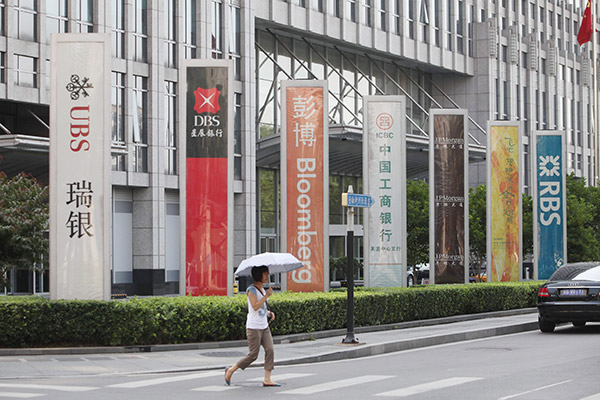
Major change in overseas ownership rules in China will increase investment and boost competition
China's financial industry will become more competitive in the wake of the government's decision to further open up the sector to foreign competition.
Major new rules announced earlier this month by Zhu Guangyao, deputy finance minister, will give global investment banks and insurance companies unprecedented access to the world's second largest economy.
Foreign financial firms will be allowed to own up to 51 percent in mainland fund managers, securities ventures and brokerages from the current 49 percent.
Spread over a three-year period, a "no limit" clause kicks in after that.
"Following years of opening up and reforms, China's competence in the financial sector has been significantly improved and is able to face more competition from the global market," said Wang Jun, chief economist with Zhong Yuan Bank, a commercial lender based in Zhengzhou, Henan province.
During the past 15 years, red tape in the financial sector has been cut and regulations tweaked from 33 percent foreign ownership to the present 49 percent.
In the insurance sector, China plans to lift the overseas ownership cap to 51 percent for three years and remove the limit after five.
Already this series of far-reaching decisions by the government is being hailed as a positive and progressive move by economists and analysts.
"The country's financial sector is now operating in a stable manner, which provides excellent conditions for further opening up the industry," said Lian Ping, chief economist with Bank of Communications Ltd, one of the biggest lenders here.
"Market liberalization will help to meet foreign capital demands and attract more foreign capital to China in the long term," he added.
Liberalization will also encourage Chinese-owned financial firms to become more competitive.
Customers can expect a new array of products while management structures will be streamlined.
"The move was unprecedented and far beyond market expectations," Wang, of Zhong Yuan Bank, said.
Smaller commercial lenders, such as Zhong Yuan Bank, Wujiang Bank, Bank of Wuxi and Zhangjiagang Rural Commercial Bank, are the sort of financial service providers that would be open to foreign investment.
Overall, the new policy is expected to be "credit positive" for the country as it will encourage foreign capital to flow to financial firms and strengthen their risk management capabilities.
"This is in alignment with the regulator's target to enhance overall risk management in the financial sector," Moody's Investors Service stated in a note.
But one area of the industry which will not be affected involves the big State-owned banks.
Combined assets of China's top five lenders were 92.1 trillion yuan ($13.88 trillion) by the end of September, 2017.
"It is very unlikely that foreign enterprises would take major ownership stakes in big State-owned banks as they are often included in State-owned strategic capital," Minsheng Securities stated in a note.
Overseas companies will probably focus on increasing their presence in China's insurance, securities and fund-management industries.
This has "significant room for development", Oliver Rui, professor of finance at the China Europe International Business School in Shanghai, told Bloomberg News.
Naturally, foreign financial firms have applauded the decision with major players, such as JPMorgan Chase & Co and Morgan Stanley, announcing they are committed to China.
"We welcome this milestone policy change which we believe will bring further investment to China and create new business momentum for the financial services industry," a Morgan Stanley spokesperson said.
"Morgan Stanley is committed to growing our businesses in China and we see this policy change as an important step in the further development and opening-up of China's capital markets," the spokesperson added.
Still, this latest move is in line with other key policies during the past few years to increase foreign capital in the country's markets.
The Wholly Foreign Owned Enterprises, or WFOEs, pilot program was rolled out in selected free trade zones in the country, allowing foreign firms to have access to various financial sectors.
Since last year, more than 10 WFOEs have applied to launch private fund management firms with at least half up and running by the fall.
In November, three more WFOEs, Invesco Finance Plc, Neuberger Berman Group LLC and Value Partners Group Ltd, were approved by the regulator to operate in China.
"A higher number of WFOEs would mean the capital market will have more options and a wider range of products," a research note from China Merchants Securities stated.
"(This will) create more opportunities for investors to hold assets in a diversified manner."
In the long term, brokerages, insurance companies, fund managers and banks look certain to benefit from this latest round of market liberalization, Shenwan Hongyuan Securities pointed out.
"Opening up will come at its own pace and generate its own momentum with risk management and control as the bottom line," Shenwan Hongyuan Securities stated in a note.
"Both foreign (firms) and Chinese financial services providers are going to be patient (during this period). But the trend is irreversible," the research note added.