



Organ donation program moves into overdrive







Nearly 150 postgraduate students will begin training this month as the country continues to refine the national system, as Yuan Quan and Gao Bei report for Xinhua Features.
'I do." Those two words brought Liu Yuan, a father of two boys, to the verge of tears. But it wasn't a wedding vow; it was an affirmative answer from the relative of an organ donor.
In China, every post-death organ donation must be approved by relatives. As the coordinator of organ donations at the Beijing Youan Hospital, the 38-year-old spends his days approaching the families of potential donors, procuring organs and arranging funeral services.
This month, he and 21 colleagues from Shanghai, Beijing, the Guangxi Zhuang autonomous region, and the provinces of Yunnan, Hubei and Jiangxi, will start training postgraduate students in organ donation and transplantation techniques.
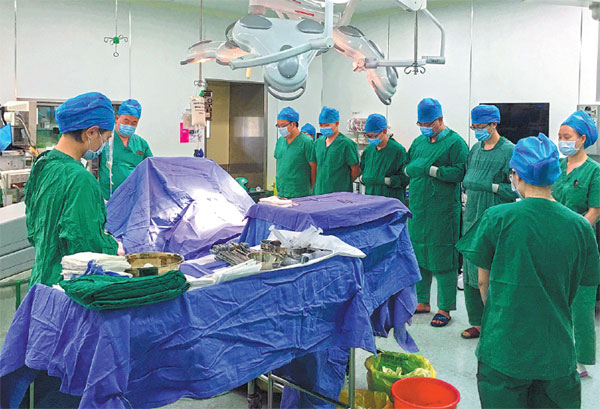
Members of the medical staff honor an organ donor in an operating room at the Beijing You'an Hospital. Provided to China Daily |
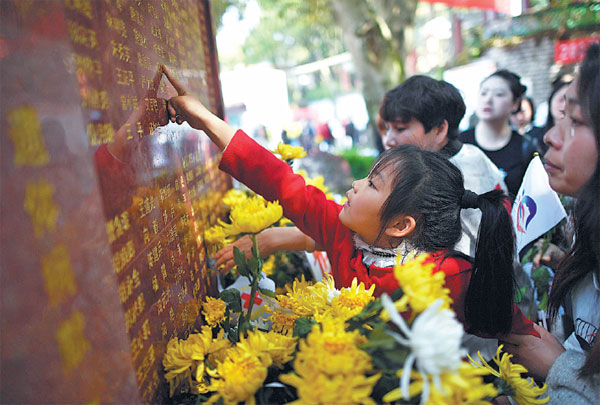
Children read the names of donors at the opening of a memorial park in Chongqing, Southwest China, on April 1. Provided to China Daily |
They believe the training will be a key step in China's progression toward a more professional approach to organ donations in line with international practices.
Skills shortage
Liu, a liver transplant surgeon, had never handled organ donations before taking up his post in 2013.
Initially, he was reluctant to accept the position, and mistakenly thought the job of coordinator involved little more than "persuading people to donate".
His predecessor quit because there had been no donations for more than six months.
Liu read books and took courses in the hope of better communicating with the families of protential donors. He completed his first organ donation over a drink.
A 13-year-old girl with a brain tumor had been declared brain dead and was being kept alive by machines, but her family was reluctant to donate her organs.
Liu invited her father for a drink, and the two men formed a bond. He recalled how they cried all night, not only for the suffering of the family, but also for a father's regrets.
His companionship and understanding worked. The next day, the father agreed to donate his daughter's liver, kidneys and corneas, helping at least three people.
In the past four years, Liu has completed more than 30 organ donations. But the failures "could be more than five times that number".
He understands that the main obstacle to donation is that many conservative elderly people still firmly believe in the tradition of burying the dead intact. Even his own parents disagree with organ donation, he said.
His work has resulted in him being verbally abused and he has even been accused of being involved in organ trafficking.
China banned the use of organs from executed prisoners in 2015, making voluntary donation the only legitimate source of organs.
As the system has become more fair and transparent, the number of donors has grown and public awareness is rising.
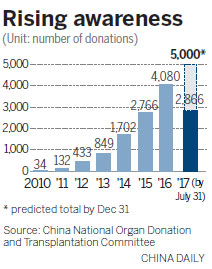
So far, about 10,000 people nationwide have donated 28,000 organs. Last year, 4,080 people donated, while in 2010 the number was only 34. Almost 300,000 people have also expressed a wish to donate.
The growing awareness of the practice has seen the authorities accelerate the training of doctors to overcome a skills shortage.
Liu has seen several cases where members of staff in intensive care units have failed to maintain the organ functions of potential donors, which has led to organ failures and affected the quality of donations. Those failures were the result of a lack of expertise, he said.
In response, this month seven universities will begin offering postgraduate courses in organ donation and transplants, under the KeTLOD project (Knowledge Transfer and Leadership in Organ Donation from Europe to China).
It is expected that 140 postgraduate students will enroll for the project, which was jointly founded by the European Union's Erasmus+ programme and Chinese universities.
Liver transplant specialist Xue Feng will teach the course at Shanghai Jiaotong University, which will fill a gap in China's medical education.
"We have lagged behind Western countries for nearly three decades. We have to work harder," she said.
Online course
In February, Liu and his 21 colleagues joined a special online course, during which they were questioned by organ donation specialists from Spain, Italy and France.
The specialists offered their expertise and experience of clinical approaches, along with organ donation management and dissemination strategies, in accordance with European guidelines.
The three-month online course was conducted through a discussion group on a social networking app that enabled the Chinese doctors to read lecture notes on their smartphones.
Surgical operations were presented via diagrams and videos, while an online tool helped translate the English-language lectures and instructions into Chinese.
In May, the Chinese medical professionals spent a week studying at the University of Barcelona in Spain.
The training will enable them to teach the postgraduate students at the universities in the next two years.
According to Marti Manyalich, president of the Donation and Transplantation Institute in Barcelona, the training is not just about sharing knowledge, but also about adapting the course to Chinese needs.
"Seven universities are not enough. We must train more Chinese professionals in more colleges in the coming decades," he said.
Spain has the highest organ donation rate in the world. Last year, the figure stood at 43.4 donations per 1 million people, while in China the number was just 2.98.
However, in 2010, the number in China was 0.03 people per 1 million.
One reason for Spain's success is that it pioneered the professionalization of donation programs. Starting in the 1980s, the University of Barcelona began offering graduate courses in organ donation, which were recognized and followed by other European countries.
Since then, Spain has taken the lead in establishing international training and exchanges, providing tuition to more than 10,000 professionals around the world.
China joined the project in 2013. Wang Lu, a colleague of Liu's who is also an organ donation coordinator, is one of the "seed doctors". She was impressed by the extensive, open discussions, scenario teaching and the Socratic tuition method, all of which are rare in Chinese training programs.
Liu said he learned that sometimes keeping silent during approaches to family members can be more effective than talking.
Meanwhile, Zhang Lize, a neurologist who took part in the training, said that humility wins trust: "This also applies to other aspects of the work."
Best prescription
However, despite the recent successes, some doctors still question the benefits of organ transplants, and are unwilling to help find potential donors among their patients. Some lack knowledge, while others prefer to avoid potential tensions with patients.
In some hospitals, organ procurement organizations - the teams responsible for evaluation and procurement - are poorly organized or severely marginalized, and there are no offices or full-time coordinators.
Chen Xiaosong, a coordinator at the Renji Hospital in Shanghai, is worried about finding doctors who want to teach the course and students interested in studying the subject, and no textbooks have yet been translated into Chinese.
Hou Fengzhong, deputy director of the China Organ Donation Administrative Center, said that although many remarkable achievements have been made in the past 10 years, China's organ donation program is still at a rudimentary stage, and society needs to work together as a whole to ensure faster progress in the future.
He advocated closer cooperation in the legal, economic, political and medical sectors.
He also suggested that the Ministry of Education should offer supportive policies to encourage more colleges, and even middle or primary schools, to host classes about organ donation.
Li Wenlei, a liver transplant specialist and head of the organ donation course at Capital Medical University in Beijing, said education is "the best prescription" for the national program.
"If organ donation is a river, then medical staff work downstream, dealing with individual cases," Li said.
"But when organ donation becomes a part of the education system, they will be able to move upstream and influence an entire generation."
(China Daily 11/14/2017 page6)



- China issues work plan to strengthen food safety in kindergartens and schools
- China's cybersecurity agency issues warning on AI agent OpenClaw
- PLA delivers two guided-missile destroyers to the East Sea Fleet
- Racing through Jiading of Shanghai
- Guangzhou Baiyun International Airport cements its position as a key global aviation hub
- Shanghai enterprise gets world's first approval for implantable BMI medical device





