China leading the way at APEC meeting







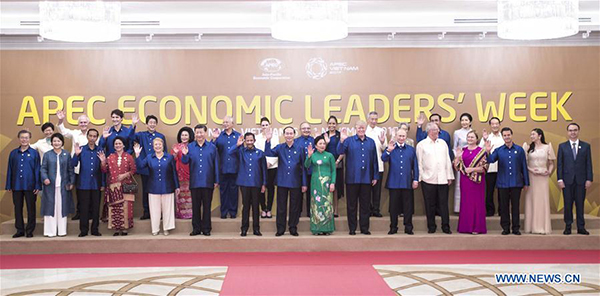 |
| President Xi Jinping (6th L, front) poses for a family photo before a gala dinner hosted by Vietnamese President Tran Dai Quang and his wife for leaders, delegates and spouses attending the 25th Asia-Pacific Economic Cooperation (APEC) Economic Leaders' Meeting, in Da Nang, Vietnam, Nov 10, 2017. [Photo/Xinhua] |
At the Beijing leaders' meeting of APEC in 2014, China proposed a study on the Free Trade Area in the Asia Pacific, called the “Beijing Roadmap for APEC's contribution to the realization of the FTAAP”. This was suggested because 2020 was only a few years away and the Bogor goals from 1994 of achieving an area of open trade and investment by 2020 was not near completion.
In 2016 at the Lima leaders’ meeting, this study was presented and APEC members endorsed it. They committed to work toward achievement of the FTAAP through existing agreements among APEC members, treating the Trans-Pacific Partnership and Regional Comprehensive Economic Partnership as pathways or pillars for achieving the FTAAP.
With the withdrawal of the US the TPP scheme has weakened, but now under the leadership of mainly Japan and Australia, a TPP 11 is being pushed up. The other pillar of the FTAAP is the RCEP, where China, as the biggest economy in this group, is pushing for a completion of negotiations. It was expected negotiations for an RCEP agreement could finish this year, but that will not be the case. China should still continue to pursue an agreement and uphold the principles of achieving a free and open system of trade and investment among APEC member economies.
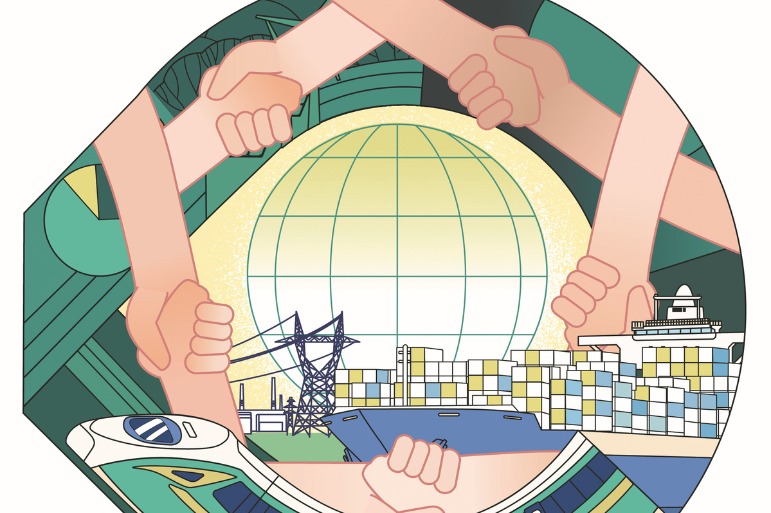
A lack of physical infrastructure, like roads, seaports, railways and power grids makes connectivity difficult to achieve and is a problem for many APEC member economies. Its solution will facilitate trade, movement of people and general business in the region.
In this regard China's Belt and Road Initiative is a big step in achieving that and should be promoted in the APEC forum. China has the experience, the technology, the companies, the human and financial resources and, most importantly, the will to contribute with APEC economies to solving the problem of building needed infrastructure.
The question of facilitating business in the region is not only a question of building physical infrastructure, but also of promoting a payment system to increase online shopping and a cashless economy. In this regard China is the most advanced country in the world, providing a system of mobile payments with its Alipay or Wechat Pay schemes.
More than half of China already uses this system, making payment easier for businesses and people. These systems allow millions of small firms to do business with just their mobile phones. China should promote this technology among APEC member economies.
But China's main contribution to APEC is probably the commitment made by President Xi Jinping at the 2016 leaders’ meeting in Lima and ratified on several other occasions, most recently at the 19th National Congress of the Communist Party of China, that China will continue opening its economy. This includes buying more products from abroad, investing more abroad and continuing to receive more investment and encouraging more Chinese to travel abroad. That is, to continue being an engine for the world economy.
In times where some countries pursue protectionism and shun multilateral and regional agreements, this is a big boost for the objectives of APEC and achieving an open system of trade and investment among its members.
The author is a professor at San Marcos National University in Peru and director of its Institute of Economics Research. He is a specialist in the economic development of East Asia.
The opinions expressed do not represent the views of the China Daily website.