



Kobe Steel scandal exposes fault line in 'Made in Japan' program







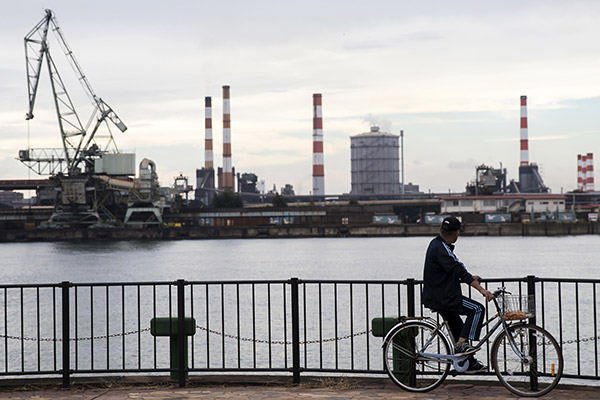 |
| The imposing red and white chimneys of Kobe Steel Ltd plant dominate the harbor of Kakogawa, Hyogo, Japan. [Photo/Agencies] |
TOKYO-Made in Japan became a byword for industrial quality under the once-vaunted keiretsu system of trust-based ties between manufacturers and suppliers.
But that reputation has been eroded during recent years.
Kobe Steel is just the latest in a string of corporate scandals involving data tampering and other methods of cheating to tarnish the Japan Inc quality stamp.
It may be a sign that the government's push to improve corporate governance is seeing greater disclosure of wrongdoing.
Yet the root cause is more likely that Japanese manufacturers are failing modern compliance standards as they grapple with a shrinking domestic market and increased global competition.
As the focus has shifted to market mechanisms instead of cozy relationship-based arrangements, Japanese companies have had to compete on price and expand their client base.
"Growing global competition has forced Japanese manufacturers to cut costs to be more efficient, while fulfilling a production quota, which is often difficult to achieve," said Motokazu Endo, a lawyer at Tokyo Kasumigaseki law office.
The keiretsu system was the bedrock of Japan's automotive industry.
As the market has become more competition based, those automakers now invest less in their suppliers and spend less time checking what those suppliers' factories are producing, according to Hitoshi Kaise, an auto industry consultant and partner at Roland Berger.
Beyond that, Japan's economy has suffered decades of anemic growth, bogged down in deflation with its population shrinking and with growing competition from its Asian neighbors.
"Those pressures have potentially whittled away at Japanese firms' ability to compete," said Hideaki Miyajima, a Waseda University professor and corporate governance expert.
The list of manufacturer miscreants is long and growing.
Nissan Motor Co has had to recall every new car it sold in Japan in the last three years after it falsified safety checks.
Suzuki Motor Corp and Mitsubishi Motors Corp have faced scandals over fuel economy tests on their vehicles, and there was even wrongdoing by the now bankrupt air bag maker Takata, Toyo Tire & Rubber Co and Asahi Kasei Corp.
"While focusing on targets was right in the beginning, it has gone too far, with companies that can't hit their targets resorting to deception," said Hiroshi Osada, a production quality expert and Bunkyo University professor.
During the last 15 years, compliance rules have become stricter but many Japanese companies have carried on with practices common in the past.
"There are many of these problems lying dormant on the factory floor," said Nobuo Gohara, a lawyer specializing in compliance, who took part in an audit of Olympus Corp after its accounting scandal in 2011.
Professor Thomas Clarke, a corporate governance expert at the University of Technology in Sydney, stressed that Japan runs the risk it will "lose out as other Asian economies, including China, progressively raise their standards of quality and reliability."
Even when moves are taken to strengthen external monitoring of companies, "it's not possible to conduct checks day in, day out," said Osada at Bunkyo University, who sat on an external panel that audited Toyota during its 2010 recall crisis.
Companies must do more to develop a culture in which workers are able to raise concerns and say "no" to their bosses, and in which teamwork is used to catch wrongdoing by other employees.
"More attention should be focused on Japan's board members, who are not active enough in engaging with scandals when they occur," said Shin Ushijima, lawyer and president of the Japan Corporate Governance Network.
REUTERS
- China to focus on improving product, service quality
- China moves to ensure safety, quality of exported, imported goods
- Chinese banks' H1 results show better asset quality, but weaker profitability
- Kobe says overseas businesses may be affected
- Teflon-coated name for Japanese quality tarnished by scandal




















