Eating in harmony with the land







Editor's Note: China is divided into as many culinary regions as there are different ethnic groups. Its geographical diversity and kaleidoscopic cultural profiles contribute to the unending banquet of flavors.
There is a little corner in China where field-to-table is a way of life that has been practiced for generations.
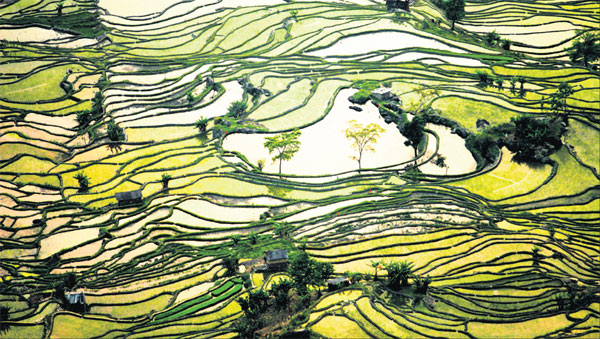
About 1,000 years ago, marauding Mongols drove a peaceful tribal community in western China deep into the southern hills. These refugees settled in the Red River Valley, the Honghe region of Yunnan near the China-Vietnam border.
Here, they carved rice terraces out of the steep hillsides, using every centimeter of land and establishing an irrigation system that is still used today.
| The Honghe Hani Rice Terraces are now a UNESCO World Heritage Site, spread across the Honghe Hani and Yi autonomous prefecture. Photos Provided to China Daily |
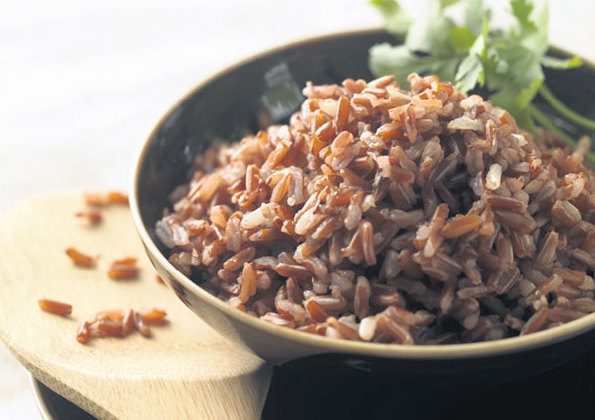
| Hani red rice is of both glutinous and nonglutinous varieties. |
The Honghe Hani Rice Terraces are now a UNESCO World Heritage Site, spread across the Honghe Hani and Yi autonomous prefecture, an isolated paradise.
Every Hani farmer has a song in his heart. It is these songs that have channeled the wisdom of their ancestors down through the ages, a wisdom that teaches them to respect and nurture the land.
It is also these folk ditties that have preserved the Hani Rice Terraces and the dual heritage of an ethnic lifestyle intimately connected to the land and the secrets of keeping an ecological balance that results in rice fields perennially rich and lush.
While all the stars are partying in the sky,
The palm trees are dancing happily on the Earth.
The Honghe Hani Rice Terraces are a well-preserved, sustainable eco-agricultural system - a carefully choreographed harmony between man and land.
In yet another song of the Four Seasons, the Hani are reminded that "the wisdom of past sages is like oil squeezed out of rock, and it is the lifeblood of our people."
The sages' songs are manifested in the forested hilltops, the village hamlets with their mushroom thatched roofs, the terraced rice fields, the little reservoirs and wetland patches, the underground water and the irrigation network above ground.
Another important aspect is the food chain. It is a combination of nature blessing the land and the people appreciating and protecting these benevolent gifts.
When the rice fields are first planted, Hani farmers release ducklings into the terraces. They also seed the terraces with carp fingerlings.
The ducklings and fish grow with the rice, picking off pests and fertilizing the fields with their waste. The ducklings keep the rice seedlings healthy, and by the time they grow to adulthood, the rice plants are also strong enough to withstand any more destructive attention.
In the flooded terraces are also other rich offerings for the Hani.
Dragonfly larvae are voracious carnivores that hunt underwater until they grow juicy and fat. The Hani call these xiabachong and eat them deep-fried like prawns. Insect protein is a natural resource.
The rice fields are home to native bullfrog tadpoles, and they, too, are eaten with relish in stews that are spiced with wild ginger, cardamom and chili. Their parents are also on the menu.
By the time the rice is ready for harvest, the carp are grown and perfect for the dining table, as are freshwater crayfish whose life cycle follows that of the rice plants.
For vegetables, the Hani plant yams, water convolvulus, amaranth, wild spinach and a host of local vegetables and herbs on the dikes.
Much of the herbs are eaten raw, simply washed and served as a salad, with a bowl of spicy red chili sauce that they dip the greens into. The hearts of yams are cooked as a vegetable, while the roots are steamed or made into fritters.
The Hani have, over time, also learned to forage for fruits and berries that grow in these hills, and their little ills and sicknesses are cured with herbal brews and concoctions.
Chickens and ducks are killed for the occasional feasts or when honored visitors are hosted, but on the whole, the villagers still prefer to let the birds lay eggs.
It was in a Hani village that I tasted one of the best sunny-side-ups in my life, a perfectly fried duck egg. The white spread out like snowy crisp lace, with a deep golden yellow yolk that was beautifully rich. It needed very little seasoning apart from a few drops of soy sauce.
Everything the Hani people need is in these rice terraces, but this near-idyllic existence is under threat.
While the micro-ecology comfortably feeds the Hani families, there is little or no money for the modern day necessities of television, internet or smartphones. Young people are leaving the villages to work in the city, and there are fewer and fewer of the able-bodied to work the rice terraces.
Now that the terraces are a UNESCO World Heritage site, tourism is bringing in money. But it is a double-edged sword.
Too many feet trampling about may destroy the delicate ecology, but tourism money is much needed to keep the new generations at home. The secret is to balance profit and preservation.
paulined@chinadaily.com.cn
Field-to-Table Cuisine
A typical Hani meal starts with the pride of the rice fields - rice that has been cultivated since the terraces were cut. These are not the modern hybrids, but old-fashioned varieties, carefully preserved.
The best known is Hani red rice, an original organic species, with both glutinous and nonglutinous varieties.
The protein on the table may be unusual.
Dragonfly larvae are harvested and then kept alive in tanks. They are mostly rinsed off and then deep-fried and served with a sprinkling of salt and chili flakes.
Bullfrog tadpoles are braised whole in a spicy sauce flavored by tiny wild gingers, sour wild fruit and more chili. To the Hani, the tadpoles are just like little fish.
Duck eggs are popular, and the quality is so good that they need little preparation. Most of the time, they are flash-fried in hot oil to create a golden brown crispy edge and a yolk that is firm but with a center that is still runny.
Carp is probably the most common main dish, and they may be fried before being braised or steamed, smothered in a thick layer of spring onions, ginger and chili.
The Hani also raise ater buffaloes and little black pigs.
The water buffaloes help till the fields and are respected for their contribution to the success of the harvests.
Hani tradition is such that water buffaloes get right of way, whether in the terraces or on the roads. Cars will patiently wait for a herd of buffaloes to meander across the roads, and the locals will definitely frown if impatient visitors honk at the animals.
To the Hani, all nature sings in harmony, and man better just hum right along.
(China Daily Africa Weekly 10/13/2017 page20)






Today's Top News
- Economic stability a pillar of China's national security
- Xi taps China's deep wisdom for global good
- New rules aim for platforms' healthy growth
- Chinese web literature grows overseas
- Postgrad exam trend points to thoughtful approach
- World's highest urban wetland a global model