Retracing a revolutionary generation's footsteps







Cadres and business leaders are gaining firsthand experience of the harsh lives endured by early members of the CPC, as Cao Yin reports from Jinggangshan, Jiangxi.
Editor's note: Ahead of the Communist Party of China's 19th National Congress, which will start on Oct 18, China Daily is publishing a series of reports focusing on the work of the country's major Party schools, where cadres study the history of the CPC, its ideology, aims and methods of governance. More reports will be published in the days to come.
Han Yan often wears fatigues when she teaches politics at a military college in Anhui province, but last month she donned the uniform of the Red Army, the predecessor of the People's Liberation Army, for the first time.
 |
| Teacher Huang Hongmei lectures students at the China Executive Leadership Academy in Jinggangshan, Jiangxi province. [Photo by Feng Yongbin/China Daily] |
"I think I look more like a soldier in the uniform than my classmates," she said proudly, but breathlessly as she leaned on a stick to walk along a steep hillside path.
Han didn't wear the uniform to play a part in a movie. Instead, she was attending a course at the China Executive Leadership Academy in Jinggangshan, Jiangxi province, which is renowned as the Red Army's birthplace.
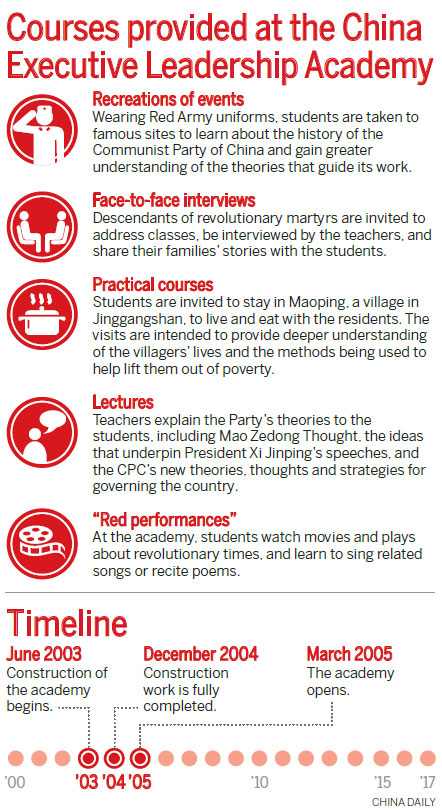
During the course, the students gain firsthand experience of the harsh lives endured by China's revolutionary generation by visiting the places they lived and fought, and by wearing similar clothing, such as uniforms and bamboo hats, and carrying the same equipment, even guns.
The path in Jinggangshan was regularly used by Mao Zedong and his comrades in the late 1920s.
"I never thought the path would be so hard to walk," said Li Changlei, as he rested. "Now, I understand how difficult it was for the troops led by Mao and Zhu De to cover this path almost 90 years ago. Those soldiers must have been very strong, because they carried more than 150,000 kilograms of rice with them."
Both Han and Li had read about the path in history books, but their visit to Jinggangshan allowed them to experience the reality of walking on it.
"The feeling of standing on the path while wearing the uniform isn't easy to describe; it's special and so different from reading about it in books or watching movies of the period," Li said.
Mei Liming, the academy's executive vice-president, said the path has been one of the most popular aspects of the course since the academy opened 12 years ago. "Combining the province's historical resources with training is a major way of developing 'red education' - that is, education related to understanding the history and theories of the Communist Party of China," he said.
Another student, Hao Rong, vice-president of the Central Academy of Drama in Beijing, said, "I have attended many different kinds of training before, but learning about the Party's past by visiting their revolutionary places is wonderful." He believed the experience would not only help him understand the Party better, but also contribute to his work.
Deeper understanding
The leadership academy began providing training for officials, business leaders and military officers on March 20, 2005. So far, 83,386 people have taken courses there.
The academy's courses take full advantage of Jiangxi's history to help students gain a deeper understanding of the Communist Party and its history, and improve their governance and management abilities.
"Anyone who wants to know the CPC must come to Jinggangshan, because it's the home of the CPC's first rural revolutionary base (established in 1927)," Mei said. "But our task is to introduce the Party's history and help more people to understand it."
Following a number of pilot programs, the academy's leaders decided to take students to visit places relevant to the Red Army's stay in the area. "We hope they will better appreciate the bitter lives the older generation lived," Mei said.

The academy provides instruction at more than 110 historical sites, some in neighboring provinces, such as Fujian and Hunan.
"The courses aren't based on traveling around, though" Mei said. "Our teachers relate one story about one figure at one site to help students understand the Party in detail. Our teachers undertake detailed preparations before their classes, so they are definitely not tour guides."
Huang Hongmei, a teacher whose specialist subject is the former residence of Zhu De, an early Party member who later became commander-in-chief of the PLA, said she visited Zhu's hometown, Yilong county, Sichuan province, in 2014 and interviewed several of the late general's descendants.
"I took a train to Chengdu, capital of Sichuan, and then traveled to Yilong by coach. If I hadn't visited Zhu's hometown, I wouldn't behave believed how arduous the journey was," she said.
To better explain Zhu and his personality, she also visited relatives of his wife, Kang Keqing, in Wan'an, a county in Jiangxi. "Coincidently, my hometown is also in Wan'an, and my primary school was next to the Kang museum. It may be my fate to focus on Zhu," she said.
Huang's preparations for the visits lasted more than 18 months, even though her students only stay at Zhu's former home in Jinggangshan and listen to stories about him for 15 minutes or so.
She wrote 12 drafts of her commentary before settling on the final version: "The stories I relate are the ones that moved me most. As an academy teacher, if I am not familiar with, or moved by the Party's history, how can I teach it to the students?"
Xiang Li, a professor of philosophy and aesthetics at Yunnan University who was attending the academy, praised the teaching methods: "Visiting the places the Communist leaders stayed, singing the songs they sang and eating the same sort of food they ate provides insights that can help us understand their behavior."
Inspiration
Han, from the military college in Anhui, was excited by her visit, and also learned a lot.

"I teach politics, but I find many young students, especially those born in 1980s and '90s, were bored by the stories I related, but I didn't understand why. The 10-day course at the academy helped me find the answer. Young people have no firsthand knowledge of the Party, so it's hard to help them understand its theories and history," she said.
"I've copied some teaching materials, including videos and photos, from the academy, and will share them with my students. Although my college has fewer historical resources related to the CPC, I want to try to simulate situations with my students. Participation in class is the key to helping young people learn about the Party."
Hao, of the Central Academy of Drama, said his acting skills improved during his course.
"We always say art comes from life, but some actors don't know what life is," he said. "If an actor doesn't experience the life he plans to depict, he won't play the role well."
He said his visit to Jinggangshan will contribute to his dramas about the Red Army and the history of the CPC.
"When I visited the revolutionary places the veterans fought, and listened to the descriptions given by the teachers, I really felt their grievances and difficulties, which are the best treasures for my creation of related dramas or related roles." he said.
Focus on youth
The academy acknowledges that the Party leadership in some counties and cities is becoming younger, so it is adapting its work to suit.
"We're establishing new courses and improving our scenic courses for people born after 1980," Mei said.
Li, from Jinan University, Shandong province, praised the courses, saying members of the younger generation would learn a great deal during visits.
"More young people are going overseas to study and learn about Western culture. I think we can also teach the history of our country and the Party in a similar way to those countries, by experiencing it firsthand," he said.
Mei said: "I don't think it is hard to educate young people. If our methods are designed the right way, I believe they will enjoy learning more about the Party. The CPC's theories are a must, but our training and education must be adapted to suit the modern era."




- Integrated hip-fracture model cuts mortality rates
- AI 'remix' videos may violate law
- China introduces national subsidy for elderly care services to foster senior-friendly society
- Geothermal energy keeps Shandong town toasty
- Leopard matriarch builds four-generation dynasty
- Researchers break robot 'emotional barrier'