A miracle economy in East Africa







Ethiopia, once the world's second-poorest nation, has averaged 10.9 percent growth since 2004
Starting from dire poverty, as the second-poorest nation in the world in 2000, Ethiopia has been the miracle economy of the past decade.
World Bank data shows that the country has averaged 10.9 percent real annual growth since 2004 and is expected to grow by 8.3 percent in 2017.
Ethiopia's real per capita income has increased from $200 (169 euros; ??148) per year in 2000 to above $500 today, and the percentage of the population living in poverty has declined from 55 percent in 2000 to less than 30 percent today. The country's income distribution is still one of the most equal in the world.
| Students of the Institute for South-South Cooperation and Development celebrate commencement on Sept 8. From left are Ndiaye Abdoulaye, Senegal; Dilamo Otore, Ethiopia; Plingloh Emmanuel Munyeneh, Liberia; Teklay Fikadu, Ethiopia; Yatta Hillary Lukudu Dominic, South Sudan; Leul Gebru, Ethiopia; and Mrisho Said Haji, Tanza-nia. Zou Hong / China Daily |

In many ways, Ethiopia's economy resembles China's in the mid-1980s. In both cases, initial agricultural reforms, infrastructure investments and special industrial zones allowed the initial high-growth escape from poverty. If Ethiopia can continue at this rate, it will be a middle-income country by 2025. But, of course, the question is what kind of development model will allow this astounding growth to continue.
According to the African Development Bank, East Africa as a whole achieved 5.3 percent growth in 2016. It was followed by North Africa, with 3.3 percent, while the rest of the continent ranged from 0.4 percent to 1.1 percent growth.
Ethiopia sent six senior officials this year to study economic development at the Institute for South-South Cooperation and Development, showing the importance the country attaches to understanding and analyzing China's development model. China Daily interviewed four of these officials. Wondimu Tekle Sigo was state minister in the Ministry of Water, Irrigation and Electricity before entering the program. Dilamo Otore was head of the Addis Ababa Trade Bureau. Leul Gebru was deputy director-general of the Ethiopian Broadcasting Authority. And Teklay Fikadu was head of the Addis Ababa Public Mobilization Department of the Tigray People's Liberation Front.
The four officials stress the importance of agricultural reforms, noting that 80 percent of the population is still rural. Ethiopia has fundamentally changed because the government works on the productivity of the farmers. By introducing them to technological inputs, like using fertilizers; letting them sell their own products to the market; and supporting the farmer in general, the yield in agriculture has been going up rapidly. That is one turning point for the economy.
The country now has 65,000 agricultural extension workers - on average, one for every 500 farmers. This very closely supports and gives agricultural extension services to those farmers, promoting agricultural productivity on their parcel of land, the officials say.
The nation retains ownership of the land but each farmer has usage rights, including the right to lease out the land. Ethiopia is a very densely populated nation. In the Ethiopian highlands in the central part of the nation, the population density is very high, so it is very difficult to mechanize. The system has to ensure land productivity at the household level, they say.
The World Bank confirms that agricultural productivity has increased by 7 percent per year since 2004.
A major focus now is on creating a link between the industrial sector and the agricultural sector - agri-processing. Agricultural products should be processed through the industrial system. There is a transformation plan that gives a focus - agricultural products to industrial products, the officials say.
The country is also building 10 special industrial parks throughout the country, allowing foreign investment to create jobs, especially in textile and garment manufacturing.
Another key government initiative is the creation of small and micro enterprises at the grassroots level. Wherever you go in Ethiopia, you can find this, the officials say. In rural areas, these enterprises supplement farming incomes. They produce construction materials such as bricks, clothing and many kinds of services. The government provides training in technical and vocational skills, market integration, legal support and loans. The officials see this as somewhat similar to the town and village enterprises that helped boost the Chinese economy in the 1980s.
Ethiopia's highlands are the water tower of East Africa. The country is now seventh in the world and first in Africa in terms of hydropower capacity. This will allow the building of a green economy in Ethiopia and will also be the "East Africa Power Port", helping to integrate the region, the officials say. Power is now exported to Sudan and Djibouti, and power lines to Kenya are under construction. Self-generated power will also cut Ethiopia's dependence on oil imports, which currently use up 70 percent of its hard currency receipts.
The officials say that internal mobilization of resources is a priority. Currently the country saves 23 percent of income and invests 20 to 23 percent. The country stretched to self-finance the $4.5 billion Grand Ethiopian Renaissance Dam on the Blue Nile River.
The officials say that Ethiopia welcomes private and public investment from China. For example, there are many new Chinese restaurants throughout the country, run by Chinese but employing Ethiopians.
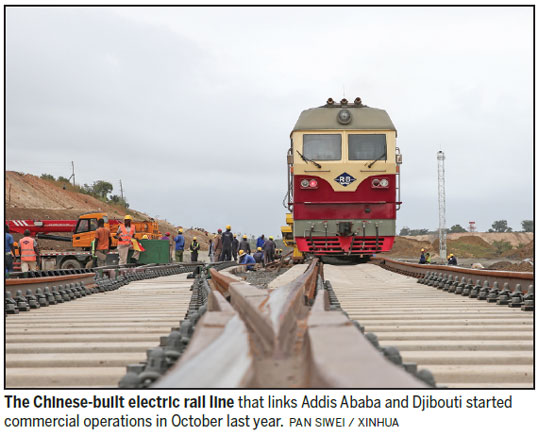
China funded and built Addis Ababa's new subway line and the new standard-gauge rail line to the port at Djibouti. The subway line has done a lot to solve the transportation problems that plagued the city, the officials say. The rail line, which is now in a trial period, will replace thousands of big trucks that took more than a week to transport goods to Djibouti. Since it is electric, it is green and saves hard currency.
China and the other East Asian developing states transformed their economies over 30 years, not the 200 years it initially took Western countries. The senior Ethiopian officials were sent to the Institute for South-South Cooperation and Development because the government sees the need to learn from Chinese experience and from theoretical economics. They all stated their determination to use their studies to contribute to their country's economic development. They stressed that Ethiopia gives equal weight to economic growth and to democratic political development.
In conclusion, the officials say, they are not going to take everything from China. They are not going to copy everything. What is good for the country, they will take, they say. Their country has some experiences similar to China's - party discipline and anti-corruption, for example.
In terms of industrialization and infrastructure, China is a good experience, they add. Quoting Deng Xiaoping, they say, "It doesn't matter whether a cat is white or black, as long as it catches mice."
davidblair@chinadaily.com.cn
(China Daily Africa Weekly 10/06/2017 page8)




Today's Top News
- Lawmakers review draft law to expand childcare services
- China's new-style tea brands find a hot new market in US
- Xi extends congratulations to Chilean president-elect
- Japan urged to stop provocative moves
- Shanxi ends province-wide blanket fireworks ban
- Tech park set to lift GBA's development