Unicorn's success is the stuff of legends







China's largest co-working space provider takes collaboration to new heights in the sharing economy
Mao Daqing studied architecture as his first degree, holds two PhDs in regional economics, has run 70 marathons and spent almost 20 years working in real estate.
Disparate though these parts are, they have together shaped Mao to become who and what he is today.
The 48-year-old is the founder and CEO of UrWork, the largest Chinese provider of co-working space. UrWork, with a market valuation of $1.3 billion, is one of an increasing number of "unicorns" in China - startup companies valued at more than $1 billion.
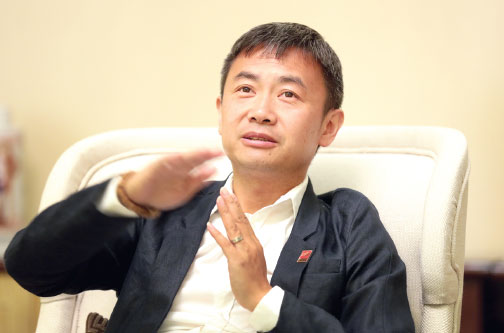
| Mao Daqing, the founder and CEO of UrWork, says he hopes that the small and medium-sized enterprises will be able to use UrWork to find opportunities outside China, and vice versa for those overseas. Provided to China Daily |
UrWork, founded in 2015, has 88 co-working spaces in 20 cities in China and Singapore. By the end of this year, it plans to open one location each in Los Angeles and New York in the United States.
Its current tenants - known as "members" - include other unicorns such as bicycle-sharing companies ofo, Bluegogo and Mobike, internet technology company NetEase and supply-chain services company JD Logistics, a unit of JD.com.
Mao's business cannot be described as merely creating shared offices with common amenities. "The era when a co-working space was only a physical office is past. After rounds of upgrading, it has transformed into resource optimization and a business network," he says.
It is perhaps this clarity of thought about co-working's new definition that has helped him steer UrWork to stand out among the sector's more than 4,000 brands in China. In fact, Mao has pieced together a business that is as multidimensional as he is.

Mao says he hopes that his tenants - particularly the small and medium-sized enterprises - will be able to use UrWork to find opportunities outside China, and vice versa for those overseas.
This is being done in three ways - the company app, the Express Financing Program and the Link China Program.
Apart from its venue and desk-booking function, the UrWork app lists marketing programs and activities from its database of more than 1,000 partner service suppliers. These range from financial advisory to intellectual property protection and startup accelerators.
Just as useful is the Express Financing Program, which selects the best incubation projects through a rigorous process and provides training, capital and services support to help the UrWork platform's members to grow.
The company also operates China's first shared entrepreneurship institute under the sharing economy, where it trains, selects and provides capital support for high-potential entrepreneurs.
Finally, the Link China Program collaborates with Chinese government agencies and service suppliers from all trades to provide quick market entry for overseas startups.
"For example, at our Singapore space, we have Volans-i, a Silicon Valley-originated startup manufacturing drones for the B2B (business to business) sector, which has partnered with us thanks to the Link China Program," Mao says.
Bridge-building aside, Mao, who is a Singaporean national, also has ambitions to help 10,000 SMEs scale up and grow through partnerships, such as with real estate operators, governments and service suppliers.
"SMEs and innovations in China are happening at an exponential rate. They have become a pillar of the national economy. The Belt and Road project will also witness the eruption of a large group of SMEs in the region," he says, referring to the China-led strategy to revive the ancient Silk Road routes.
In a way, Mao's plans for UrWork are learning points from his own challenges early in the startup game.
"When chatting with friends about potential venture ideas, we thought it would be wonderful if someone could set up a platform and support us with all the services we need, to save operational cost, improve work efficiency and scale up things at a much faster rate.
"Creating an interconnected and wholesome co-working ecosystem was the whole idea when I created UrWork," he says.
Visits to incubators around the world pushed him in this direction, but the "eureka moment" was a realization that there was a commercial property glut outside of Beijing and Shanghai that needed a solution.
"The idea was also built on the philosophy of genius loci (the pervading spirit of a place), a concept incepted by the renowned Norwegian architect Christian Norberg-Schulz, indicating that architecture needs to create a sense of recognition and belonging.
"Through curating a space where various contexts are enabled, the collaborative opportunities are unlocked and imagination maximized. The sharing economy thus is no longer just a business model, but more of an ideology, a way of reconstructing people-to-people relationships."
Mao, born in Beijing in 1969, started out in life along a very different path as the son and grandson of engineers. His grandfather, in particular, was someone he looked up to: Mao Ziyao, an architect who helped design Beijing's Great Hall of the People.
"He's been a tremendous role model to me, with his strict work ethic, loyalty to his country and passion for his work. It took a lot of foresight, architectural finesse and guts to create a building ahead of (its) time and yet with such longevity. His fortitude, pioneering spirit and sheer vision have inspired me till today."
Little wonder that Mao went on to study architecture. His dream back then was to either practice or teach the subject.
From 1992 to 1996, Mao put his degree to good use, working first in Thailand, then Singapore.
Next, he applied his skills and knowledge to real estate - at Singapore-based CapitaLand and later China Vanke.
Life, though, had other plans for him. In 2012, immense stress from work caused him to be diagnosed with depression.
Fortunately, relief came in the form of running. "Some of my good friends are hobby runners and told me about the benefits of the sport."
Running helped him shift his focus from indoors to outdoors, where he learned to commune with nature.
"The sport pushes you out of your normal boundaries, challenges your mental strength, and those small incremental adjustments really make the difference in the end - just like running startups."
Today, he can boast of having run 70 marathons, recently completing one in Mauritius.
Looking ahead, Mao has big plans to boost the number of UrWork locations to 150 in 35 cities within the next three years.
Singapore is the first city it has entered outside China, doing so in June this year. Although the city-state already had more than 80 co-working providers, Mao was keen to establish a presence there, confident that UrWork occupies a unique niche.
On the international stage, Mao's brand is commonly compared with WeWork, the US equivalent. But the competition does not faze him.
"I think we are definitely well-positioned to face any international competition. I myself have a commercial real estate background and understand how to keep the wholesale rental low.
"Also working to our advantage is the invaluable support from our phenomenal investors and our strategic alliance with the government."
He says UrWork is committed to diving deep into the Chinese market. Its home-ground advantage lies in knowing the needs of the Chinese entrepreneur and being able to offer a comprehensive platform to help Chinese startups and SMEs grow.
"UrWork is about building a seamless community where dreamers, doers and creators work together to make great ideas happen."
For China Daily
(China Daily Africa Weekly 10/06/2017 page31)





Today's Top News
- Ukraine says latest peace talks with US, Europe 'productive'
- Asia's rise and Europe's structural decline
- Economic stability a pillar of China's national security
- Xi taps China's deep wisdom for global good
- New rules aim for platforms' healthy growth
- Chinese web literature grows overseas