



Only US, DPRK can resolve peninsula issue







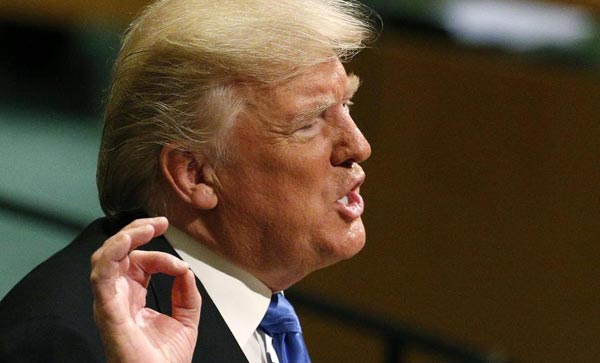 |
| US President Donald Trump addresses the 72nd United Nations General Assembly at UN headquarters in New York, US, Sept 19, 2017. [Photo/Agencies] |
In his maiden speech at the United Nations General Assembly on Tuesday, US President Donald Trump threatened to "totally destroy" the Democratic People's Republic of Korea if need be.
In his earlier remarks, Trump has called on China and Russia do more to restore peace on the Korean Peninsula, but he has been adding fuel to the fire by launching frontal attacks on the DPRK leader, as he did at the UN General Assembly.
On Sept 11, the UN Security Council unanimously passed Resolution 2375 to impose the strictest sanctions on Pyongyang for conducting its sixth and to date strongest nuclear test on Sept 3. But it seems the belligerent attitude of Washington toward Pyongyang prompted the latter to test-fire a missile over Japan into the Pacific Ocean despite the fresh UN sanctions and further escalating tensions in Northeast Asia.
Amid rising global condemnation of the DPRK, the United States has time and again said that China should shoulder most of the responsibility and take "direct action" to resolve the Korean Peninsula nuclear issue. The DPRK's nuclear tests also challenge China's national security and interests. And China has done more than enough to restore peace in the region, but its efforts have failed because the main disputing parties have ignored its suggestions.
The fact is that only the DPRK and the US can peacefully resolve the peninsula issue, as Pyongyang has decided to develop nuclear weapons to ensure national security and the US, unwittingly or otherwise, has influenced that decision.
The US has of late upgraded its military cooperation with its allies in the Asia-Pacific region, especially the Republic of Korea, held many large-scale military drills with them, and has deployed the Terminal High Altitude Area Defense anti-missile system on ROK soil, which perhaps have prompted the DPRK to conduct more nuclear tests and further worsen the situation in the region.
Besides, sanctions and isolation from the international community have dealt a blow to the DPRK's economy, forcing Pyongyang to develop nuclear weapons to bolster its security, thereby creating a vicious circle of more sanctions followed by more nuclear tests.
Surprisingly, though, the rising tensions in the region have benefited the US. For example, using the inflammable situation on the peninsula as an excuse, the US has strengthened its alliances with some Asia-Pacific countries, such as the ROK and Japan, and widened its influence in the region.
Moreover, after the US deployed THAAD in the ROK and urged China to impose sanctions on the DPRK, China's relations with the two neighbors have suffered.
Beijing has always supported the peaceful denuclearization of the peninsula and made great efforts to make that a reality, as nuclear tests in the neighborhood are detrimental to China's national security. Beijing has always stood for stability; it has strictly followed the UN Security Council resolutions, and strongly urged the DPRK to halt its nuclear program in exchange for the US and the ROK stopping their large-scale joint military drills.
Actually, the pressure the US laid on China was not to resolve the DPRK issue but to blame China's opposition to the US for the worsening situation in the region. It is to put an end to such speculative diplomacy-and to protect the interests of Northeast Asia, actually the whole of Asia-Pacific-that China has been trying to resume the stalled Six-Party Talks, so that all parties can voice their grievances and seek their redressal.
China has done more than it could to resolve the DPRK issue. But the key to ultimately resolving the issue lies with the DPRK and the US. For the long-term stability of the international community, the two sides should fulfill their due responsibilities and come to the negotiation table to peacefully resolve their differences.
The author is an associate professor of world politics in the School of Public Administration, Jilin University.





