



Game of assurance for peninsula peace







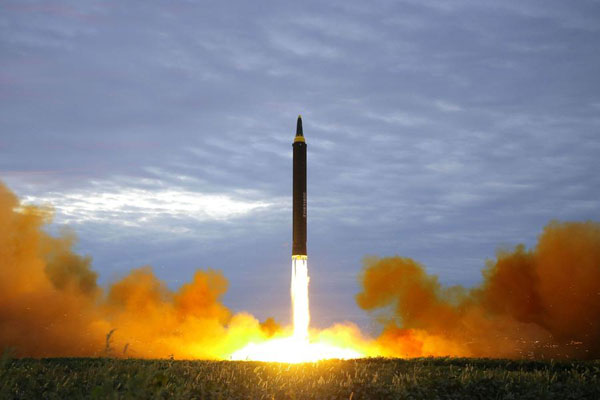 |
| A missile is launched during a long and medium-range ballistic rocket launch drill in this undated photo released by the Democratic People's Republic of Korea (DPRK)'s Korean Central News Agency (KCNA) in Pyongyang on August 30, 2017. [Photo/Agencies] |
How should the United States deal with the Democratic People's Republic of Korea? The US and the DPRK are locked in a dangerous game of chicken characterized by threats and counter threats. The problem with threat escalation, as has been happening on both sides in recent weeks, is that it leads to the hardening of positions, the misreading of signals and the risk of catastrophic miscalculation.
US President Donald Trump was likely to address the DPRK nuclear issue in his debut speech at the UN General Assembly on Tuesday, days after the UN imposed the strictest sanctions on the DPRK after it conducted its sixth and to date strongest nuclear test on Sept 3.
Hopefully, Washington and Pyongyang will heed each other's concerns and de-escalate tensions on the Korean Peninsula.
The DPRK leaders have long held the belief that the real intention of the US is regime change. Conversely, the US seems to believe the threat from the DPRK is real when in fact it is meant for defensive purposes. The DPRK, for instance, has repeatedly said its weapons are meant to deter US aggression and allow it to develop its economy. This is probably an accurate reflection of its objectives but Washington would find it hard to accept a nuclear-armed Pyongyang which can harm the interests of the US and its allies.
Both countries claim their intentions are defensive but their actions are read as offensive. This is the dilemma in US-DPRK relations.
The DPRK wants assurance against regime change and a stop to the joint war games by the US and the Republic of Korea. The US has said it is not pursuing regime change and the war games are defensive, but neither assurance is credible to the DPRK.
The US wants assurance that the DPRK's weapons program is defensive in nature and policy. The DPRK has said this is so, but its threats and missile tests send a different signal.
Moreover, there is no guarantee that the toughest sanctions yet against the DPRK would work for a country that deeply values self-reliance, national pride and accords the top priority to the military. Even if the sanctions might hurt the DPRK's economy, it is unlikely to give up its trump card.
If indeed Pyongyang's weapons program is defensive in nature, and if indeed Washington says regime change is not its agenda and its military drills with Seoul are defensive in nature, then both sides should stop the chicken game. Instead, all parties should stand down and focus on offering assurance.
The US would have to give the DPRK credible assurances that it will not pursue regime change. The verbal assurance given by US Secretary of State Rex Tillerson is not enough; Washington has to send strong and credible signals such as suspending the US-ROK drills that Pyongyang says is a prelude to regime change.
And since no more drills are scheduled for recent months, there is no need for Pyongyang to play its missile game, because it has already demonstrated its capabilities and strong resolve.
In relative terms, the threat from the DPRK is much smaller than what the US faced against the Soviet Union during the Cold War.
If indeed the intention of both sides is defensive, then there is all the more reason for them to stand down, rethink the game of chicken and reflect how to play the game of assurance.
The author is an associate professor at and vice-dean (research) of the Lee Kuan Yew School of Public Policy, National University of Singapore. He is also a faculty fellow at the Center for Asia and Globalization.





