



Growth and eco-protection not antithetical







 |
Yet some officials still accord priority to economic development at the cost of the environment, while others pursue environmental protection while turning a blind eye to economic growth, which could compromise people's livelihoods.
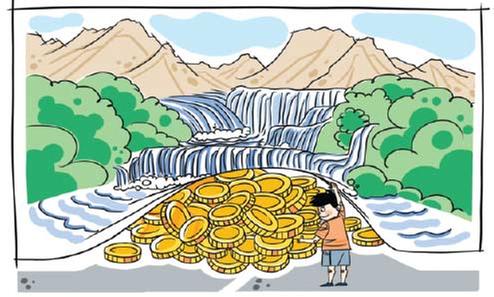
Since the 18th National Congress of the Communist Party of China, Xi has been emphasizing that the pursuit of harmony between humans and nature is about having both "gold mountains" and "green mountains". As such, Xi's philosophy is about striking the right balance between environmental protection and economic growth.
In China's experiences of modernization and building an ecological civilization, environmental protection and economic growth are not incompatible. The key to making them compatible lies in ideology and the policies to manage them.
If, for example, some regions' ecological and environmental assets are their strength, they should be allowed to develop eco-agriculture, eco-industries and eco-tourism. This way, their green assets could facilitate economic development.
Effectively combining industrial development with ecological development, and following the principle of environment friendly economy is the best way to build an industrial structure based on ecological civilization.
The environmental problems that China faces today are partly the result of the country's imbalanced industrial structure. Therefore, governments at all levels should take measures to transform the structures of three pillar sectors-industry, agriculture and tourism-following the eco-friendly and resource-efficiency principle. Apart from implementing a water-saving policy for the industrial, agricultural and tourism sectors, China has made great achievements in energy-saving and eco-friendly industries-the country accounts for 24 percent of the global installed capacity of renewable energy, and is a leader in the use of new and renewable sources of energy.
To strike a balance between ecological benefits and economic effectiveness means creating economic values while protecting the environment. For instance, planting sea buckthorns in the desert regions of North China can prevent desertification. Besides, local residents can use the buckthorns to make handicrafts and other commercial products to improve their livelihoods, and the shrubberies in the deserts can be developed into tourist attractions to create more jobs.
But the authorities and local residents have to make sure the fragile desert environment is not overexploited lest the area turns into sand again.
Ecological civilization should play a central role in the three pillar industries. In agriculture, for instance, China has a splendid tradition of "mulberry fish ponds", an integrated ecosystem that brings into play the production potential of humans and their environment through the promotion of different branches of agriculture, by turning the banks of fish ponds into mulberry dikes. Avoiding practices that damage the environment and learning from traditional farming methods can boost agricultural production, not only in terms of quantity but also quality.
In manufacturing, Industry 4.0 and "intelligent manufacturing" are becoming reality, as China explores new ways of industrialization that combines high-tech content, good economic returns, low resource consumption and little environmental pollution. There is also a need to give priority to ecological tourism.
In other words, Xi's pledge that "the pursuit of harmony between humans and nature is about having both gold mountains and green mountains" shows the Party's determination to build harmony between human beings and nature as part of the grand vision of socialist ecological civilization.
The author is a professor at the School of Marxism and a research fellow at the National Academy of Development and Strategy, Renmin University of China.





