 |
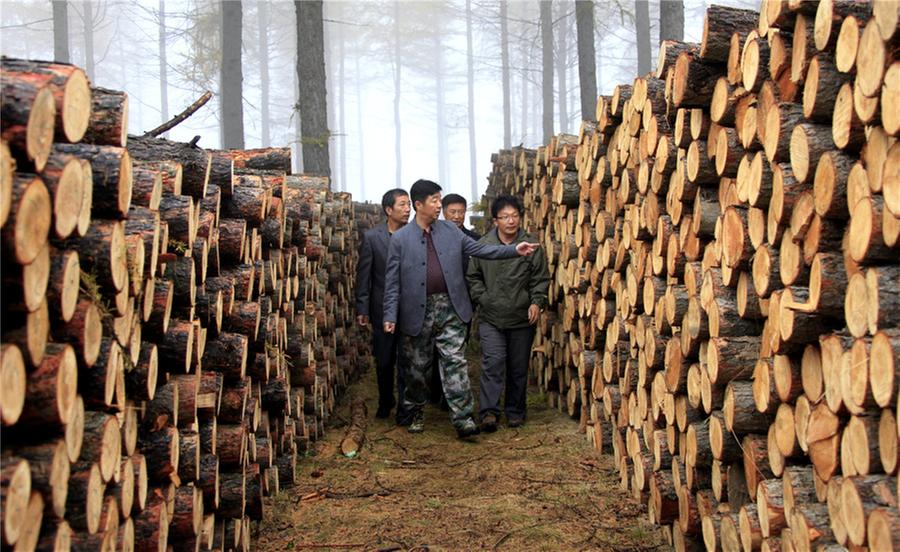
| A member of the Saihanba management team assesses stocks of wood the park sells for profit.[Photo by Zou Hong/China Daily] |
Conifers, competition and a changing climate
At the northern fringe of Saihanba, China's largest man-made forest, just a few hundred meters separate green from yellow.
From a vantage point on a firewatching tower, close to the border of Hebei province and the Inner Mongolia autonomous region, even those few hundred meters are reduced to a thin line. On one side of the line lies an army of trees-tall, vigilant conifers standing side by side-which form a dividing line at which the greenery abruptly gives way to yellow.
Fifty years ago, the divide did not exist, according to Chen Zhiqing, deputy director of the forest's management team. "There used to be just one color-yellow," he said. "Back then, sand ruled this vast land, and was clearly on the move southward, toward Beijing. Today, that move has been halted, and as the forest expands the sand is effectively on the defensive."
Today, most residents of the capital have no idea that at one time the city was threatened by the seemingly unstoppable sand.
"Tree leaves fall and rot, creating a layer of humus soil that grows year after year. Like a giant palm, this layer of soil, previously nonexistent, helped to keep the sand below in place," Chen, 46, said.
In addition, the forest helps to conserve the wetlands and rivers that are a crucial source of water for Beijing, Tianjin, 280 kilometers away, and even Liaoning province more than 600 km to the northeast.
"These days, we have almost no surface runoff," Chen said. "The forests have certainly benefited the surrounding regions greatly, but the people who planted the trees have gained the most."
Wang Limin is head of the forest's business office. Last year, the forest sold 11,700 cubic meters of wood, bringing in an estimated 95.5 million yuan ($14 million), according to Wang. "The amount of wood sold is just 1.4 percent of our total forest stock, and is only 30 percent of our annual stock increase," he said. "All the wood comes from man-made forests because felling in natural forests is banned."
Other sources of income are seedlings and saplings, which the forest authorities cultivate on a large scale and sell to gardeners.
"All our clients come from further north, where the climate is cooler. The most popular species include Scots pine, spruce and birch," Wang said. "Last year, we sold 44,000 of them, bringing in 12 million yuan.
"The price of seedlings has fallen a little during the past few years, mainly due to competition from farmers who live nearby. Realizing that tree planting can be a profitable business, they've all started doing it," he added.
"The forest may be earning less, but the environment has benefitted. We are also considering carbon trading in the near future, something we believe will be our biggest and most stable source of income."
While some people are busy planting trees, borrowing from the experience gained by the forest's workers during the past 55 years, others are tapping into a burgeoning tourism business as Saihanba becomes increasingly well-known for its lush green beauty.
"Last year, 510,000 tourists came. At full capacity, the forest, which now is also a natural forest park, can accommodate 48,000 tourists a day during peak season, June to October, but we are still far from that limit," Wang said. "Tourists are barred from setting foot in our nature reserve, which is estimated at about 14,000 hectares."
During summer, Saihanba's "golden season", the forest is draped in green and the weather is comfortably cool. Later, as autumn arrives, the trees produce a combination of red, yellow and dark green.
That's before the long winter takes hold in mid-October, lasting until early May. For the "early settlers", those who spent their lives restoring the forest, winter is the season they remember most vividly.
With the growing forestry coverage, Saihanba's microclimate has changed. The number of frost-free days has risen from 52 to 64, and annual precipitation is now 410 millimeters compared with 460 mm previously.
"It's not as cold compared with before, but it is still freezing during winter," Chen said. "For us, the cold serves as a reminder of all the hardships endured by those who came before us and worked hard so we can call this place a forest."