Credit policy aims to push production of new energy cars







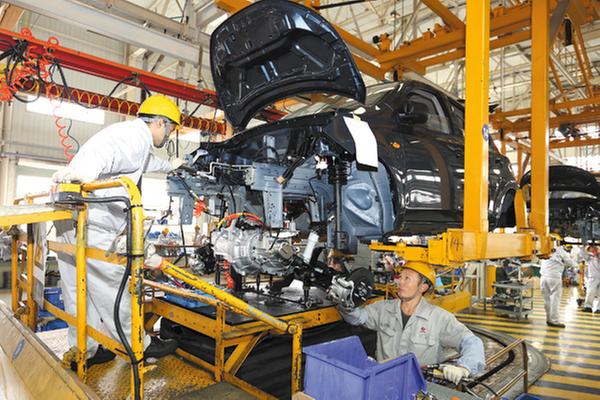 |
| Workers assemble an ER30 model on a production line at Dongfeng Automobile in Xiangyang, Hubei province. YANG DONG / FOR CHINA DAILY |
Carmakers failing to meet manufacturing goals could be fined; Daimler, Volkswagen already speeding up e-plans
China will soon introduce a dual-credit scheme for gasoline cars' fuel consumption and new energy car production, almost a year after first seeking public opinion about the issue in September 2016.
Zheng Lixin, spokesman of the Ministry of Industry and Information Technology, said at a news conference on July 25 that the scheme is undergoing necessary procedures for promulgation and will be released soon.
Industry insiders believe the move shows China's commitment to speed up the development of clean vehicles, now that the government is gradually cutting subsidies and withdrawing them completely by 2020.
According to the draft scheme, automakers in the country will be assessed against the country's fuel-consumption demands. Meanwhile, they will be examined in terms of new energy vehicle credits.
Such cars include pure electric cars, plug-in hybrids and fuel cell models, though hybrids such as the Nissan Leaf are excluded.
As stipulated in the draft, the credits should account for 8 percent of an automaker's total in 2018, 10 percent in 2019 and 12 percent in 2020.
One new energy vehicle will be calculated as one to several units depending on a number of factors, including their mileage on one charge.
Those who fail to meet the goals will have to buy credits from other automakers or be fined.
Car associations of several countries including the United States, Japan and South Korea had asked the Chinese authorities to ease some of its items or postpone the scheme for some time out of worries that carmakers from their countries are not well prepared.
For example, Volkswagen, which currently sells about 4 million cars in China, may have to produce 60,000 to 300,000 electric cars a year.
Cui Dongshu, secretary-general of the China Passenger Car Association, said the authorities may make some adjustments to its scheme. The spokesman acknowledged that the ministry would study their proposals, but said there will not be major changes.
He said carmakers should not be obsessed with whether there will be changes but work full speed to meet the goal.
"With or without changes, new energy vehicles are the overriding trend of the automotive industry. Those who hesitate are only wasting their time."
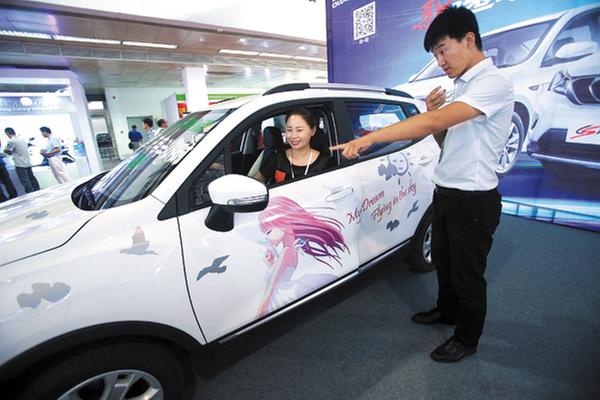 |
| A visitor tries an electric car at an international new energy auto expo in Beijing this year. CHEN XIAOGEN / FOR CHINA DAILY |
China has been the world's largest new energy car market since 2015. In the first five months of this year, sales totaled 136,000 vehicles nationwide, representing 7.8 percent growth year-on-year, according to the China Association of Automobile Manufacturers.
Many automakers are accelerating their efforts to start local production of new energy vehicles.
German car giant Daimler has signed an agreement with China's BAIC Group to produce Mercedes-Benz-branded electric cars via their joint venture Beijing Benz Automotive.
In accordance with the 5 billion yuan ($736 million) agreement, the two are preparing to produce electric vehicles in China by 2020 and to provide the necessary infrastructure for battery localization using Chinese cells.
Volkswagen is partnering with JAC Motors to develop, produce and sell electric vehicles.
The 50-50 partnership will have a total investment of 6 billion yuan. Its first model, which will be produced at existing JAC facilities, is expected to roll off the assembly line in 2018.
Volkswagen is planning to deliver 400,000 new energy vehicles by 2020 in China.
John Zeng, managing director of LMC Automotive Shanghai, said the dual-credit scheme will even help to change carmakers' over-reliance on SUVs, which tend to consume more gasoline than sedans, for growth. Earlier this month, Great Wall Motor, China's largest SUV producer by sales, became a stakeholder of a new energy carmaker Yogomo, which analysts believe is a move to brace for the scheme.