'Student soldiers' swap university for uniforms







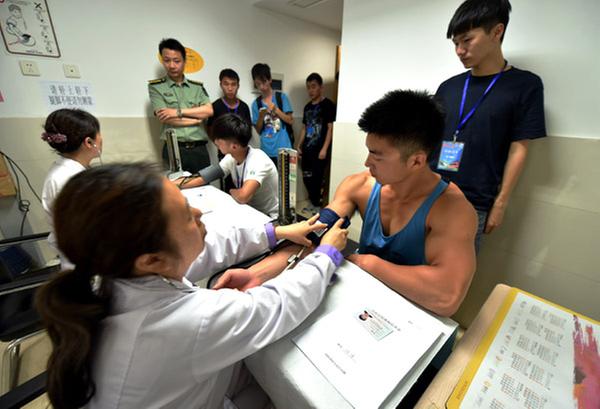 |
| Student undergo military medical checkups in Nanjing, Jiangsu province. [Photo by Dong Rui/For China Daiy] |
A growing number of scholars are suspending their studies to join the People's Liberation Army
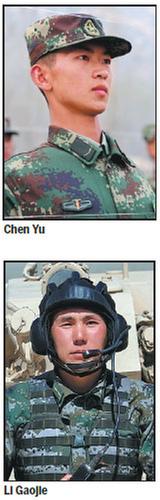
Chen Yu, a straight-A student and a descendant of a New Fourth Army soldier who was killed during the War of Resistance Against Japanese Aggression (1931-45), had two childhood dreams. His first was to attend China's best college. His second, to join an elite unit of the People's Liberation Army.
He fulfilled both after becoming a student at Tsinghua University in Beijing.
In 2012, Chen, 17 at the time, was admitted to the country's top school. Two years later, before he started his third year at college, Chen postponed his studies and enlisted in the PLA Rocket Force, serving in Northwest China for two years.

Each year, young people from across the country suspend their studies and enlist. They are known as student soldiers.
In 2016, the number of students who applied online to join the PLA exceeded 1 million for the first time, and the proportion of students among new recruits continues to rise, according to China National Defense Newspaper. In Beijing and Shanghai, students have accounted for more than 70 percent of all applicants this year, compared with about 30 percent nationally. The PLA declined to reveal complete recruitment numbers.
Benefits package
Beijing, the city with the most colleges, offers a benefits package for students who enlist, subsidized by the municipal government and the army. Undergraduates receive about 214,000 yuan ($31,680) a year, while students at vocational colleges get 206,000 yuan.
Students at the capital's universities who enlist and serve at least two years before resuming their studies are granted Beijing hukou, or permanent residence, when they graduate and start work in the city.
Other cities and provinces offer similar packages, tailored to local conditions.
Government departments and State-owned enterprises in Beijing reserve 10 to 15 percent of their annual employment quota for discharged student soldiers.
Those given second-class military merit awards or higher are recommended for graduate school directly after demobilization, and they are excused from the national graduate entrance exam.
Lyu Jishu, a teacher of military theory at Tsinghua, said the army began enlisting students in 2002 because the rapid modernization of weaponry and equipment required better-educated soldiers.
Deng Yu, deputy director of Tsinghua's national defense education office, said the program to recruit the university's students was launched in 2005, and by the end of last year, 134 students, mostly male, had enlisted from a wide range of majors.
While that may not seem a large number, every Tsinghua student excelled in the army. Eighty-nine of them have been demobilized so far, all returning to Tsinghua having been decorated as outstanding soldiers, while 30 received first-, second - or third-class merit awards, according to Deng. "Their performances were above standard," he said.
Numbers rise
Lyu, who was dispatched by the army to lecture on military theory at Tsinghua, said only two students enlisted when the undertaking was initially launched. The following year, only one applied.
"But the number has risen recently, with more than 20 students enlisting every year," he said, adding that although large numbers of people apply to join the army, only a few achieve their ambition.
"Most failed as a result of issues such as myopia, which led to them failing the physical examination," he said.
Enlistment generally begins in June, ahead of the summer vacation. After registering online, applicants undergo initial selection procedures, followed by physical and political examinations. Those chosen are officially recruited in early September.
According to Deng, the enlistment requirements are the same for students and nonstudents, and the only real difference between them is age. For example, male applicants from urban areas are required to have graduated from high school and be ages 18 to 21, while male undergraduates age 22 or younger and male graduate students age 24 and younger are also eligible.
Most Tsinghua students enlist as they approach their junior or senior years, he added.
A range of ambitions
Deng said Tsinghua students enlist for a variety of reasons: "Some have had a passion for military life since childhood; some want to experience a different life; and for some, it is an opportunity to develop a new career."
Chen Yu, who was discharged in September last year, said one of the reasons he joined the army was the example set by his great-grandfather, who was killed while fighting more than 50 years ago. His appetite was also whetted by TV series such as Soldiers' Sortie, a highly popular program shown in 2007.
"All these factors made me think that being a soldier is cool and joining up is an honor," said Chen, who has now returned to Tsinghua's department of engineering physics.
He insisted on joining the PLA Rocket Force because his university department had produced a number of famous experts on atomic and hydrogen bombs, and artificial satellites. He wanted to walk in their footsteps.
"Joining the Rocket Force made me feel close to them. I felt I was making a contribution, just as they did decades ago, although my contribution was minimal and different," he said.
However, the decision to enlist is not easily understood by some people.
The feeling was even stronger 10 years ago. Li Gaojie, one of the two Tsinghua students who enlisted in 2005, said his decision surprised many people.
"I was the only one in my hometown - a small, impoverished village in Henan province - to be admitted to a top university during recent decades. In many people's eyes, I should have followed an academic path and then landed a decent, professional job, like the majority of students did. They didn't understand why I suspended a well-designed academic and career path and took the road less traveled," the 30-year-old said.
"I had always been fond of military things and had wanted to experience life in the army since I was a little boy. I never expected to have the opportunity at college, but when it came, I seized it without hesitation."
During his two years in the People's Armed Police in North China, Li was comfortable with army life, and realized that the military, rather than civil engineering - his university major - was his real passion.
After returning to college, he continued to study military-related courses, and when he graduated in 2011, he caused a second surprise by declining several job offers and refusing to apply for graduate school. Instead, he re-enlisted.
Hard to leave
Li, now deputy commander of an infantry unit, said he found it difficult to leave the army and turn to a civilian occupation.
He believes he learned a lot in the army, including discipline and teamwork - things he seldom considered before joining up but which are now paramount in his life.
"If I had to leave one day, I think I would work in a sector or industry related to the military," he said. "The hallmark of a soldier will accompany me wherever I go, whatever I do."
Lyu, the military theory teacher, said Tsinghua students are intellectually elite, but they may also be fragile psychologically and sensitive to criticism.
"In that sense, joining the army would be a very good exercise and training for them to overcome their weaknesses," he said.
According to Deng, the students have always regarded the army as an environment - a campus outside Tsinghua - where they can thrive and hone their skills.
"We are happy to find that students have changed after demobilization. Many become stronger, both physically and mentally. They have also progressed in terms of getting along with other people and dealing with all kinds of unexpected situations."
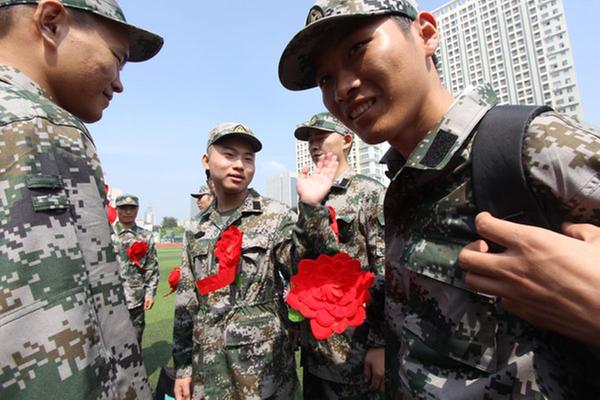 |
| New student recruits in Hefei, Anhui province, chat at a ceremony in their honor. [Provided to China Daily] |



- Why do China's cultural and creative products go viral?
- Aviation sci-fi park Nantianmen to open in 2027
- Chinese researchers make breakthrough in green cooling technology
- Former head of national forestry and grassland body under investigation
- A new lease of life: Providing dialysis access in rural China
- China's grain output hits new high in 2025