



Data of China's first X-ray space telescope to be open to global scientists







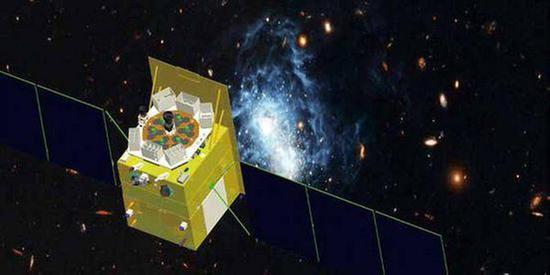 |
| An artist's impression of the Hard X-ray Modulation Telescope (HXMT). |
BEIJING -- China's first X-ray astronomical satellite, launched in mid June, is expected to start regular observation in November and its data will be open to scientists all over the world, say the main designers of the satellite's data system.
The 2.5-tonne Hard X-ray Modulation Telescope (HXMT), dubbed Insight, transmitted to a ground station its first data on its second day in orbit. The data proved to be of good quality, and the telescope detected a gamma-ray burst 10 days after its launch.
HXMT carries a trio of detectors -- the high energy X-ray telescope (HE), the medium energy X-ray telescope (ME) and the low energy X-ray telescope (LE) -- that cover a broad energy band from 1 keV to 250 keV. It will help scientists better understand the evolution of black holes and the strong magnetic fields and interiors of pulsars.
"We will finish calibrating all instruments within the first five months in orbit before Insight starts regular observation," said Song Liming, deputy chief designer of the HXMT science ground segment and a scientist with the Institute of High Energy Physics (IHEP) of the Chinese Academy of Sciences (CAS).
Song and his team solicited observation proposals from scientists around the country last year, and drew up a one-year observation plan after evaluating 90 proposals from six CAS institutes and 10 universities.
"After starting regular observation, the telescope will spend 30 to 40 percent of its first year scanning the Galactic plane and the rest of the time on pointing observation," said Qu Jinlu, deputy chief designer of the HXMT science ground segment and a scientist with IHEP.
"We divide the galactic plane into 19 sky zones. It will take the telescope over two hours to scan each and about two days to finish the whole, if we don't count the time to avoid the sun," said Qu.
Insight will see recurrent or even periodic outbursts of known sources, and is good at searching for new sources that are transiently bright in X-rays.
"If the telescope detects a new source, we will assess its scientific value right away to decide whether it's worth a pointing observation," Qu explained.
Song said experts who have contributed to the HXMT project, both at home and abroad, and those who see their proposals adopted can access and use the observation data exclusively for one year, in line with international practice.
"After one year, the data will be open to everybody. Even middle school students will be able to download our data, if they are interested," Song said.
Song's team will build a calibration database and offer more than 300 data products.
"We will process the original data into products that are up to international standards, so that it's easy for scientists from around the world to analyze for further information, such as the energy spectrum or light curve," Song said.
Before joining the science ground segment, Song was researching the high-energy radiation of pulsars. "The biggest challenge for me was changing from a user to a designer," he said.
Song, like most domestic astronomers, relied on data from foreign satellites in his research, but had never thought how to build a data system.
"How do we make our data available to users? What kind of products shall we offer? We knew nothing when we first started setting up the ground segment," he said.
Song and his co-workers went abroad to learn by asking all kinds of "silly" questions. But sometimes, they had to figure out answers by themselves.
"For example, we had no idea where the background data of those foreign satellites come from, which forced us to study the problem from the very beginning," he said, "We got to know the whole structure and detailed procedures when building the science ground segment, which is our biggest achievement and will help us better support new satellites in future."


- Chinese healthcare innovations debut at World Health Expo Dubai 2026
- Senior CPC official stresses advancing peaceful relations across Taiwan Strait
- Shanghai hosts Spring Festival reception for intl media
- Former senior Chinese defense official charged with bribery
- Chinese convict transferred from Russia to China
- China's self-developed Antarctic vehicle travels over 10,000 km












