



Protectionism won't lead Trump anywhere







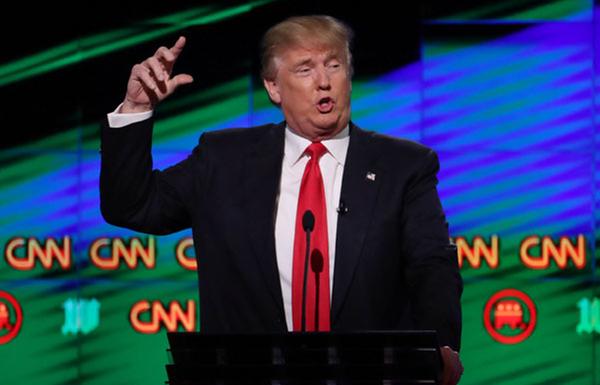 |
| File photo showing Republican US presidential candidate Donald Trump speaks at the Republican US presidential candidates debate sponsored by CNN at the University of Miami in Miami, Florida March 10, 2016. [Photo/Agencies] |
US President Donald Trump has changed the United States' trade policy to resort to trade protectionism, which goes against globalization and trade liberalization. Trump has pulled the US out of the Trans-Pacific Partnership agreement because he believes it could undermine the interests of American workers. The US president also wants to renegotiate the North American Free Trade Agreement and has threatened to withdraw his country from the World Trade Organization.
The Trump administration's actions can be attributed to the president's belief that globalization is responsible for the rising unemployment in the US and the decline of the domestic manufacturing industry. Trump also believes that only trade protectionist policies can help the US middle class flourish.
To reduce the US' trade deficit, especially against China, the Trump administration has adopted a series of trade remedy measures vis-à-vis its trade partners. And it aims to reduce the US' trade deficit with China by also taking trade protectionist measures against other Chinese imports.
The Trump administration uses the US' domestic standards to judge the global trade system, which, in a way, is a manifestation of the unilateral trade policy the US has been using for a long time. As such, Trump's protectionist measures may intensify the trade frictions between China and the US in the short term.
According to data from the US International Trade Commission, from January to April this year, the US' trade deficit in terms of imports from China was $106.48 billion. That means the US' trade deficit against China is the highest and accounts for 44.39 percent of its total trade deficit. The January-to-April data show that among the top 10 commodities imported by the US which resulted in trade deficits for the country, six were from China. This suggests the Trump administration is likely to build more trade barriers against China.
The US economy has been recovering, so US voters now care more about improving their livelihoods and economic status and less about whether Trump is a leader with strategic insight. Perhaps that's why the Trump administration has continued to announce anti-trade liberalization policies.
That the US is resorting to protectionism after its economic recovery is cause for global concern. The Trump administration's trade policies can also be seen as a compromise between the US Congress and various interest groups.
The trade remedy measures the Trump administration has implemented recently show the political power the interest groups exercise in the US. The US' labor unions and organizations lobby the president and Congress members to seek political solutions for domestic unemployment and trade deficit problems.
And when political forces promote trade policies and legislation that favor protectionism, the interest groups can use various trade remedy measures to take on trade partners legally to protect US industries and create job opportunities.
But the Trump administration should realize that protectionism can never "make America Great Again". The fundamental reason why the US manufacturing industry has been suffering is the decline in labor efficiency, due partly to the increasing use of automation. It was easier to transfer labor-intensive industries from the US to developing countries before the rapid development of Sino-US trade. And the huge trade deficit between China and the US is mainly because of Washington's refusal to export advanced technologies and technological products to Beijing.
Free global trade has the potential to optimize resource distribution through the international division of labor and connectivity, which is beneficial to exporters and importers alike. Till now the Sino-US trade relationship has been mutually beneficial. And to further consolidate this relationship, both sides have to reduce their trade frictions.
The author is a researcher with Chinese Academy of International Trade and Economic Cooperation.





