



The dark side of voting in elections







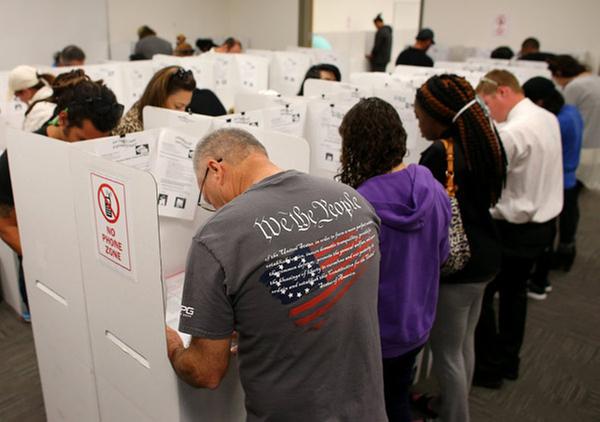 |
| A voter wears a shirt with words from the United States Constitution while casting his ballot early as long lines of voters vote at the San Diego County Elections Office in San Diego, California, US, November 7, 2016. [Photo/Agencies] |
For most of the people surveyed, the costs of voting-including lost wages from time off work, transport to the polling station and the need to secure proper identification (such as a driver's license or passport)-were simply too high. This reflects a broader trend in the US, with poor people often unable to participate fully in their country's democracy.
According to the US Census Bureau, fewer than half of eligible adults with family incomes of less than $20,000 a year voted in the 2012 presidential election, whereas voter participation among households with incomes of more than $75,000 a year was 77 percent. In the 2014 midterm election, the think tank Demos reports, 68.5 percent of people in households earning less than $30,000 a year didn't vote.
This is a serious problem. But the proposals most often put forward to address it have serious drawbacks.
The proposed solutions typically focus on digital technology, which many claim would boost voter participation, by lowering the costs of voting. For example, mobile apps have been touted as a means to boost voter turnout: people could vote at their convenience, whether in the break-room at work or from the comfort of their own home.
The idea certainly sounds appealing. In Estonia, which is widely considered to be a leader in the use of voting technology, almost 25 percent of all votes in the 2011 parliamentary election were cast online.
Yet the actual impact of such technology on voter participation remains dubious.
Although the rate of online voting in Estonia increased by nearly 20 percent between the 2007 and 2011 elections, overall voter turnout increased by less than 2 percentage points (from 61.9 percent to 63.5 percent). This suggests online voting may simply prompt regular voters to change how they cast their ballots, rather than encouraging additional voters to participate.
But voting technology may not just be ineffective; it could actually be damaging. Such technology doesn't reduce costs only for voters; it also reduces costs for the state, making it easier than ever to conduct elections. The risk is that lower costs would encourage more frequent elections and referendums, thereby undermining the efficiency of government.
At a time of lackluster global economic growth and deteriorating living standards for many, efficient government could not be more important. According to the US Millennium Challenge Corporation, an efficient government helps to reduce poverty, improve education and healthcare, slow environmental degradation, and combat corruption.
A key feature of an efficient government is long-term thinking. Policymakers must work toward the policy goals that got them elected. But they must also be given enough political room to adjust to new developments, even if it means altering policy timelines.
Amid constant elections and referenda, that, however, isn't really an option. Instead, policymakers face strong pressure to deliver short-term, voter-pleasing results-or get punished at the polls. The likely result is a shortsighted agenda prone to sudden politically motivated reversals. Beyond hurting political credibility and market confidence, such volatility could create friction between elected politicians and civil-service technocrats, damaging a relationship that is critical to efficient, forward-looking, and fact-based decision-making.
Proponents of referendums hold them up as the epitome of democracy, giving ordinary citizens a direct say in specific policy decisions. But, in a representative democracy, referendums undermine the relationship between the voters and their political leaders, who have been entrusted to make policy on behalf of citizens.
Ominously, referendums are already becoming an increasingly common-and consequential-feature of policymaking in the West. The United Kingdom has held just three referendums in its entire history, but two were held just in the last six years (plus another in Scotland).
Elections, too, are becoming more frequent. The average tenure of a G20 political leader has fallen to a record low of 3.7 years, compared to six years in 1946-a shift that, no doubt, is contributing to a rise in short-term thinking by governments.
It is not yet clear whether voting technology actually does spur greater voter participation. What is clear is that, if it is adopted widely, it could exacerbate trends that are undermining public policy, including governments' ability to boost economic growth and improve social outcomes.
Reducing barriers to democratic participation for the poorest citizens is a worthy goal. But what good will achieving it do if those citizens' interests are harmed as a result?
The author, an economist and author, sits on the board of directors of a number of global corporations.
Project Syndicate





