Japanese citizens protest 'conspiracy' law following its forcible enactment







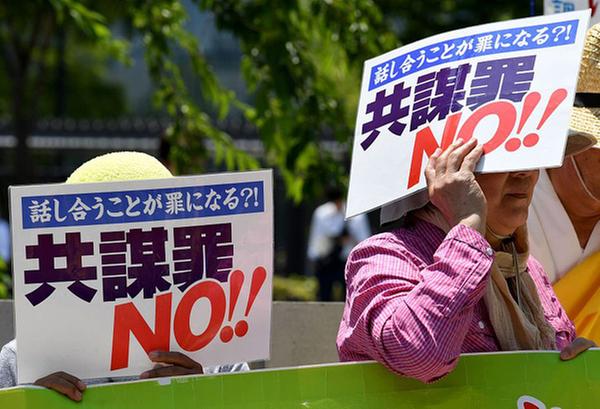 |
| Protesters holding placards reading "No!! conspiracy bill" gather near the parliament building to protest against the controversial anti-terror law in Tokyo on June 15, 2017. [Photo/VCG] |
TOKYO - "It could be the case that in the future, peaceful demonstrations like this could be viewed as an act of terrorism and we could be facing criminal charges," bellowed Riyo Hamada, 59, over the noise of a massive protest that had continued overnight through Thursday outside the Diet building in Tokyo.
More than 5,000 people rallied in front of the Japanese parliament building to protest a highly-controversial law to criminalize the planning of serious crimes as well as the way it was forcibly enacted by Prime Minister Shinzo Abe's ruling coalition.
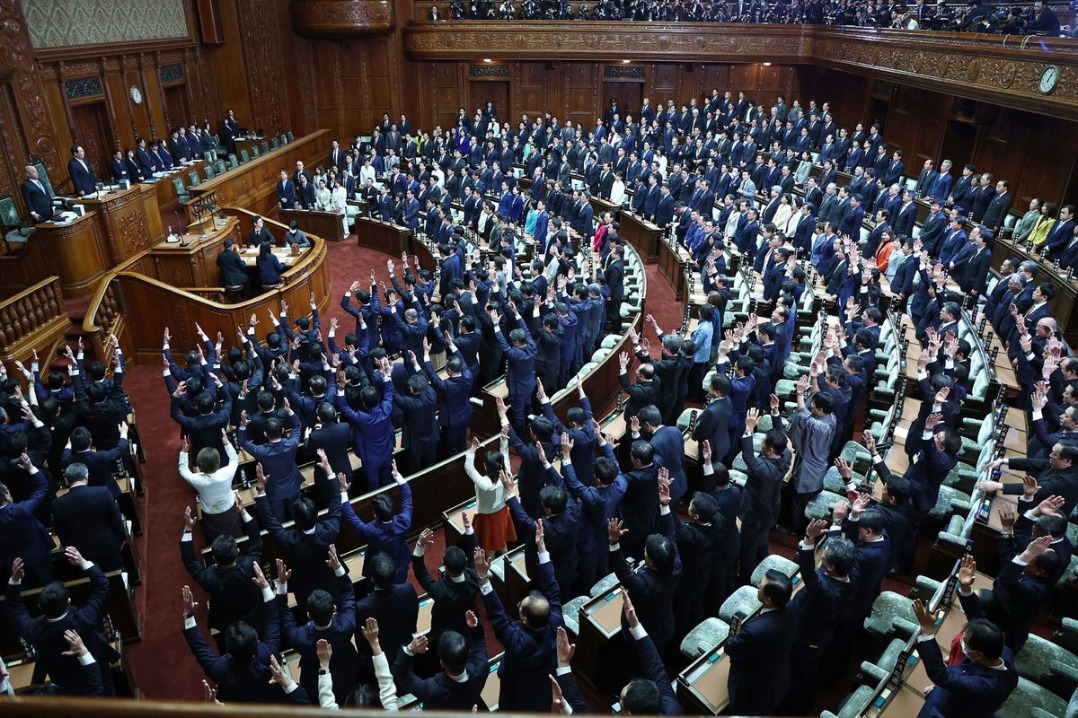
The legislation to criminalize the planning of serious crimes was enacted by the Diet on Thursday despite vociferous calls from opposition parties to scrap the bill amid public discontent and mass protests around the nation.
Placard-wielding protesters in their thousands were still in good voice well into Thursday at the heart of politics in Tokyo, unwilling to relinquish their right to civil liberties.
The demonstrators comprised civic groups, student bodies, legal representatives, lawmakers, teachers and individual citizens, all up in arms and highly fearful that the current course of the Abe administration was headed toward autocracy and that certain freedoms enjoyed for decades could be legally stripped away.
University student Miho Tanishiro told Xinhua over the hullabaloo that not only is she opposed to the "conspiracy" law as she feels it could create a "surveillance state," but was livid at the way Abe seems to continually steamroll contentious bills through parliament.
"This is supposed to be a democracy, but the prime minister seems to have his own agenda and increasingly does not allow enough time for important topics and bills to be discussed in parliament. It's scary for our generation as the future is so unclear," the welfare and social studies undergraduate student complained.
Abe's ruling coalition used its majority so the amendment to the law could clear a vote in an upper house plenary session, after the Abe-led bloc contentiously bypassed an upper house committee vote.
The bypass tactic allowed the ruling camp to circumnavigate the regular legislative procedures necessary for the bill to be enacted, with the unorthodox move effectively forcing the contentious conspiracy bill into law without having to extend the regular Diet session, which ends on Sunday.
The ruling parties' tactic of bypassing the committee vote, while technically permissible, is rarely used in parliament and caused an uproar among opposition parties and the public.
"Are we witnessing the death of democracy in Japan?" quizzed Atsushi Noda, 71, a retired civil servant. "Can the government now just freely fast-track its bills into law without following the due process? This is shameful and makes a mockery of politics in Japan!" Noda lamented.
His opinion was echoed by 36-year-old Makoto Hashimoto, an architect in Tokyo, who told Xinhua that he thought that the government had blatantly steamrolled the bill into law and that this sets a very dangerous precedent for the future.
"It's problematic on a number of different levels," Hashimoto said. "Not only will the law potentially criminalize innocent people, the way it was enacted completely ignored the public's feeling on the matter. We've seen this before with the secrecy law and the security bills, our opinions seem not to matter to this government," said Hashimoto. "I feel disgusted," he added.
Under the law, groups of two or more people found to have planned one of 277 listed crimes, with at least one of them having made advanced preparations, can be punished, but opposition parties, legal scholars and civil rights groups are arguing vehemently that the law could be arbitrarily applied to ordinary citizens and allow law enforcement authorities undue rights to infringe on civil liberties by way of unrestrained surveillance.
Paul Matthews, 45, a long-term resident in Japan working for a university-linked think tank here, told Xinhua the law and its forced enactment against the will of the people reminded him of life in the United States after the 9/11 terrorist attacks.
"What seems to be happening in Japan now is not so different from the Patriot Act being written into law without full congressional approval," Matthews said.
"Innocent people at the time in the US were subjected to wire tapping, businesses probed without prior warning and some innocent individuals and groups were viewed as terrorists first and unduly criminalized and surveilled," he said.
Legal experts have also been quick to voice their opposition to the law, with the Japan Federation of Bar Associations describing the law as being ambiguous in its scope and its vagueness regarding the definition of terrorist organizations and criminal groups.
The federation said the law could lead to the undue punishment of innocent civilians and groups. The group's President Kazuhiro Nakamoto said the federation will work towards trying to abolish the law.
Prior to its forced enactment, the bill was also resolutely criticized by UN special rapporteur on the right to privacy Joseph Cannataci, who said it could lead to excessive constraints on the rights to freedom of speech and privacy, owing to its potentially wide reaching scope.