



Talks best way to settle Arab nations' row







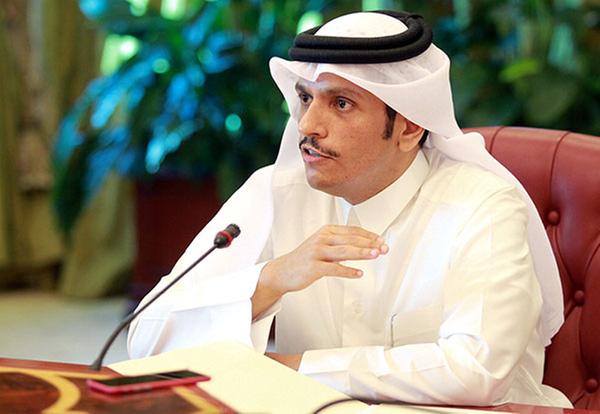 |
| Qatari Foreign Minister Sheikh Mohammed bin Abdulrahman al-Thani speaks to reporters in Doha, Qatar, on Thursday. Naseem Zeitoon / Reuters |
The discord between Saudi Arabia and its allies on the one hand, and Qatar on the other, stems not only from the conflict between Riyadh's efforts to maintain its leadership in the Gulf Cooperation Council and Doha's "ambitions", but also from intermingled sectarian and economic interests, and the changed demographic structures in some Middle East countries.
That Saudi government feels the need to present to the outside world a more resolute image and US President Donald Trump has hinted at changing the United States' policy toward the Middle East might also be responsible for the diplomatic rows.
Given that the US has long exerted great influence in the Middle East, its changed approach has also helped change the region's geopolitical permutation and combination. True, the Trump administration is keen on promoting "value diplomacy", but there is little doubt that even an "ambitious" Qatar would be a "useful instrument" for the US, not least because even other Arab countries see it as the most energetic and diversified economy in the GCC.
So Saudi Arabia and the other Arab countries, despite being unhappy with Qatar, would not have taken the decision without other geopolitical reasons. Perhaps Trump's insistence-from his presidential campaign to his presidency-that he would reduce the US' military presence and intervention overseas and, instead, mobilize resources for domestic economic development had something to do with the decision of Riyadh and its allies.
In his inaugural address on Jan 20, Trump said he wished to consolidate or mend ties with other countries, stressing that all countries have the right to prioritize their own national interests. He also said the US does not seek to impose the American way of life on other countries, and hoped it would become a model for others to follow.
Such remarks by Trump could be construed as the US abandoning its previous policy of supporting "color revolutions" in the Middle East and other parts of the world. It is therefore likely that this changed policy of the US prompted the Saudi government to "teach a lesson" to Qatar while trying to mend ties with the US, which suffered a setback because of Trump's critical remarks against Riyadh during his campaign trail.
Riyadh has issued an ultimatum to Doha to cut its links with the Muslim Brotherhood and Hamas, among other things. However, despite the diplomatic rows, the Arab countries are not likely to use force against each other, and meditations and talks will become the ultimate means to settle the dispute. One reason for that is, the West has long seen Qatar as a reformist representative of Arab countries and thus does not want to see Saudi Arabia, which has a stronger religious inclination, overpower it.
Besides, Saudi Arabia will refrain from using military means, because Qatar is home to the US Central Command in the Middle East. Considering its military's limited success against Houthi rebels in Yemen, several "terrorist" attacks on its soil, and the repeated setbacks the armed forces supported by it have suffered in Syria and Iraq, Saudi Arabia cannot afford to open a new front against Qatar. And by fighting a war with a Qatar, where foreigners comprise the majority of the population, Saudi Arabia would also risk diplomatic rows with other countries.
But one thing looks certain. The diplomatic turbulence in the Middle East will weaken a previous deal reached by members of the Organization of Petroleum Exporting Countries to cut oil output-and prevent them from striking a fresh deal to that effect. And the resulting glut in oil production will drive down oil prices, dealing a blow to not only OPEC members but also the global oil industry.
The author is a researcher at the International Trade and Economic Cooperation Institute of the Ministry of Commerce.





