



AI and the next revolution in military defense







 |
| Cai Meng/China Daily |
Last week, AlphaGo, an artificial intelligence program developed by Google’s DeepMind team, beat China’s top go player Ke Jie in Wuzhen, East China’s Zhejiang province recently, suggests AI will occupy center stage in the next technological and industrial revolution.
But what is AI’s significance for the defense industry? And how to address the security challenges that AI may cause if inappropriately used in the defense sector?
 |
| Zhu Qichao is director and professor of the Center for National Security and Strategic Studies, National Univeristy of Defense Technology, China.[Photo/China Daily] |
Colossus was a set of computers developed by British codebreakers during World War II to help in the cryptanalysis of the Lorenz cipher. It is thus regarded as the world’s first programmable, electronic, digital computer.
Since then, technologically advanced satellite sensors and wearable equipment have helped improve intelligent sensor and information processing. To manage data and information for maximum advantage, the development of command-and-control system has been on top of the military agenda.
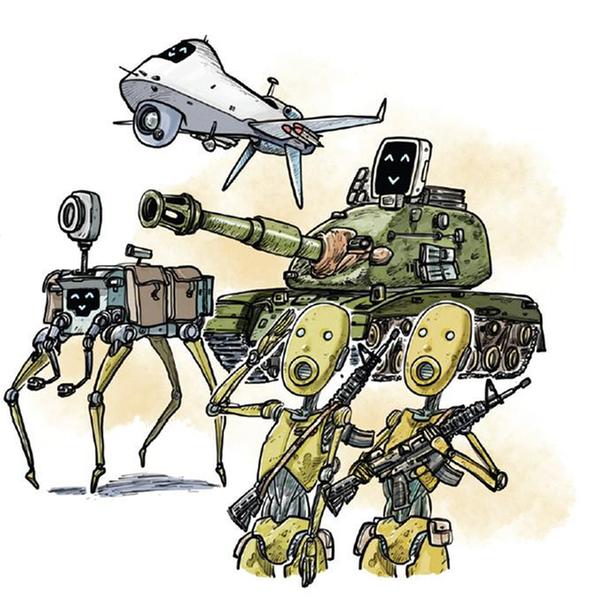
AI has the potential to reshape defense technology and turn science fiction into reality. And the new challenges for defense and security should not be underestimated.
First, AI will make future wars more precise, quicker and crueler. The unmanned system will be widely used by the technologically advanced states to reduce their military casualties, which could pose a greater threat to civilians. And an AI war may undermine the rules of human morality.
Second, AI may never replace human ingenuity. So human ingenuity will be more important than the AI it gives birth to. Like any tool, when used in the wrong way AI can cause a lot of harm and destruction.
Third, AI is far from perfect. In a confrontational environment, AI systems could be invaded or damaged by malware and viruses. Thus, an uncontrollable AI system could end up killing innocent people.
And fourth, because of the coexistence of human-in-the-loop and human-out-of-loop, it is difficult to identify those responsible for faulty missions. For example, those responsible for a humanitarian catastrophe caused by drones may involve the pilot, the computer programmer, the procurement officer, the commander and more. Therefore, it would be more difficult to identify those responsible for AI mistakes than human errors.
Moreover, terrorists could exploit AI and its weaknesses to launch attacks. In an increasingly interconnected world, a cyber attack using AI technology could lead to the hacking of the control systems for nuclear weapons, or chemical and biological weapons.
Many countries are upgrading their defense capabilities by introducing AI technology, but they need to exercise extreme caution while using AI. And since it will become increasingly difficult for a country on its own to ensure absolute security, people should work more closely to respond to international security challenges. To build a community of shared destiny, I have three recommendations.
First, world leaders in military technology should take on more responsibility. A double-track security dialogue should be organized under the aegis of think tanks from all countries to discuss how to strengthen information exchange and sharing, assess the hacking risks in internet of things, estimate the effect of AI proliferation, and prevent wars and conflicts caused by both a sovereign state’s miscalculation and attacks launched by non-state actors.
Second, in the disaster warning mechanism, global fight against terrorism, crackdown on transnational crime, and the humanitarian assistance missions, every country needs to facilitate deeper cooperation with other countries by using AI technology.
And third, drafting an international law on the use of AI as weapon is very important for avoiding AI abuse. Plus, international organizations should coordinate and cooperate to reach a consensus on how best to implement such a law globally.





