



Foreign doctor devoted to raising medical standards







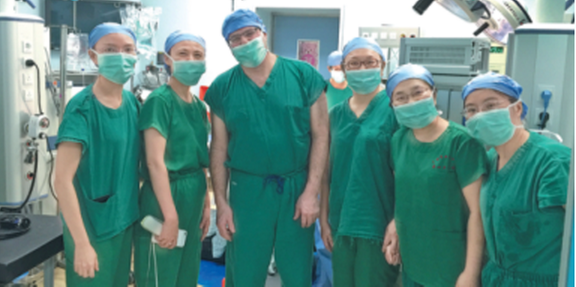 |
| Abraham Morse (third from left) with his colleagues in an operating room at the Guangzhou Women and Children's Medical Center. Provided To China Daily |
Guangzhou hospital aims to deliver care with an international vision
Abraham Morse made headlines in local newspapers when he started working as a doctor at Guangzhou Women and Children's Medical Center, as foreign doctors are still a rarity in Chinese public hospitals.
His move to China marked a return to the country where he studied Chinese and interned at a joint venture company in 1986 as a student.
Morse attended medical school as part of a joint program between Harvard Medical School and the Massachusetts Institute of Technology.
He completed a residency in obstetrics and gynecology at Johns Hopkins Hospital and a fellowship in urogynecology at the Mayo Clinic in Scottsdale, Arizona.
Before moving to Guangzhou, capital of Guangdong province, he worked at Brigham and Women's Hospital in Boston, Massachusetts.
He was attracted by the "innovative and slightly unusual" job posting by the medical center in Guangzhou on an international website, which said it was seeking a new head of urogynaecology. Morse said it stood out because it was not just a search for someone to conduct clinical work like most other postings for positions in Asia.
He started working at the medical center in August and took over as director of the urogynaecology department in January. "As an open and inclusive city, Guangzhou has become an international metropolis. It needs medical care that has an international vision and internationally renowned doctors," said Xia Huimin, president of the medical center.
The center has set standards that are aligned with Western practices, Xia said, adding that it has more than 20 foreign doctors engaged in research, and an ophthalmologist from the United States who spends one week each month seeing patients at the center.
Morse said of the urogynaecology department: "We take care of a broad range of gynecologic issues. I hear about all the patients and we discuss the management of their conditions.
"I sometimes discuss the US approach to problems, such as what medication we might use and when we might consider surgery. It doesn't mean one method is right and one is wrong - all cases are different. It's interesting to compare approaches to help us understand our goals and those of the patients."
One of the big differences is that a lot of technology, such as that used in laboratory testing, advanced imaging and advanced minimally invasive surgery, is relatively new in China, Morse said.
"My experience in the US has enabled me to appreciate the balance between the advantages and disadvantages of some medical approaches. In China, patients and doctors sometimes overestimate the value of advanced technology and surgical intervention," he said.
"There is so much information available that the biggest challenge is to assess what information is important. Experience is crucial. It's also a systematic process of understanding a patient's history, their symptoms and their goals. I always encourage a careful assessment of each patient," he said, adding that too many hospitals in China are overcrowded.
Morse sees about eight patients for clinical assessment a day, many of whom have noncomplex conditions, which points to another difference in the two systems.
In the US, Morse was a specialist in pelvic-floor problems, with most of his patients being referred by another doctor. Such a system, known as primary care in the US, is largely not in place in China, he said.
"Here, patients are pretty much on their own in figuring out what doctor they should see. Almost every doctor is a specialist."
Patients are charged 9 yuan ($1.30) to see Morse at the medical center, compared with about $125 in the US.
Some patients come to see him out of curiosity about a foreign doctor, he said, adding that he communicates with patients through a translator, but his Chinese is improving and he has learned a little Cantonese.
Morse helps to plan surgeries and attends three to five surgeries a week as the primary surgeon or as an assistant teaching another surgeon.
He also mentors and consults with both resident and attending doctors to help them develop their research ideas and edit manuscripts in English.
In addition, Morse helps his colleagues generate knowledge from data, as the medical center focuses on developing electronic medical records and electronic data resources.
He also noted a difference in attitude toward taking medicine.
"In the US, we are accustomed to taking medication over a long time, sometimes for the rest of our lives. In China, many people are reluctant to take medication every day for three months to treat a condition, for example. There are different reasons for that," he said.
In addition, both the patient and a family member are required to sign a consent form for surgery in China, while in the US, only the patient signs the form.
"In the US, we believe the patient should be responsible for making decisions about their health. In China, there is a sense that the family as a whole is jointly responsible for making decisions about a relative's health," he said.
On the other hand, documentation from doctors in the US can be overwhelming, including things not directly related to the care provided, Morse said.
His wife and sons are also living in Guangzhou, "It will be a good experience for my sons to live and go to school in a place that is very different and very unfamiliar to them."
Huang Zehui contributed to this story.
liwenfang@chinadaily.com.cn


- Consumer rights protection disputes in new business models surge in Guangzhou
- French vloggers explore highland scenery and Tibetan culture in Yunnan
- Village in Jiangxi gives 100,000 yuan bonus to residents turning 100
- World's leading lab service provider opens China headquarters in Wuxi
- 'Ride to spring' becomes a major tourist attraction in Chongqing
- Lawmakers with disabilities advocate AI and robotics to improve lives





