Bird Man's Flights Of Fancy







Exhibition emulates a game, tracing the stages of distinguished artist's career
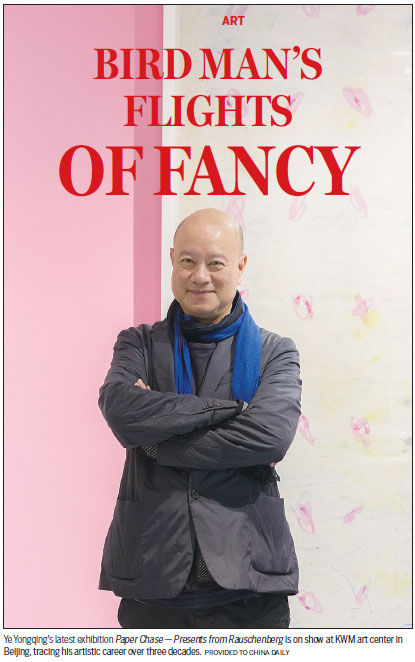
Ye Yongqing is part of the first generation of Chinese artists to be exposed to Western modernism. His 10-year engagement with the London art scene inspired him to create his best-known bird series. Now, Ye's latest exhibition Paper Chase - Presents from Rauschenberg is on show at KWM art center in Beijing, tracing his artistic career over three decades.
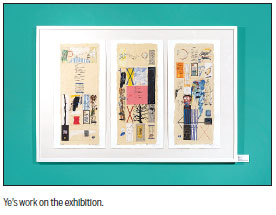
On display are more than 80 artworks. Among them are 29 pieces on the type of paper specially manufactured for US artist Robert Rauschenberg in 1982 by an Anhui paper factory in China.
"They are presents from Robert Rauschenberg," Ye says. "More important, they embody the inspiration Rauschenberg gave me that art is created for fun."
In line with the fun spirit, Ye named the show after a running game, Paper Chase.

"It is a 14th century English game, where the discovery of clues in the form of pieces of paper left in the countryside leads one from point Ato B," Ye says. "Each work on display is a clue to my understanding of art."
Born in 1958 in Kunming, in Southwest China's Yunnan province, Ye became a student in the Oil Painting Department at Sichuan Fine Arts Institute in 1978, the second year after China restarted the national college entrance exam following the "cultural revolution" (1966-76).
Ye and many of his classmates were voracious art students, including Zhang Xiaogang and Zhou Chunya, who later would become big players in the Chinese art scene.
"We couldn't go a day without painting," Ye said in his 1993 memoir.
In the 1980s, the second wave of Modernist thought and influence started to enter China. Ye sought to emulate Western masters such as Paul Gauguin, his favorite artist at the time, and was fascinated by Western poetry and literature.
"There were actually no art books in the school library. To see the only copy of World Art Anthology required an application by a teacher to take the entire class to look together - only after everyone had washed their hands. Later on, the school locked the anthology in a display case, turning one page each day. I would go there each day and emulate the shading and composition of each famous work in chalks," he says.
In 1985, the exhibition ROCI China by Rauschenberg at the institution - now known as the National Art Museum of China - attracted more than 300,000 visitors over its three-week run, inspiring an emerging generation of Chinese artists during a period that would later come to be known as the "85 New Wave".
In the 1980s, China's exposure to Western art was limited to reproductions in catalogs and the understanding of art was largely confined to academic painting, sculpture and printmaking, art critic Li Xianting says.
Rauschenberg's first show in China in 1985 introduced a style of art that concentrates primarily on collage and embraces materials traditionally outside the form for artists, turning away from the seriousness of Abstract Expressionists. Rauschenberg would cover a canvas with house paint, or ink the wheel of a car and use it to create a drawing on paper.
"No exhibition shocked me more than the Rauschenberg one," Ye says. "It's the first time I strongly felt the power of contemporary art. This differed remarkably from the art for art's sake and the artistic education I had received for years. It gave more fodder to my suspicions about the meaning of 'pure art'."
In the 1990s, Ye created Big Posters and a series of collages on canvas, in which he applied scribbles, numbers and large characters on newspaper, canvases or silk scrolls and also boldly blended photographs of his studio, friends and letters, along with philosophical quotes and texts.
"The formal resemblances of his paintings at that time hold some proximity to those of Rauschenberg," says Robert C. Morgan, a New York City-based art critic. "In many ways, the impact of the American Neo-Dadaist exhibition offered a spur for Ye to advocate a rough traditional style of painting on old calendars, wall posters and newsprint, and thus to reveal the internal symbolic aspects of his imagery with a new formal apparatus."
Following his collages, Ye became completely absorbed in painting birds, and these works achieved tremendous popularity on the Chinese art market when he first began producing them in 1999. Consequently, Ye produced them steadily for more than 10 years.
"I often see my life as like that of migratory bird moving among several different cities, fragmented and with no fixed abode. I paint and put together my creations the same way: I hit one target and move on," Ye wrote in a letter to art critic Li Xianting in 1991.
The change of style started when he worked in London. In 1997, Ye went to the British capital and ever since has worked regularly in the country, thanks to sponsorship from the British Arts Council.
Living overseas, far away from his native language, gave him a strong sense of loss and a feeling of physical disruption.
"Identity and the desire to belong were the two of the most relatable struggles that I was dealing with at that time," he says.
He was "fighting against the role framed by the West in every possible way" and realized it was necessary for him to master Chinese traditional culture and art.
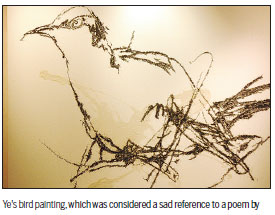
The flying bird is traditionally an expression of the wandering, unconventional and transcendent spirit in a Chinese context. Some consider Ye's bird painting a sad reference to a poem by Du Fu, a Chinese poet of the Tang Dynasty (618-907): "Fluttering, fluttering - where is my likeness? Sky and earth and one sandy gull."
Ye often uses a "slow scribble" technique of drawing with ink, creating dense thickets of marks that make up his lines. He has said that scribble usually gives an impression of being fast and simple. But if I sketch something childish in a slow, mature way, people might mistake it for a child's drawing at first, then suddenly discover the meaning in it."
"This is an interesting process. I am like a trap setter, making a joke to visitors just for harmless fun," Ye says.
lijing@chinadaily.com.cn
(China Daily USA 05/12/2017 page1)


Today's Top News
- China's finance minister pledges expanding fiscal spending in 2026
- CPC leadership meeting urges steadfast implementation of eight-point decision on improving conduct
- Autumn grain purchases exceed 200m tons in China
- Wang to meet foreign ministers of Cambodia, Thailand in Yunnan
- China's top legislature concludes standing committee session
- Thailand and Cambodia agree to temporary ceasefire