



Bilateral mechanism can help deepen trust with Australia







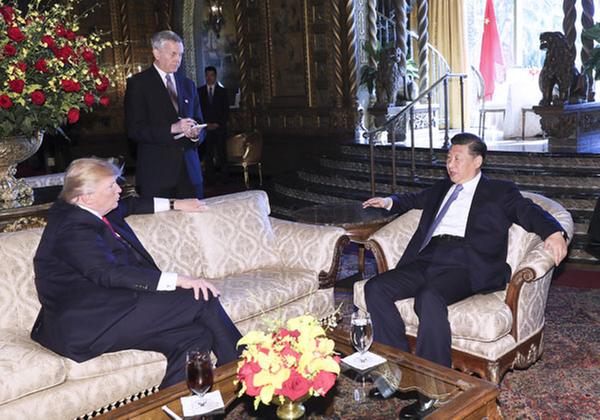 |
| Chinese President Xi Jinping (R) and his U.S. counterpart Donald Trump (L) hold the second round of talks in the Mar-a-Lago resort in Florida, the United States, April 7, 2017. [Photo/Xinhua] |
Yet fewer people seem to have realized that similar distrust has also marked the relationship between China and Australia from time to time. One proof of the distrust is that Canberra has almost always supported Washington in issues such as the South China Sea disputes, and the US' "freedom of navigation" operations near disputed waters and other major strategic maneuverings in the Asia-Pacific region.
On April 18, US Marines started arriving in Darwin in northern Australia on a six-month deployment program as part of the US "pivot" to Asia strategy. A Reuter report says that, although the 1,250 US troops in Australia comprise half of the 2,500 Marines to be gradually deployed there according to an agreement signed in 2011, Australia will see the largest deployment of US aircraft contingent in peacetime history.
Many see a stronger US military presence in Australia as serving the US' strategic interests in the Asia-Pacific and a major response to China's "rising assertiveness" in the region. And by jumping on the US bandwagon to contain China, Australia has fueled suspicions among its citizens about China.
Many Chinese still cannot understand why the "China threat" theory has been hyped from time to time in Australia, because being thousands of miles away from Australia, China cannot possibly pose any direct threat to the country. They also cannot fathom why Chinese investments have been under the most severe scrutiny in Australia despite Australian politicians repeatedly saying they welcome investors from China. This is all the more surprising because the two economies remain highly complementary, and trade with China is playing a significant role in boosting the Australian economy.
Such issues hindering the smooth development of China-Australia ties are largely the result of some Australians' distrust of China. Many have ascribed Australia's strategic distrust of China to the country's alliance with the US, which was forged after World War II.
In a clear sign that the US administration under Donald Trump intends to strengthen the alliance with Australia, US Vice-President Mike Pence, during his visit to Canberra, reiterated the US' "enduring commitment" to the alliance between the two countries.
Australians tend to believe the alliance with the US is vital to safeguarding Australia's security. Whether or not the decades-old alliance is still relevant and compatible with today's global trend, it should not block Australia's healthy interactions with China.
Fortunately, insightful people in Australia have begun to see Canberra's ties with Beijing differently. They believe Canberra needs to have a more independent foreign policy and forge a closer relationship with Beijing, as they see Australia's future development hinges more on its relations with China than with the US.
The first China-Australia high-level security dialogue was held in Sydney on Friday, with both sides pledging to boost cooperation in such fields as judicial and legal affairs, cyber security, and combating terrorism and transnational crimes.
And the new bilateral mechanism, agreed by Premier Li Keqiang and Australian Prime Minister Malcolm Turnbull during Li's visit to Australia in March, shows that the two sides are keen on deepening strategic mutual trust and bridging the gaps in regional and international security issues.
With efforts of such kind, it is believed Beijing and Canberra can gradually dispel their mutual distrust and differences, and forge a steady and stronger relationship, so as to realize more mutual benefits and jointly contribute to regional peace and development.
The author is a senior writer with China Daily. wanghui@chinadaily.com.cn





