



Best policy for HK prosperity and residents







July 1 marks the 20th anniversary of Hong Kong's reunification with the motherland and the implementation of the principle of "One Country, Two Systems" in the special administrative region. Evaluating the implementation of this national policy of "One Country, Two Systems" is of great political significance today.
Two basic indices are needed to objectively evaluate the implementation of a policy: its original political goal and the actual result it produces.
When China first advanced the "One Country, Two Systems" policy in 1978, its political wisdom profoundly impressed the international community. But the process that transforms this political concept into actual institutional arrangement changed with the complicated global developments.
Yet the "One Country, Two Systems" policy has passed the severe tests of the drastic changes of the past decades and won wider recognition in Hong Kong.
On April 4, 1990, the Basic Law of the Hong Kong SAR, which incorporated the spirit of the "One Country, Two Systems" principle was approved by the third session of the 7th National People's Congress. The session also decided to make Hong Kong a special administrative region in accordance with the "One Country, Two Systems" policy.
The Basic Law of the Hong Kong SAR was enacted based on the Constitution of the People's Republic of China, establishing the constitutional basis of the special administrative region. And the system and policies implemented in Hong Kong are in accordance with the Basic Law, which explains the political relationship between the central government and the SAR. The Basic Law, as such, is the judicial and institutional outcome of the principle of "One County, Two Systems".
No wonder paramount leader Deng Xiaoping called the Basic Law a creative masterpiece and praised it for its historical and international significance.
The "One Country, Two Systems" policy came into effect on July 1, 1997, when Hong Kong was reunified with the motherland. But some Hong Kong residents were skeptical about the implementation of the policy at that time, and they have voiced their dissatisfaction with the policy over the past two decades.
Legislation of National Security, based on Article 23 of the Basic Law, has been laid aside for a long time. The "Occupy Central" movement in 2014 raised wide public concern. And the political reform plan was impeded in the Hong Kong Legislative Council, with some SAR residents even calling for "Hong Kong independence". As a result, the way to achieve political reform which the Basic Law stipulates appears a bit difficult today.
But despite the "One Country, Two Systems" policy facing some difficulties at the moment, the central authorities' confidence in the policy is as strong as ever.
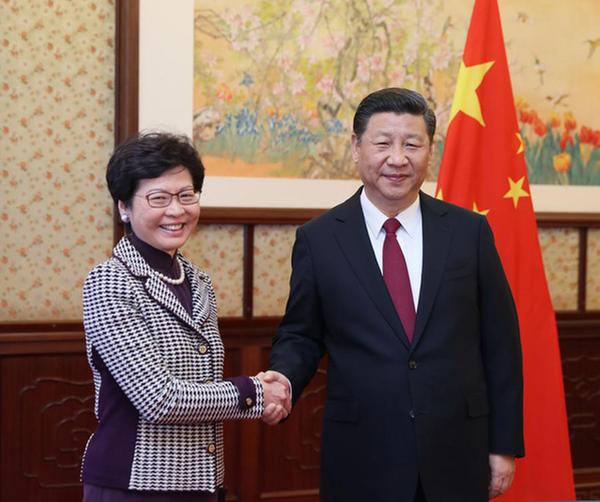
At his recent meeting with newly elected Hong Kong Chief Executive Carrie Lam Cheng Yuet-ngor, President Xi Jinping reiterated that the central government's confidence in the "One Country, Two Systems" principle, Hong Kong people ruling Hong Kong, and the SAR's high-degree of autonomy is as strong as ever. Xi also said the central government will give full support to the new Hong Kong government's administration according to the law. Hong Kong society responded actively, saying the "One Country, Two Systems" policy is the best choice for the SAR.
The goal of the "One Country, Two Systems" policy is to achieve national unity and maintain Hong Kong's prosperity and stabilization. And one can safely conclude that the "One Country, Two Systems" policy has achieved great success. The most obvious proof of that is the central government's successful exercise of sovereignty over Hong Kong, the implementation of the system stipulated by China's Constitution and the Basic Law, and the continued prosperity and stability of Hong Kong over the past two decades.
Hong Kong has witnessed some problems in recent years. But Hong Kong society should always remember that the "One Country, Two Systems" policy that stresses inclusiveness is basically a national policy of, rather than an expediency for China. And only when we fully understand and implement this progressive policy can it fully play its role.
The author is a professor at Shenzhen University and a member of the Chinese Association of Hong Kong and Macao Studies.





