Reforms cut costs and improve services







|
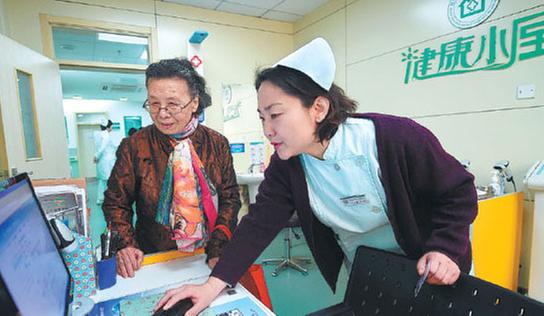
A nurse takes the health details of a senior patient at Donghuashi Community Health Center in Beijing.Luo Xiaoguang / Xinhua |
Markups on drug prices have been abolished in the capital's hospitals as part of a series of measures to provide better, targeted treatment at lower prices. Wang Xiaodong reports.
Wu Weihong hasn't been affected by the medical reforms implemented in Beijing this month, but the new measures have had a big impact on his 61-year-old mother, who has regular treatment for chronic kidney disease.
Wu subscribes to Beijing's basic medical insurance program, which means most of his medical fees are reimbursed. However, his mother, a farmer in neighboring Hebei province, subscribes to a different program so she has to bear the entire cost herself.
"We paid 100 yuan ($14.50) to see a senior doctor," said Wu, who works for a property management company in Beijing, after accompanying his mother to the China-Japan Friendship Hospital, a major treatment center in the capital.
"In the past, the cost of seeing a similar-ranked doctor was only 7 yuan."
A patient surnamed Li, who recently had surgery at the same hospital, said he has heard about the reform in recent days and is curious to see what will happen next.
"I heard hospital drug prices have been reduced. Many patients with my illness have discussed the issue online. Some said doctors are now prescribing fewer drugs than before, so they have to go to the hospital more frequently to get new supplies," he said.
"I have not been affected by the change, but I think people who have been prescribed drugs that cost more than 1,000 yuan will feel the difference."
Prices and fees
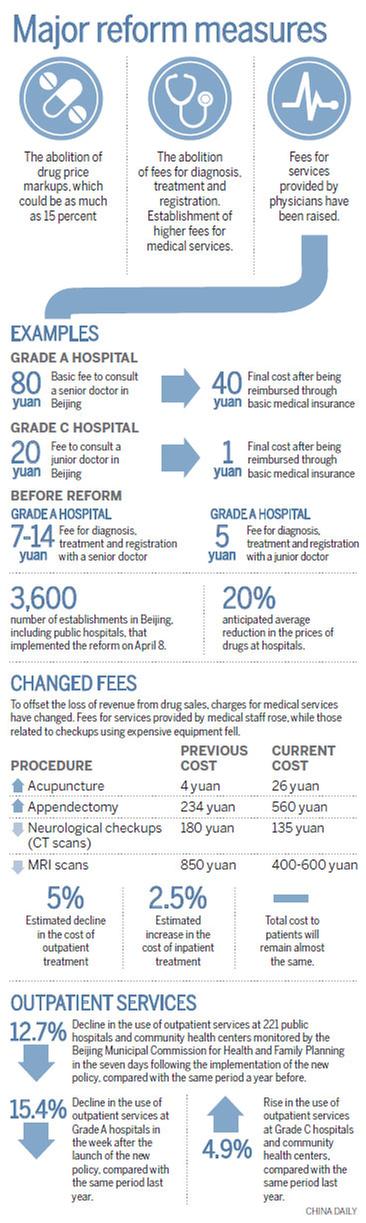
The measures, introduced on April 8, are designed to end the markup levied on drugs prescribed at hospitals and also modify the fees for registration, consultation and treatment.
Following the implementation, the National Development and Reform Commission, the top economic planner, announced that public hospitals nationwide must end markups by the end of September.
Figures released by the Beijing Municipal Commission for Health and Family Planning show that between April 8 and 15, the amount spent on drugs per visit fell at outpatient departments in large hospitals and smaller community clinics.
Moreover, average expenditure on drugs per visit to outpatient departments at Grade A hospitals - the top-level in the country's three-tier system - was 230 yuan, 3 percent lower than the same period last year.
At a media briefing last week, Wang Hesheng, vice-minister of the National Health and Family Planning Commission, the top health authority, said: "Beijing's medical reform is heading in the right direction, and has won support from a majority of patients. We will watch the reform and promote the experience in other parts of the country."
Markups abolished
The long-held practice of price markups on drugs sold at public hospitals has traditionally been a key source of income.
The system, which usually adds about 15 percent to the price, was promoted in public hospitals in the 1950s. Some experts said it encouraged hospitals to prescribe too much, and more expensive, medication, which contributed to soaring healthcare expenditure.
Despite being designed to help hospitals overcome shortfalls in government funding, the markup system became a way to make profits and resulted in ever-worsening problems, such as overprescription of drugs, excessive use of antibiotics and rising costs, said Wang, from the NHFPC.
Eradication of the system is also a key part of the nation's ongoing medical reform, which aims to provide universal coverage of basic healthcare services, according to the NHFPC.
In 2012, pilot programs were introduced in five large hospitals in the capital, including Beijing Chaoyang Hospital and Beijing Friendship Hospital.
Last year, the income generated by drug sales accounted for about 33 percent of the two hospitals' total incomes, compared with 43 percent in 2012, the municipal commission said.
On April 8, the reform was expanded to more than 3,600 institutions across the city, including public hospitals.
In addition, all institutions are now obliged to purchase drugs from pharmaceutical manufacturers through an open and competitive public bidding process to further reduce prices, according to Fang Laiying, head of the municipal commission.
The measures should result in drug prices falling by about 20 percent. To compensate for lost revenues, hospitals involved in the reform have raised fees for a number of services, such as surgery and acupuncture, it added. For example, the cost of acupuncture has risen to 26 yuan per session from 4 yuan.
Fees will be reduced for checkups that require the use of expensive equipment. Moreover, diagnosis and registration fees have been abolished, and replaced by a much higher "medical service", or consultation, fee, which varies according to the grade of hospital and the seniority of the doctor involved.
The move is intended to reflect the true value of services provided by medical staff.
For outpatient services, the cost of consulting a senior physician at a Grade A hospital is now 80 to 100 yuan per visit, while the fee to see a junior doctor at a Grade C hospital, the lowest ranked, at community-level clinics is 20 yuan.
Before the reform, the combined consultation and treatment fee for a senior physician in the outpatient department at a Grade A hospital was 7 or 14 yuan per visit, while it cost 5 yuan to see a junior doctor. Medical professionals said the fees underestimate the value of their work and have called for increases.
"My consultancy fee is now just 80 yuan, which, in my opinion, undervalues the services provided by doctors. Despite that, the reform has made a good start," Wu Changyan, a cardiologist at Beijing Anzhen Hospital, wrote on WeChat.
Li Sufang, deputy director of the Beijing Commission of Development and Reform, said the measures are expected to result in the cost of outpatient treatment falling by about 5 percent, while the cost for inpatient treatment, including surgery, will rise by about 2.5 percent.
A statement issued by the municipal commission said: "The reform will promote the establishment of a dual-layer healthcare system in Beijing and public hospitals will become 'more public' in nature."
Dual-layer system
In the week following the reform's implementation, about 2.1 million people were treated in outpatient departments at Grade A hospitals, a decline of more than 15 percent from the same period a year ago. At the same time, 185,000 people were treated in outpatient departments at grassroots hospitals and community health centers, a rise of 4.9 percent.
In Beijing, and many parts of China, large hospitals are crowded with patients waiting in long lines, even though many smaller and community hospitals have empty beds. The problem is exacerbated by the fact that registration tickets to see a doctor are so difficult to obtain in some hospitals that the market is plagued by scalpers, who charge hundreds of times the face value, according to media reports.
Health authorities in Beijing and across the country have taken a number of steps to promote a dual-layer healthcare system, in which resources will be more-evenly distributed among different types of hospitals. The aim is to encourage more patients to seek treatment at community hospitals. Ma Jun, director of the Dongxiaokou Community Health Service Center in Beijing's Changping district, said following the reform, the minimum consultation fee is 20 yuan, and residents who have subscribed to the city's medical insurance program only pay 1 yuan.
"We haven't seen a big rise in the number of patients because the reform only took effect a few days ago," he said. "But I think in the long run, the measures will encourage more patients to turn to grassroots medical institutions for treatment of commonplace illnesses and minor problems."
Wu, the Beijing resident, said there is no health center in his community in Daxing district and a shortage of doctors at small hospitals near his home means he often waits three or four hours to consult a pediatrician about his son's health.
"I would rather drive for two hours to visit to a big hospital where there are plenty of doctors. Besides, many drugs are unavailable at small hospitals. I hope more measures will be established to make life more convenient for patients," he said.
"For example, many people with chronic illnesses go to the hospital just to get medication, but like the other patients they have to wait a long time to see a doctor and get their prescription."
Zhu Hengpeng, a researcher of healthcare reform at the Chinese Academy of Social Sciences, said the reform is the right way to reverse the rising cost of providing services, but he urged further changes to relieve the financial burden on patients.
"More measures should be taken to introduce competition in the medical sector and improve the payment of medical insurance fees to public hospitals to encourage them to control costs," he said.





- Community memory clinics help aging minds stay connected
- Guangzhou's bald cypress trees turn red after cold snap
- Chinese researchers create novel computing architecture for major power boost
- Chinese astronauts conduct key training, experiments on space station
- China maintains strong momentum in anti-corruption drive
- China maps cotton's evolutionary secrets to build better crops