History of the BMW 5 Series







With its 1500, 1800 and 2000 models, BMW remodeled itself under the New Range banner in the 1960s, establishing a globally successful series. The company's competence in development and production spurred it to a worldwide breakthrough as a manufacturer of modern and highly desirable sedans with very unique characteristics.
Refocusing on the 5 Series in 1972, BMW not only introduced new brand names, but also a new era in design. The number five immediately became synonymous with unmistakable driving pleasure.
Since its introduction to the market, the BMW 5 Series has been an exemplar in balancing sportiness and elegance. The series also reflects a unique combination of driving dynamics and motoring comfort, ensured by a superior drivetrain and suspension technology. The 5 Series therefore offers a concentrated rendition of BMW's outstanding development competence.
1972

Debut
BMW first presented its 520 and 520i models - featuring four-cylinder power units - at the 1972 Frankfurt Motor Show as successors to the New Range. The branding approach introduced a new concept that still determines the names of BMW cars to this day, with the "5" at the beginning specifying the series and the two following numbers indicating the model.
In design, the first BMW 5 Series model stood out from the start, due to its stretched and sleek lines, large windows and low waistline. As design elements typical of the brand, the dual headlights and the Hofmeister kink at the foot of the C-pillar were re-interpreted in a new style and technology. For the first time, BMW's engineers used computers to a greater extent to ensure superior safety based on precisely analyzing collision impact zones.
The introduction of the BMW 525 the following year hailed the launch of the first sixcylinder engine. The powerful and refined engine delivered an impressive power of 145 horsepower.
BMW's pursuit of greater achievements in auto racing fueled the establishment of BMW Motorsport GmbH in 1972 and later led to the BMW M535i with its 160 kilowatt, six-cylinder engine in 1980.
1981

Second generation - first diesel
The second generation of the 5 Series was launched in 1982 and continued the success of its predecessor, remaining faithful to its design principles of clear silhouettes and large windows.
Even with its more striking look, the new BMW 5 Series offered far greater presence and flair on the road. Engineering refinements and intelligent lightweight technology provided more interior space, optimum weight and improved occupant safety. The newly developed suspension - with its doublejoint front axle and semi-trailing arm rear axle - served to enhance the new model's motoring comfort.
Modern electronic systems were also introduced into the BMW 5 Series at this point, ranging from anti-lock brakes via an onboard computer, all the way to electronic fuel injection.
BMW took a revolutionary step in 1983 to enter the fiercely contested diesel market with the BMW 524td. The 2.4-liter straight-six turbo diesel engine offered a maximum output of 115 horsepower, fulfilling fuel efficiency requirements.
BMW had already undertaken various studies to develop innovative fuel-efficient technologies, while also looking for alternative sources of energy. An example is the hydrogen-powered test car presented as early as 1976 on the basis of the first-generation BMW 5 Series.
In 1985, BMW Motorsport GmbH proudly presented the epitome of the sports sedan, the BMW M5. Power came from a straight-six boasting four-valve technology. Output of this drive unit derived from the legendary BMW M1 was 286 hp, developing supreme thrust and performance previously offered by only the most thoroughbred sports cars.
1988
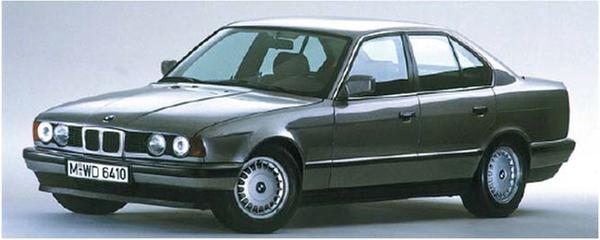
Third generation - the first Touring
With BMW introducing catalyst technology in 1984, the third generation of the BMW 5 Series was fitted exclusively with this high standard of emission management. The first models available in 1988 were the 520i, 525i, 530i, 535i, and 524td, all with six cylinders and electronic fuel injection.
The eight-cylinder 530i and 540i were launched in 1992, followed by the 518i, which was introduced in 1993 as a four-cylinder entry-level model. In the meantime, the six-cylinder engines, benefiting from four-valve technology and variable camshaft management, had gained even greater power, torque and efficiency.
With its precisely defined deformation zones - which absorb the impact from collisions - and even stiffer passenger cell, the third generation of the BMW 5 Series set new standards in safety. Automatic stability control was also available for the first time, in addition to the anti-lock brake system.
The first BMW 5 Series - with electronic all-wheel drive - was launched in 1991, capturing the concept of fully variable power distribution from front to rear, together with a rear axle differential lock. From the first comparative tests, it proved to be superior to all four-wheel-drive systems available previously.
Compared with its predecessor, the third-generation BMW 5 Series was significantly longer and came with much more space inside, also thanks to its brand-new design. Indeed, the new sedan created under the guidance of Chief Designer Claus Luthe combined sporting elegance and flowing lines with a distinctive wedge shape. This stylish character was then carried over by the designers to the first BMW 5 Series Touring, this unique five-door revealed at the 1992 Frankfurt Motor Show, offering a brand-new look and brand-new features behind the B-pillar.
1995

Fourth generation - light-alloy suspension
The fourth-generation BMW 5 Series made its debut in 1995, offering an evolutionary development with its sporting and elegant style. One stand-out feature at the front was the dual round headlights behind a glass cover, with the light rings for positioning and daytime running lights.
This generation brought about the first large-scale production car in the world to be made almost completely of light alloy. To enhance driving dynamics and safety, the body came with a significant increase in torsional stiffness. The newly developed all-aluminum power units also helped to significantly reduce the weight of the car.
Both the sedan and the Touring offered more space within the passenger compartment. Boasting features including a multifunction steering wheel, a navigation system, active seats and dynamic stability control, the BMW 5 Series was acknowledged as a particularly outstanding high-tech representative of its segment.
The new model entered the market with straight-six power units, delivering a maximum output of 150 to 193 horsepower. Technical innovations gave both the petrol and diesel engines even more power on further reduced fuel consumption. Two V8 engines were introduced in 1996, and the M5 entered the market in 1998 with a powerful engine with output of 294 kW.
2003

Fifth generation - localization
Starting in 2003, BMW began producing its fifth-generation 5 Series in China. In November 2006, a BMW 5 Series long wheelbase version was launched. It is the first-ever 5 Series tailor-made for Chinese customers. Offering striking design, innovative technology and outstanding efficiency, the fifth generation continued the victorious family history.
BMW's typical design language - with convex and concave surfaces, as well as flowing transitions from the front and side to the rear - gave the fifth edition of the BMW 5 Series a particularly characteristic note. The improved interior featured as standard, with its clear-cut functions highlighting, above all, the iDrive control system.
Once again, the sedan and Touring edition, launched in 2004, together set new benchmarks in proactive safety, driver assistance systems and fuel efficiency. Dynamic stability control was another significant innovation contributing to the car's excellent suspension technology. The same superiority was provided - for the first time - by BMW's active steering and adaptive drive technologies, with electronic damper adjustment and anti-roll stability management.
The fifth-generation BMW 5 Series also featured cutting-edge technologies, including the head-up display and BMW night vision, active cruise control with stop & go, and lane departure warning introduced as new systems inside the car.
Engines with aluminum or a composite aluminum and magnesium crankcase - besides the lightweight aluminum front section of the car - ensured the balance of weight 50:50 front-to-rear. Another important component developed during this phase was the integral rear axle, which was likewise made of aluminum.
Starting in 2007, all versions of the fifth-generation BMW 5 Series were enhanced by BMW's EfficientDynamics technologies, fitted as standard. The ultimate benchmark for efficiency in the upper midrange segment was set by the 520d's average fuel consumption in the European Union test. It recorded 5.1 liters/100 km and 136 grams carbon dioxide emissions per kilometer, despite engine output of 130 kW.
2010
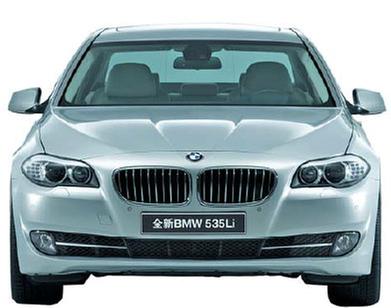
Sixth generation - record sales
The sixth generation has been the most successful BMW 5 Series ever built, with an overall sales volume of more than 2 million cars worldwide. Revered for its great looks, brilliantly built interior, excellent technology and superb ride quality, the cabin of this generation gave a great feeling of luxury.
BMW combined the highly advanced drive train with suspension technologies to ensure agile handling and a high level of riding comfort for all passengers. Driver assistance systems offered many fascinating functions, including driving dynamics control, electronic damper control, active roll stabilization, parking assistance, top view cameras and frontal collision warning.
Once again, BMW developed a long wheelbase version for Chinese customers, which produces the same results in test conditions as the standard wheelbase version.
The sixth generation of the 5 Series is also the most successful BMW model by far in China. In the seven years since its launch, more than 800,000 vehicles have been delivered to Chinese customers, contributing to BMW's total China sales volume exceeding 3 million vehicles for the first time this month.