



Dispute resolution and risk control mechanisms needed for B&R projects







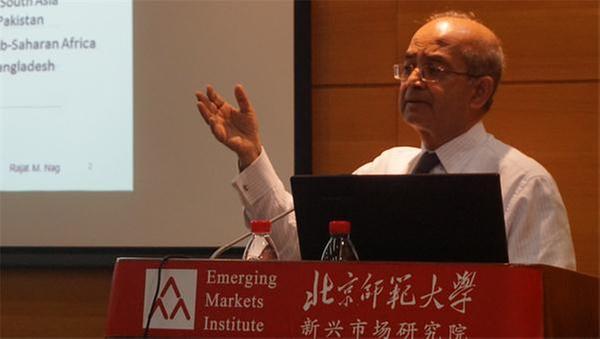 |
| Rajat M.Nag gives a presentation themed "the challenges Asia faces" in the Emerging Markets Institute of Beijing Normal University on April 5, 2017. [Photo provided to chinadaily.com.cn] |
Editor's note: In a long-ranging interview with China Daily, Rajat M. Nag, the former Managing Director General of Asian Development Bank, shares his expectations of the Asian Infrastructure Investment Bank (AIIB) and the Belt and Road initiative's potential contribution to the world. As an Emerging Markets Institute professor at the Beijing Normal University, Nag also suggests disputes resolution and risks control mechanisms should be designed in advance.
Q1: With 70 members, AIIB now outnumbers the European Bank for Reconstruction and Development (EBRD) and the Asia Development Bank (ADB). AIIB has become the world's second-largest multilateral development agency; so, with this information, how would you see AIIB perform across the international community, and what kind of contribution would you expect AIIB to make, being a newly initiated multilateral development bank?
Professor Nag: AIIB's mandated to promote infrastructure development in Asia. This is one area, for which, there is huge demand in the continent. AIIB, thus, has a very important role to play in the continued development of Asia.
The Asian Development Bank (ADB) recently estimated Asia's infrastructure investment, over a fifteen year period (2016 to 2030), would amount to $26 trillion in total, equaling $1.7 trillion per year. The large demand cannot be financed by just the government or even the private sector, or one or two multilateral institutions. It is, therefore, very important the AIIB, ADB, World Bank and other institutions partner well in meeting these needs.
Q2: Could you suggest a few necessary, key points for projects organised by AIIB in the future?
Professor Nag: Demands for infrastructure in Asia cover sectors including roads, railways, ports, telecommunications and airports, and AIIB can assist in each of these areas.
The bank could greatly support the Asian Highways and Railways network, which still have several missing links. AIIB could also contribute to developing infrastructure in Asia, alongside improving connectivity.
Q3: Could you highlight some of the projects AIBB and ADB have worked on together, so far? Has co-financing projects been successful?
Professor Nag: It is too early to tell since the co-financing of projects, in a partnership by AIIB and ADB, have only just begun. However, I am quite sure ADB has applied a very stringent preparation criteria – in technical, economic, financial, environmental, social sections – to the co-financed projects, and AIIB has performed a due diligence on them. I, therefore, expect the projects would be well prepared and should have good chance at success.
If a project is designed well, it has a high probability of success, and, of course, implementation is key.
Q4: What would you say are the secrets to controlling the risks of Chinese companies who want to be involved in the B&R initiative?
Professor Nag: In order to control or minimise risks, it is important projects are well prepared – this would include having a well set out dispute resolution mechanism.
Projects must be clear and have a well laid out risk-sharing mechanism, which should state who is responsible for what risk if it succeeds or fails. If traffic demands turn out to be less than expected, somebody needs to wear the consequences of the lower toll revenues. Similarly, who will be responsible for project delays if the land acquisition process takes longer than originally thought?
The key to avoiding this from happening is to have a plan which clearly lays out possible contingencies, stating how they will be dealt with. A team also needs to have a clearly agreed mechanism, detailing how disputes will be resolved.
Q5: How do you regulate capitals for infrastructure projects, correctly and precisely?
Professor Nag: The answer depends on who is financing the project. If a private sector partner is involved, it is important to ensure the project earns a reasonable financial return. Appropriate tolls and tariffs, for example, must be levied, and there needs to be a mechanism in place for doing so.
Unfortunately, many infrastructure projects may not be financially viable, even though the project may be very desirable from a country's socio-economic perspective. The Government may, therefore, consider it very worthwhile to invest in these projects, and it could, overall, be a very good use of the national resources. The key to being successful is, however, the project must be assessed rigorously from an economic point of view, which is different from a financial view alone, to decide if the project should be undertaken.
You must also look at a country's limited resources are being effectively used, as well as monitor sound implementation and have close supervision of the project.





