The appliance of science cleans Lake Taihu







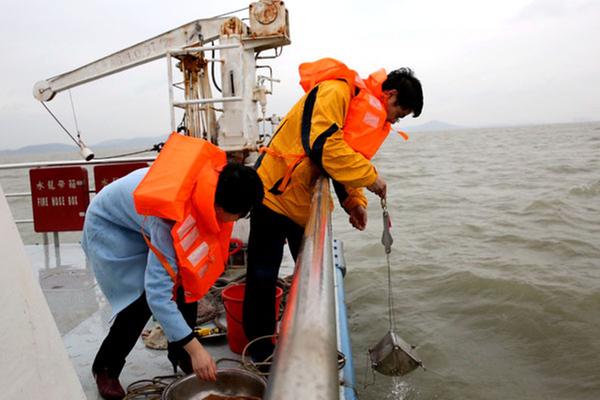 |
| Researchers collect water samples from the lake.[Photo/Xinhua] |
While the platform is highly effective at surface level, it can't address the bigger problem-stopping the algae from blooming in the first place. To do that, the scientists have to tackle the lake-bed sediment in which the plant thrives.
Researchers have discovered that algae outbreaks have four stages: dormant in sediment; resuscitation; mass reproduction; and surface outbreaks. "If the algae is removed from the sediment, it is gone for good," said Yang Guishan, an ecologist at the academy.
The two main fuels for algae outbreaks-nitrogen and phosphorous-are also deposited in the sediment, so it is important to clean the soil when the algae is dormant, he said.
Dredging and replacing the lake bed have been tried, but they are expensive because of the high cost of labor and transportation of clean soil.
In December, the academy's scientists successfully tested a new dredging platform that shaves off the sediment's top layer, cleans it and pumps it back into the water.
The dredger is 21 meters in length and has a 6-meter-long arm attached to one end. The end of the arm has two rotating paddle blades and a number of water pumps.
The pumps disturb the water near the top layer of sediment-where most organic waste and algae are deposited-while the paddle blades collect the mixture and another pipe sucks it onto the platform. The mud is then filtered before being pumped back into the water. The manufacturer claims the process can remove more than 80 percent of the algae and organic waste in the sediment, meaning there is no need to transport fresh soil.
The platform can clean 1 hectare of soil an hour, and can hold about 50 metric tons of algae and waste.
Again, there's a downside. The dredger is a prototype, and it will be years before it can be used widely. Moreover, its size and the arm's limited reach mean it only works in large, shallow lakes, and it can only be used to clean sediment that does not have a high level of biodiversity in its top layer, according to Qin.
"But circulatory cleaning, soil filtering and other technologies on the platform are already showing potential and they could be implemented earlier," he said.
Turned to stone
When they came to consider famous tourist lakes, the scientists decided to employ a more sensitive approach, because giant platforms carrying large amounts of toxic algae could ruin the scenery and damage the local tourism industry.
Last year, scientists developed a powder that glues algae into large clusters. As a cluster sinks, it acts on the phosphorus in the water, transforming it into insoluble calcium phosphate which traps both the algae and its nutrients. Just 0.3 kilogram of the powder can clean 1 square meter of water and remove 95 percent of the phosphates.
"It's like killing two birds with one stone," said Zheng Maosong, deputy director of the academy's Xuyi Center of Attapulgite Applied Technology Research Development and Industrialization, which helped to create the powder.
The key ingredient is purified attapulgite, a natural nanomaterial whose unique rod-like structure gives it strong adhesive qualities.
The mines in Xuyi, a city in Jiangsu, contain an estimated 889 million tons of attapulgite, accounting for 48 percent of the global reserve, said Wang Aiqin, a researcher at the center.
The powder is a relatively new invention, so its effect on the ecosystem will have to be studied before it can be used on a large body of water, such as Lake Taihu, Zheng said.
"Taihu is frequently buffeted by strong winds that stir up the sediment, and when that's coupled with the effects of global warming, the stones created by the mixture may break and release the pollutants back into the clean water," he said.
At the moment, the process is only suitable for use in small lakes or sewage works that have more-stable water dynamics, according to Zheng, who said he sees a strong future for the powder once it has been fully tested.
Contact the writer at Zhangzhihao@chinadaily.com.cn






- 10 dead and 84 injured in explosion at steel plant
- China unveils flexible urban planning rules to improve lives, foster new industries
- Ex–China Construction Bank executive gets 18 years for bribery, loan violations
- First batch of eco-friendly pioneer zones for construction of beautiful countryside unveiled
- Woodpeckers, finches captured in Jilin winter scenes
- Mainland reiterates 1992 Consensus as foundation for resuming cross-Strait dialogue