



Worrying revival of imperial rescript as educational tool







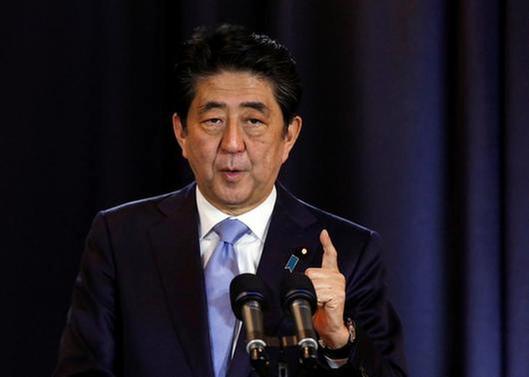 |
| Japanese Prime Minister Shinzo Abe gestures during a press conference in Buenos Aires, Argentina, November 21, 2016. [Agencies] |
In response to a question from a lawmaker about the use of the Imperial Rescript on Education, Japan's Cabinet said on March 31 that use of the rescript as material for learning is not denied as long as it is in a manner that does not violate the Constitution, the Basic Law of Education and other legal provisions.
The rescript, which was issued in 1890 and nullified in 1948, has hit the headlines in Japan after televised footage of children aged 3 to 5 being taught to recite the rescript in a kindergarten in Osaka shocked the country.
"Be filial to your parents, affectionate to your brothers and sisters," the uniformed children chant, bowing to photos of the emperor and empress. "Should emergencies arise, offer yourselves courageously to the state."
Japanese Prime Minister Shinzo Abe and Defense Minister Tomomi Inada have praised the spirit of the rescript saying it can help to foster the right moral principles.
But the Abe administration's approval of the legally invalid rescript has invited criticism from scholars and lawmakers from opposition parties in Japan.
Even the conservative newspaper Yomiuri Shimbun has said "the utmost restraint must be exercised when it comes to classroom instruction that uses the rescript as a model for subjects, including ethics", adding that the rescript was inseparably linked to the Meiji Constitution propagated in 1889.
In the Meiji Constitution, the Emperor was positioned at the center of the the state as the "Godhead", the people of Japan were "subjects". The education ministry of the Meiji era drafted the Imperial Rescript on Education, seeking to install in students patriotic pride and loyalty to the emperor and the state.
Along with the Imperial Rescript to Soldiers and Sailors issued by Emperor Meiji in 1882 as the official code of ethics for military personnel, the rescript on education thus functioned as an incubator for militarism.
In 1947 Japan wrote a new pacifist Constitution and promulgated the Fundamental Law on Education, which Japan Times has hailed as "constitution of education" based on the postwar determination of the country not to repeat the mistake of recreating the ultranationalist, state-centered education system that led to Japan's militarism.
Yet Abe has long called for an overhaul of Japan's education system to revive patriotism among the Japanese.
"After the war, the Japanese have single-mindedly blamed nationalism as the cause of the war and the reason for our defeat. As a result, the notion that the state is evil has become lodged in the corners of the minds of the post-war population," Abe wrote in his book Towards a Beautiful Country published in 2006 and revised in 2013.
During Abe's first stint as prime minister in 2006-07, the Fundamental Law of Education was revised, leaving leeway for the government's strengthening control of and intervening in education. Japan's parliament amended four education-related bills, making instilling a sense of patriotism and discipline in students as goals of Japan's compulsory education.
Since taking office in December 2012 for the second time, Abe has been aiming to add a required course on ethics to increase students' sense of patriotism.
Japan's education ministry amended the teaching guidelines in 2014, reflecting the government's stance on Japan's history, including its territorial claims. So China's Diaoyu Islands have been described for the first time in classrooms as Japanese territory since April 2016.
The Abe administration's education reforms that push for patriotic content have provoked concerns about the government's strengthening control of and intervening in education. Critics worry that students may be inculcated with patriotism that would eventually revive the kind of militant nationalism that dominated Japan in the prewar era.
The author is China Daily Tokyo bureau chief. caihong@chinadaily.com.cn





