



Positive ties with China would be good legacy for Obama







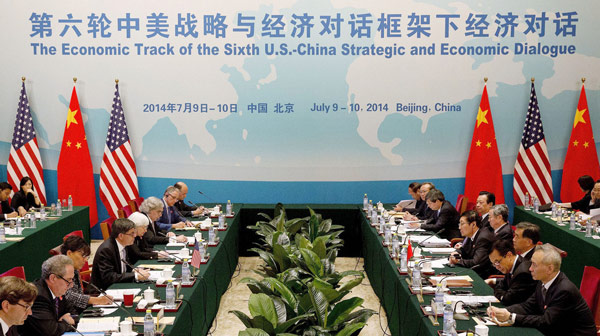 |
| US foreign policy and economic chiefs (Left) and their Chinese counterparts sit for the sixth annual Strategic and Economic Dialogue between the two countries at the Diaoyutai State Guest House in Beijing on July 9, 2014. [Photo/IC] |
The eighth China-US Strategic and Economic Dialogue in Beijing on June 6 to 7 will be a great opportunity to show not just the next US administration, but also the world, that the two largest economies are expanding cooperation and effectively managing their differences.
There have been too many headlines, too much attention and obsession on a few thorny issues such as the maritime territorial disputes in the South China Sea or on the issue of what the United States claims to be freedom of navigation. The action/reaction spiral that has emerged on these issues reflects a lack of effective management of the differences between the two countries, despite some positive confidence building measures on air and sea encounters.
At the S&ED, China and the US need to find away to improve their dynamic so there is a downward spiral of tensions and an upward spiral of cooperation.
It may be true that much of the US' posturing is just a show, a way for President Barack Obama to appease hawks like Senator John McCain or to show its allies in the region that the US is still a reliable security guarantor.
But the US military-industrial complex, whose influence former president Dwight Eisenhower warned of in 1961 in his farewell address, has been happy to see the upward spiral in tensions, as it has boosted US arms sales in the region.
If you go to US Congressional hearings, browse US newspaper headlines or attend seminars at think tanks in Washington, it seems that the South China Sea has become the largest issue between the two nations.
It should not be. Yet an unhealthy geopolitical mindset has prevented China-US relations from achieving their full potential, which if realized would benefit the two peoples and the world.
Robert Zoellick, the former World Bank president, noted in a May 23 talk in Washington that he sees common interests for China and the US in the Belt and Road Initiative, the Silk Road Economic Belt and the 21st Century Maritime Silk Road. In his view, the initiative, which will help bring stability in Central Asia, serves US interests.
Zoellick, along with people such as Larry Summers, a former top economic advisor for Obama, and Kurt Campbell, assistant secretary of state for East Asian and Pacific affairs from 2009 to 2013, has criticized the US response to the Asian Infrastructure Investment Bank.
The four European members of the G7, the United Kingdom, France, Germany and Italy, have all joined the AIIB, while the three Pacific nations, the US, Japan and Canada, have not.
It's a surprise to see the US has not changed much on this.
A Tuesday report by Michael Fuchs and Brian Harding from the Center for American Progress recommended that the US should prioritize cooperation with China. It advised the US not to rigidly defend the status quo, citing US knee-jerk opposition to Chinese-initiated regional projects such as the AIIB.
It should be a US priority to find ways to complement China's initiatives that have the potential to enhance regional prosperity and connectivity, such as its Belt and Road Initiative, the report said.
The Obama administration is desperately trying to get Congress to ratify the Trans-Pacific Partnership, a trade agreement for the Asia-Pacific that does not include China, as part of his presidential legacy.
If leaders of the two nations really mean it when they call the bilateral relations "the most consequential" and "the most important" in the world, they need to show more wisdom and courage. A positive and strong US-China relationship would be a major legacy for Obama.
The author is deputy editor of China Daily USA. chenweihua@chinadailyusa.com





