



China looks to shale to cut down on coal







Cheaper oil and gas planned for the future but extraction could be costly and challenging
As the world's biggest energy consumer, China has placed a high priority on its shale oil and gas program as it attempts to cut air pollution and reduce its dependency on imports.
In the United States, the global leader in oil and gas extraction from shale, the results have been spectacular. By 2020 it is estimated that, through shale oil and gas, the country will go from being an importer to energy exporter.
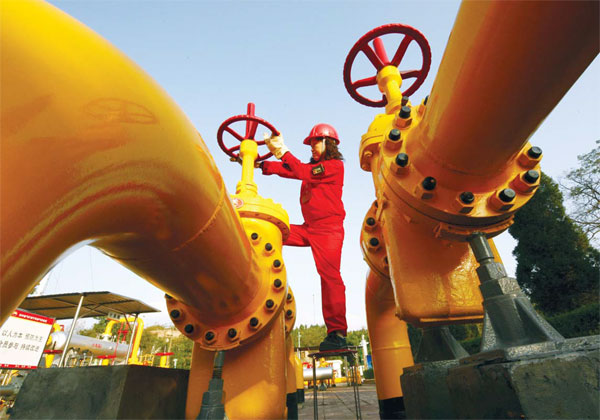
| A worker checks the valve of a gas pipe at a natural gas plant in Suining, in Southwest China's Sichuan province. As China's natural gas market is largely supply-constrained, the nation is pushing strongly to develop its shale gas resources. CFP |
Scott Nyquist, a director of global consultants McKinsey & Co, said oil and gas from shale is "an exciting game changer for the US economy".
Apart from its impact on the economy and job creation, it will also help secure the country's energy supply, he said in a discussion paper. "It will give people more confidence that they can operate without fear of being insecure when it comes to the country's overall energy needs."
China, already the world's largest crude oil importer and consumer of half the world's coal supply, hopes it can replicate the shale revolution that changed the energy landscape in the US.
Investment banking firm Goldman Sachs says the US production of shale gas has increased dramatically since 2006, with production increases among the biggest "ever seen globally". Natural gas in the US now sells for a fifth of the price it carries in Asia.
The benefits have generally been felt by consumers, including significant parts of the industrial sector, as gas is a major driver of US power generation, according to Goldman Sachs.
Olivia Boyd, an energy analyst with consultancy IHS, says shale gas "will be a major determinant of the depth of China's ability to shift its energy mix further away from coal, and substitute some of that coal demand with cleaner-burning natural gas".
The US Energy Information Administration says shale gas in the country has risen from less than 1 percent of domestic production in 2000 to over 20 percent in 2010. It also estimates that shale gas will account for 46 percent of all US gas supply by 2035.
Beijing aims to produce 6.5 billion cubic meters of shale gas by 2015, and between 60 billion and 100 billion cubic meters by 2020.
"At present natural gas is a niche fuel in China, supplying only about 5 to 6 percent of total energy demand, which is well below the global average of 22 percent," says Boyd.
She explains that China's gas market is largely supply-constrained, which means the country has significant pent-up demand to meet new gas supply.
"The government has demonstrated that it is willing to trade the lower cost of coal for higher-priced gas to a certain degree," she says.
"This is particularly evident in air pollution control policies that have targeted the Beijing-Tianjin-Hebei area, the Yangtze River Delta and the Pearl River Delta, where policies that mandate either an absolute reduction in coal demand or flat coal growth are in place.
However, Boyd explains, Chinese energy users are still very price-sensitive. This means that over the longer term, the degree to which China is able to secure large volumes of lower-cost gas will affect the degree to which gas displaces coal consumption in China's overall energy mix.
"That is why shale gas is very important," she says. "The US experience suggests that shale gas holds the potential to unlock a large supply of relatively low-cost gas, and this will determine how aggressively China moves away from its reliance on coal."
So far only two companies have made progress in exploiting the country's shale oil and gas - PetroChina and China Petroleum & Chemical Corporation, also known as Sinopec, the nation's top two energy producers.
PetroChina, China's biggest energy producer, hopes to produce 2.6 billion cubic meters of gas by 2015, according to Chinese media reports.
A recent report by the Xinhua news agency quoted PetroChina's vice-president Sun Longde as saying the company was targeting to produce 11 billion cubic meters of shale gas by 2020.
Sinopec, the biggest Asian refiner, aims to produce 5 billion cubic meters of gas by 2015 from its Fuling shale gas project in the country's southwest region.
China's annual shale gas production surged more than fivefold in 2013 to 200 million cubic meters, according to the Ministry of Land and Resources. The country consumed 169 billion cubic meters of gas in 2013, with about one-third coming from imports.
China holds 25.08 trillion cubic meters of exploitable onshore shalegas reserves, the Land and Resources Ministry said in March 2012. The US has 13.65 trillion cubic meters, according to the EIA.
By some estimates, China boasts the world's largest shale resources, nearly double that of the US, according to the EIA.
China's cabinet released a detailed plan in September 2013 that aimed to rebalance the country's energy mix so that coal, responsible for heavy pollution, could account for less than 65 percent of the overall energy supply by 2017.
China's spending on shale gas is, in some cases, four times as much as what the US spends to develop its fields, according to a study by Bloomberg New Energy Finance.
"There is a great deal of uncertainty surrounding China's future shale gas production levels, which makes predicting how significant shale gas will be in terms of overall gas production very challenging," says Boyd at IHS.
She explains that shale gas geologies in China are deeper and more complex than the shallow basins in the US.
"Chinese oil and gas companies face a major challenge in adopting drilling technologies in order to lower the cost of drilling wells (which stands at between 70 and 100 million yuan, or $11.3 million to $16.2 million) and cutting well drilling times."
Boyd says that Sinopec's shale gas block in Fuling, has demonstrated promising levels of production, "but the real test will be whether technologies developed at Fuling can be applied on a wider basis in China to bring down shale gas costs and drilling times elsewhere".
Moreover, in China, attracting the sort of independent oil and gas companies that drove the US shale gas revolution presents challenges, Boyd says.
"Unlike conventional oil and gas, shale gas in China is open to non-NOC (national oil company) oil and gas companies," she says.
"However, two of China's three national oil companies (Sinopec and PetroChina) control most of the most promising acreage, and the regulatory environment makes it difficult for independents to access gas pipeline infrastructure, unless they first sell their gas to the pipeline operator (which is in most cases PetroChina).
"The price-setting power that the pipeline operator has in the Chinese gas market means that unconventional onshore gas is often not an attractive investment for private companies."
China is pushing strongly to develop its shale gas resources, but achieving anything like the scale of the US is many years away, analysts say.
"The interim target of 6.5 billion cubic meters production by 2015 may be achieved, but the 2020 target of 60-100 billion cubic meters is unlikely with current progress," Boyd says.
"Beyond that, the potential is there for production to far exceed these targets, but getting there will be dependent on addressing these technological, cost-related and regulatory challenges.
"In short, shale gas could be a transformative new energy source for China, but given low levels of drilling activity thus far, the cost and production outlook is extremely uncertain."
For China Daily
(China Daily European Weekly 09/12/2014 page23)


Today's Top News
- Xi urges basic research push for original innovations
- Building of rare earth hub highlighted
- Seedance 2.0 signals big shift in AI sector
- United front work urged to pool strength
- Beijing refutes US nuclear test accusations
- Xi sends festive greetings to all service personnel







