60 People, 60 Stories
Class act
By Lin Shujuan (China Daily)
Updated: 2009-09-30 10:41

Primary school teacher Wang Zhoubin received a compliment from his 8-year-old pupil recently.
| ||||

While he was happy to hear that, Wang was baffled at first. His English lessons in Hongbai, a town in Shifang county of Sichuan province that was hit by the May 12 quake last year, consisted mostly of tape recordings played for his pupils because he himself confessed to be almost ignorant about the foreign language.
So the 32-year-old teacher asked the pupil what made his classes so attractive.

"It's because I can always fall asleep so easily," the pupil says.
Wang and his pupils are just some of the millions of Chinese people being caught up in a nationwide fever to learn the English language.
Wang had been teaching mathematics after graduating from vocational school in 1994. But he started to teach English three years ago, as English was made compulsory from grade three in 2001.
Wang says the last time he read English was 18 years ago, after he spent three years trying to remember a set of vocabularies and grammar so that he could score well enough to be admitted to a vocational school for teachers.
All that English has been long forgotten, Wang says. "I didn't even use it once over the past 18 years," until three years ago.
The ongoing "English fever", as the phenomenon to learn the language is known in Chinese, started to sweep into the country's most cities and hit every student above the high-school level about two decades ago.
But the enthusiasm to study English began much earlier, in 1972, after US President Richard Nixon's historic visit to China.
A few months after Nixon's visit, the local Beijing Broadcast Station started preparation to air an English teaching program.
On July 18, 1972, Premier Zhou Enlai sent a message to the station, predicting that the program would have a "great impact" in public. He instructed that the host send the lessons to such experts as Tang Wensheng - Chairman Mao Zedong's interpreter - for approval.
The rudimentary English many urban youngsters learned via radio prepared them to enter colleges in early 1978 as the first batch of language students after the "cultural revolution" (1966-1976).
Today, the wave to learn English is being felt in remote villages such as Hongbai.
With more Chinese people going abroad for work or study and more foreigners coming to the country for business, English proficiency is now an individual's hallmark for success.
Every college student must also meet a certain level of English comprehension to earn his degree.
To many, a working knowledge of English is a passport to college graduation, the key to an overseas education and a decent job in a foreign enterprise.
China's entry to the World Trade Organization in 2001 and its preparation for the Beijing Olympics last year also helped boost English-language learning.
Linguists estimate the number of Chinese now studying or speaking English at more than 350 million - or about the entire population of native English speakers worldwide. Private schools, study aids and high-priced tutors vie for a piece of this enormous market. The country's largest English-language learning network, New Oriental, is traded on the New York Stock Exchange.
Still, those like Wang continue to question the necessity of learning English. "Is it really necessary for everyone in the country to learn it?" he asks.
In recent years, the same question has been raised and debated online and in the mass media.
For now, the good news for skeptics like Wang is that the new English course focuses on developing the students' ability to use English in their daily life.
Wang says that he has also been learning English along with their students over the past two years. "Like it or not, I'm also part of this 'fever'," he says.
Time line
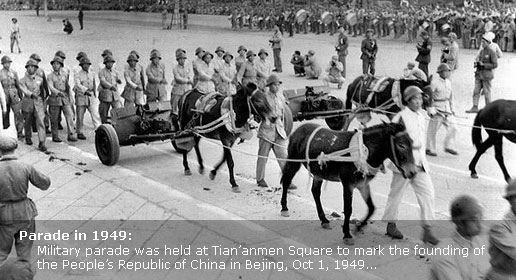
1949
As the Soviet Union is the first country to recognize the People's Republic and starts to enroll Chinese students into its universities, Russian becomes the most popular foreign language.
1951-1956
The Ministry of Education publishes draft on national standards and guidelines for English teaching in middle schools.
1959
The Ministry of Education stipulates that one third of middle schools should offer Russian language courses while the rest can open courses on English and other foreign languages.
1966-76
Normal classes are distrupted in the first few years of the "cultural revolution". When schools reopen, English classes resume in middle schools and colleges but with a focus on political vocabulary.
1978
"English Language Learning", China's first magazine dedicated to English learning (set up in 1958), resumes publication.
1984
English is included as a major subject in the country's college entrance examination.
1990-2000
Various international English-language training institutes, such as English First, appear in China.
2002
Beijing launches a "Speak English Program" in preparation for its hosting of the 2008 Olympics.
2003
Shanghai launched a citywide English training program in preparation for the 2010 Expo in Shanghai.