Cultural life
A less than happy feeling
By Raymond Zhou (China Daily)
Updated: 2009-09-11 08:12
|
|
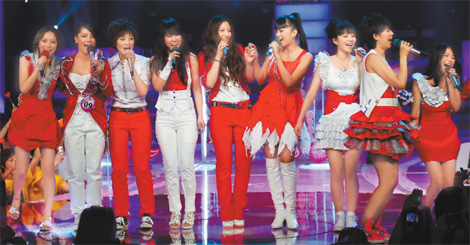
If you want to read tea leaves about China, the just concluded Happy Girls talent show offered a basketful of foliage.
The Hunan Satellite Television program was unsurprisingly a ratings champion, beating even most primetime shows while occupying an unenviable 10:30 pm to 1 am slot. With other regulator-imposed constraints, such as no mobile phone voting, the show still managed to stand out when almost all other televised singing contests have fallen by the wayside.
Formerly Supergirl, the show started in 2004 and went nationwide the next year, turning into a business dynamo and a cultural phenomenon. However, it was accused of being a copycat as it was obviously patterned after American Idol. But Wei Wenbin, the big boss of the local office of the State Administration of Radio, Film and Television (SARFT), the government agency overseeing the industry, was unapologetic when I interviewed him two years ago.
"Everyone has access to foreign programming and everyone is attempting to imitate the best. The trick is in localization."
And he was right. The Hunan programmers got the inspiration from American Idol, but they did not stop at imitation. Instead they went several steps further. For example, they started charging for voting by text messaging, thus creating an alternative source of revenue. They lengthened each broadcast to as much as four hours, maximizing advertiser exposure. They organized fan club activities that were strikingly similar to political campaigns in Western countries. They secluded the finalists and created the facade of friendly competition. They forced them to sign long-term record or performance contracts before allowing them to edge ahead in the final rounds. (Some of these practices were banned for this season.)
In other words, it was full of "Chinese characteristics". Had they borrowed (or bought) the US format wholesale, they could not have won over so many viewers.
So, lesson No 1: Learn from the best, but always customize for your own market.
The final episode for this season zeroed in on three contestants and it was no coincidence that this trio represented the dynamics in China's culture and entertainment scene. Huang Ying, a folk singer hailing from a mountainous village and with a background as a migrant worker, almost specializes in "revolutionary" songs, yet with a personal twist that broadened her appeal beyond that for school-trained songbirds. Li Xiaoyun, with her androgynous look and low-lying vocal range, was popular with the teenage crowd. Jiang Yingrong was the most professional of the three, with slick dance moves and an eclectic mix of vocal styles.
As I see it, Chinese culture and entertainment, including music, fall into three broad categories: One is government encouraged, with emphasis on good morals and altruistic values. Its aesthetics are best espoused by the programming of CCTV, the national network. Some call it propaganda, but the Chinese term is zhu xuanlu, literally "main melody". It's not static or coarse. Rather, it has a certain slickness and sleekness.
The second category is for the masses, especially the young. Their taste, as I'll elaborate later, is quite unique. And the third group of cultural consumers is the so-called elitists, those educated and knowledgeable about many genres and styles. The final three of Happy Girls happened to form a neat triumvirate of political and cultural gestalt, corresponding respectively to the inclinations of the high brow, the low brow and the "red brow".
An executive in a Hunan state-owned cultural conglomerate once told me the secret of his approach: "You cannot be cross with the authorities or you wouldn't get the green light; and you cannot be cross with the public or you wouldn't have the market. You have to find the overlapping ground." Those at Hunan TV have been pulling off something even more demanding: maximizing the audience while not offending either official or elitist sensibilities. By and large, they have accomplished what many did not even notice on their radar.
Lesson No 2: Carve a niche out of the most slippery slope where the forces of market, voice and control meet.
If left on their own, the show's creators and directors would most likely have run with their target audience, i.e. those who watch and pay, and ignored complaints from regulators and commentators.
So, who were the teenagers' choices? For 2005, it was Li Yuchun; for 2006, Shang Wenjie; and this year, it would have been either Li Xiaoyun or Zeng Yike. Their common traits include androgyny and weakness in singing. Although what constitutes good singing is to a certain degree subjective, to anyone with an iota of vocal exposure, these ladies were by far not the strongest among the finalists.
Zeng, who finished eighth, simply could not carry a tune. She sounded like a bleating sheep being dragged to a slaughterhouse. Li, the runner-up, is a much better singer but didn't hold a candle to several of the other finalists. It was their look that got them the mass adoration. As my niece, a big fan of Zeng's, justified, "she is just like me".
It dawned on me that teenage girls, the core audience of the show, were not looking for a singer who stimulates and inspires, but one who unburdens and appeases in terms of talent - in other words, someone they identify with rather than someone they aspire to.

The other fascination is with gender ambiguity. The contestants with feminine qualities (and good voices) were often represented in the final 10, but it was the "butchy" ones who got substantial support from those who actually voted or rallied. I'm not suggesting most teenage girls harbor lesbian fantasies, but if you sit down and talk to them you'll find they tend to have a transsexual or unisexual beau ideal. Is it a phase associated with adolescence or a trait of female psychology? I'm not sure, but it's definitely not a singular case.
So, Lesson No 3: Cater to the secret cravings of your core audience.
To be fair, these contestants were poor singers not because of their appearance. The two have no correlation. But for those looking for a scintilla of democracy, as was the raison d'etre for the media frenzy in 2005, the sign is not good. It hints that a relatively open and participatory process consistently fails to select the best contender. If you count the behind-the-scenes manipulation, the prospect is even more gloomy.
From the very beginning, there were rumors that the show - or shall we call it a mock election? - was rigged. A certain online source was able to predict, correctly, the result of the coming episode week after week. On top of that, the show fed the press a constant stream of gossip about some of the girls, which worked brilliantly to shape their public personas. The voting process, before it was prohibited, strongly favored those with financial backing and there were reports of block votes only possible with the infusion of large sums of money.
Lesson No 4: All participants are equal, but some more equal than others.
It is true that a complete unknown with enormous talent has a better chance at Supergirl or the reincarnated Happy Girls. But that doesn't mean this is a fair and transparent platform. It only means it may be a better one than traditional channels.
Part of its strength lies in the fact it is more attuned to public sentiments. But if the result is an accurate reflection of the public at large, it does not portend well for the political system of participatory decision-making. It shows as much about what can go wrong as what may go right. Still, as a sociological experiment, this reality show is the closest approximation to reality as we know it. So, don't rule it out yet.
(China Daily 09/11/2009 page18)