 |
|
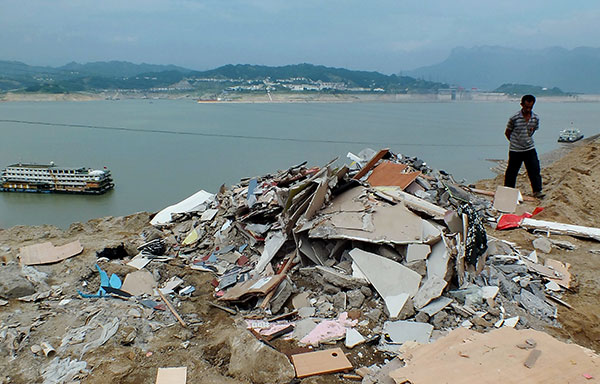
Construction debris illegally dumped on the bank of the Three Gorges Reservoir in Zigui, Hubei province. Local farmers said the waste was secretly brought by trucks. LING ZHI/CHINA DAILY |
In 2012, Shenzhen became the first city in China to impose regulations on the disposal of construction waste, according to Chen. However, the regulation, drafted by the Municipal Bureau of Urban Management, was only valid for three years, and ceased to be effective in February. The city has yet to propose new regulations on the management of dumping sites.
Even though Shenzhen is considered to be ahead of most cities in its handling of waste from building sites, "the fact that the regulation was not renewed indicates that the issue of construction waste is still not being given due attention", Chen said.
The Shenzhen Urban Management Department said that as of May, the city had five dumping facilities for construction waste, with a combined capacity of about 45 million cubic meters. There are also three separate waste-recycling facilities, which can deal with 3 million tons of material every year.
Waste dumping has become a pressing concern in Shenzhen. In 1980, the then-sleepy fishing village became the site of China's first special economic zone. In the past 30 years, Shenzhen has been transformed into a major industrial center, but extensive construction projects have left the city desperately short of land.
Statistics from the Shenzhen Environmental Health Department show that the city produces approximately 30 million cu m of construction waste every year, but Chen estimated that only about 50 percent of the waste is recycled, while almost all the subsoil is dumped.
The city is planning to construct 11 new subway lines within the next 15 years, but the project manager of a subway line under construction said illegal dumping is a major problem.
"Subway constructors usually pay transportation companies to transfer waste subsoil to designated dumping sites. It usually costs about 400 yuan ($60) to transfer each truckload of waste soil," he said, speaking on condition of anonymity. "The transportation company can also resell the waste soil and earn a bigger profit," he said, adding that some constructors choose to dump waste illegally because it is cheaper or the site is nearer.
Chen, from the Beijing University of Civil Engineering and Architecture, said the construction of a large number of skyscrapers in Shenzhen, along with exploration of underground space, including rail transit lines and underground infrastructure, has produced such a large amount of subsoil that local dumping sites are unable to process it.
"Skyscrapers use a vastly different architectural structure compared with buildings with only five or six floors. The soil is replaced during the construction of lower-level buildings, but the underground floors of skyscrapers usually go dozens of meters into the ground," he said.
A professor from the College of Civil Engineering at Shenzhen University, who preferred not to be named, said that in the past there were two primary methods of dealing with construction waste-using it for land reclamation at sea, or as a medium to level land.
However, ecological concerns have prompted tougher regulations on 'sea filling", while the volume of construction waste has swollen so much that the previous disposal methods are no longer adequate for the task, he added.
An engineering manager at Shenzhen Zhongwang Engineering Management, who declined to give his name, said the waste-disposal system needs to be overhauled. "Currently, the dumping of construction waste is in disorder. It's mainly driven by the profit motive. Governments have a responsibility to regulate when, where and how this waste is dumped," he said.


Copyright 1995 - . All rights reserved. The content (including but not limited to text, photo, multimedia information, etc) published in this site belongs to China Daily Information Co (CDIC). Without written authorization from CDIC, such content shall not be republished or used in any form. Note: Browsers with 1024*768 or higher resolution are suggested for this site.
License for publishing multimedia online 0108263 Registration Number: 130349