|
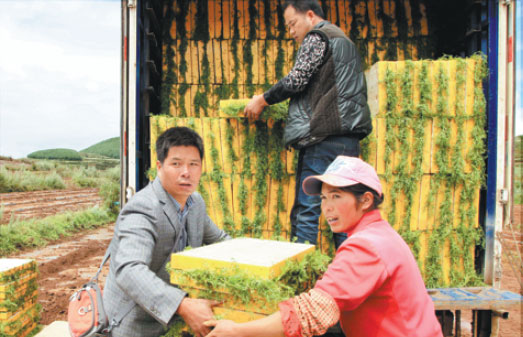
Farmers unload boxes of maca seedlings from a truck on farmland in Laoqing in August last year. Demand for the root has soared in recent years. Yan Keren / For China Daily |
Yang Shengchao, an associate professor at Yunnan Agriculture University in Kunming, capital of Sichuan province, said the best Maca is grown at an altitude of 2,800 to 3,500 meters and at temperatures of 5 to 10 C.
Since the root was introduced to China 15 years ago, Lijiang has become the country's largest Maca-cultivating base, thanks to its climate and altitude which resemble those in Peru, the global center of Maca production.
Statistics from Ma's office show that the root provides work for 100,000 residents, which has made a huge contribution to the alleviation of poverty. Planting 100 square meters of black Maca - the color represents the highest quality - can bring a farmer an average annual net income of 30,000 yuan, according to Ma.
In 2011, more than 90 percent of the company's fresh roots were bought from small producers - 986 family farms - and Dong Wanhong, manager of Yancheng Baisuifang's processing department, said the relationship encountered early difficulties.
"The concept of poverty alleviation via cooperation between farmers and companies seemed a good one, but problems quickly emerged. As a result of the soaring price, farmers who had signed a contract a year before the harvest season secretly stored black and larger roots to sell themselves and passed on inferior roots to us," he said. "In turn, if the price falls, they buy roots from other suppliers and mix them with their own in the hope of clearing their stocks."
As a result, Yancheng Baisuifang started running its own farms and now only 50 percent of its raw materials come from external sources. However, other problems undermining the industry are beyond the companies' control, such as pesticide residue and the overuse of chemicals on family farms to boost crop yields.
Quality concerns
The price of Maca not only depends on the root's color, but also its size. "The darker and bigger a root is, the higher its price will be," said Zhao Zhiwen, deputy director of Green Enhance, a large Maca retailer in Lijiang. The company has its own farms which produce 1,000 tons of fresh roots annually, all of which are processed into dry slices, power capsules and wine.
"At the moment, we aren't seeing colored roots on the market, but some farmers have treated the root with an agent that forces it to grow quickly and over a short period," said Zhao, who stressed that the plant's medicinal properties are degraded if chemical fertilizers are used to spur growth.
"That's why good quality roots command a higher price. If chemically fertilized roots entered the supply chain at a high price, the market would be roiled, which would be devastating for conscientious growers and retailers," he said.
For individual customers, buying genuine Maca root at a fair price depends on a good deal of luck. There are no official quality certificates, and size and color are no guarantee of quality. The task is even harder if the root has been processed into powders or pills.
"A quality specification is the key to regulating the business," Ma said. "As the government has limited power to intervene with individual sellers, what we can do is produce our own quality certificates to help farmers so they will regulate planting."
On Feb 10, the Lijiang Quality Control and Inspection Bureau released a technological specification on planting, and the city's first Maca Products' Quality Supervision and Testing Center began operations on June 26.
The city's Biological Resources Development and Innovation Office is drafting a guideline on planting and quality grading that will be released in the coming months, according to Ma. "The product will be graded into different levels, depending on the nutrients it contains, and the grading will be used as a reference for price," he said.
Some companies have established their own quality-control systems. Yancheng Baisuifang employs agriculture experts who pay regular visits to farms to offer advice on planting and supervise the land reserves through crop rotation and fallow years to ensure the soil regains essential minerals and elements.
In 2011, the value of the company's annual output hit 10 million yuan, and the figure doubled or tripled annually in the following four years. It is now running a lab with Huazhong University of Science and Technology to breed high-quality seeds and test nutritional composition.
"The market is now in 'survival-of-the-fittest mode'. It hurts, but really competitive companies that remain true to the ideal of producing high-quality roots will eventually become the market leaders," Yang said.


Copyright 1995 - . All rights reserved. The content (including but not limited to text, photo, multimedia information, etc) published in this site belongs to China Daily Information Co (CDIC). Without written authorization from CDIC, such content shall not be republished or used in any form. Note: Browsers with 1024*768 or higher resolution are suggested for this site.
License for publishing multimedia online 0108263 Registration Number: 130349