 |
|
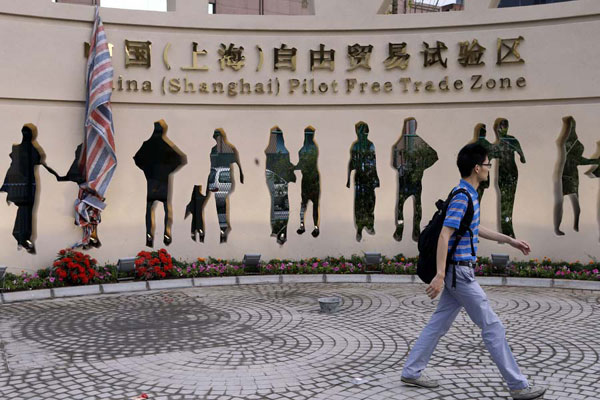
The name plate of the China (Shanghai) Pilot Free Trade Zone on a gate of the Waigaoqiao free trade zone in Shanghai. [Zhao Yun / For China Daily] |
The establishment of four pilot free trade zones, which have paved way for China to further open up in an innovative way, is one of the significant achievements made during the 12th Five-Year Plan (2011-15).
China set up its first FTZ in Shanghai in September 2013, and opened three new ones in the southeastern Guangdong and Fujian provinces and the northern Tianjin municipality in April this year, rolling out an emerging nationwide FTZ network in which each has a well-designed role to play.
The Shanghai FTZ is pioneering more convenient investment and trade in the country, while the Guangdong FTZ is designed to deepen cooperation, particularly in the service industry, with the Hong Kong and Macao special administrative regions. The Tianjin FTZ is looking to boost offshore finance and financial leasing business, as well as the China-Republic of Korea Free Trade Agreement, while the Fujian FTZ is focused on trade exchanges with Taiwan and the Association of Southeast Asian Nations.
The Shanghai FTZ has pioneered China's ongoing economic reforms and innovation, and developed a workable model based on reformed supervision and management and the aggregation of emerging industries in the past two years.
It has expedited the benign transformation of the customs supervision system, making its success "duplicable and promotable", and it is making progress to optimize the "single window system", based on the platform of an electronic port. This allows trade and transportation enterprises to efficiently submit their applications and receive results from the supervisory departments concerned. Such institutional innovation should be a boon to China's economic exchanges with other countries, because it will simplify the procedures of transnational trade, reduce the cost of doing business, and significantly improve the efficiency of customs supervision and country-to-country logistics.
To cut the investment red tape, the Shanghai FTZ has established a "negative list" for foreign investment and preferential trade and financial policies, and a registration system is applied to all foreign investments not on the list, offering them easier access to the country.
Also, the FTZ is undergoing ambitious financial reform on the premise that the latent risks are under control, in the hope of becoming a global center for capital and supply chains, as well as a base for China's overseas mergers and the backflow and transit of the Chinese currency. Steps have been taken to accelerate the internationalization of the renminbi, cross-border financing, and institutional reform in foreign exchange management, injecting fresh momentum into Shanghai's pursuit of a central role in the global financial network.
An increasing number of companies in emerging industries, such as digital finance, mobile video, smart devices, and e-commerce, are also setting up operations in the Shanghai FTZ. And there is an ongoing concentration of companies engaged in high-end manufacturing, the import and export trade, logistics, and financial services, has also empowered the FTZ to provide a host of business opportunities, products, information, capital and talent.
In fact, given the rapid integration between Internet companies and some emerging financial institutions, the FTZ is making efforts to facilitate Internet financing serving the real economy. It has issued favorable policies for the Internet industry, in order to encourage companies to provide better financial products and services. Leading e-commerce companies such as the Alibaba Group have also been invited to expand their business into the financial industry.
To acclimatize to the development of transnational e-commerce, the Shanghai FTZ has not only upgraded its fundamental system covering customs supervision, quarantine and cross-border payments, it has also launched pilot projects such as the settlement center for international trades. Hopefully, the success of the Shanghai FTZ will help the FTZ network take the lead in regional development based on the market and relevant laws.
The author is an associate researcher at the Chinese Academy of International Trade and Economic Cooperation in Beijing.

|
|
|
|
|
|
|
|

Copyright 1995 - . All rights reserved. The content (including but not limited to text, photo, multimedia information, etc) published in this site belongs to China Daily Information Co (CDIC). Without written authorization from CDIC, such content shall not be republished or used in any form. Note: Browsers with 1024*768 or higher resolution are suggested for this site.
License for publishing multimedia online 0108263 Registration Number: 130349 


















 Raymond Zhou
 Op Rana
 Berlin Fang
 Zhu Yuan
 Huang Xiangyang
 Chen Weihua