|
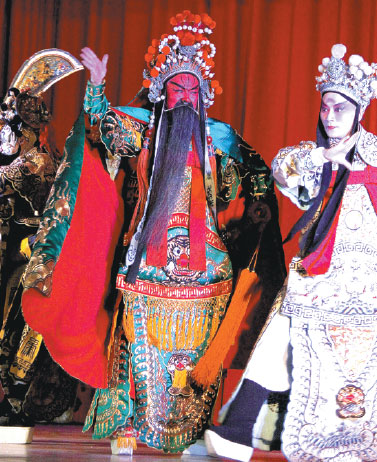
Anhui Opera artists perform for overseas Chinese in New York during a tour of the US in 2013. [Wang Chengyun / Xinhua] |
In 1982, Wang, then just 14, was one of 45 students admitted to the Anhui School of Art to study the provincial opera form. They were regarded as the second generation of Anhui Opera artists, following Zhang and his peers, but now fewer than 10 of them are still engaged in the art form.
Three years later, the provincial troupe recruited Wang, who was a student at the time, to play a number of roles in their programs. It was the start of her professional career.
In 1990, to mark the 200th anniversary of the original troupes' journey to Beijing, the central cultural authorities arranged for troupes from all the major Chinese operatic forms to perform in the capital. Wang was chosen to perform The Drunken Concubine, also a Peking Opera favorite, which was regarded as a great honor.
"In the mid-1990s, new cultures started to influence China with unprecedented speed," Wang said, referring to a period when she first began to sense that the general public was falling out of love with traditional Chinese opera. Her career stalled, mainly because there were so few opportunities to perform, and most chances came via gala events, which were few and far between. "To help Anhui Opera, new measures have to be taken to attract larger audiences, especially younger people. Young people don't hate the opera, they just don't get enough chances to appreciate it," she said.
However, other provinces have now taken the lead in protecting traditional opera forms. Despite its long history and the fame of its star performers, Anhui Opera has been relegated to the "graveyard shift" on local TV, which broadcasts a program at 8 am, when most people are either on their way to work or busy preparing for the day ahead.
The lack of media presence is compounded by a decline in the number of people who understand and appreciate the form, "not to mention those who love it", Zhang said.
The new generation
In 1997, Wang was accepted by the Central Academy of Drama in Beijing. She studied there for two years until she was recruited by a Swiss opera troupe, where she performed a wide range of roles in both Western and Anhui opera. Eventually though, she decided to return to Anhui.
In 2005, the Anhui Opera Troupe and the Peking Opera Troupe were reorganized into a new single entity called the Anhui Provincial Troupe of Anhui Opera and Peking Opera. The following year, the Anhui troupe recruited dozens of students for a five-year training program. They are the third generation of artists from the province.
"They spend half their time studying Peking Opera, and the other half doing Anhui Opera. I have to doubt the effect of such a training model," Wang said. "Although they share many similarities, Anhui Opera and Peking Opera are still two different genres, so I think the training courses will not be able to breed real talent.
"Nowadays, all the best Anhui Opera artists - and there aren't too many of them - are older than 40," Wang said, adding that talented young performers seem to be in short supply.
She was deeply concerned about the future. "Once my generation has retired from the stage, Anhui Opera may eventually die out. The first generation would be too old to teach courses, and the good times for us - the 'second generation' - may end soon. A lack of opportunity to practice may mean that the third generation, all of whom are still very young, may not progress," she said.
As a member of the Provincial Committee of the Political Consultative Conference, Wang has repeatedly called for greater protection for Anhui Opera. She has also submitted a number of proposals and suggested the establishment of a professional teaching team to raise the level of training.
"We should try hard to protect classic and traditional Anhui Opera programs and make full use of them, but whether the art form can survive the current difficulties depends on the measures taken," she said.
Ji Guoping, vice-chairman of the Chinese Dramatists Association, said adapting Western plays is an innovative way of reviving traditional operas, and called for a greater range of measures to be employed to ensure the survival of the Anhui form. "Adaptations are a perfect combination of tradition and innovation. They give us an effective way of reviving and promoting Chinese opera to a much wider audience," he said.
Contact the writers through zhulixin@chinadaily.com.cn
|
Wang Danhong during an Anhui Opera performance in 2011. [Zhang Jing / for China Daily] |


Copyright 1995 - . All rights reserved. The content (including but not limited to text, photo, multimedia information, etc) published in this site belongs to China Daily Information Co (CDIC). Without written authorization from CDIC, such content shall not be republished or used in any form. Note: Browsers with 1024*768 or higher resolution are suggested for this site.
License for publishing multimedia online 0108263 Registration Number: 130349