 |
|
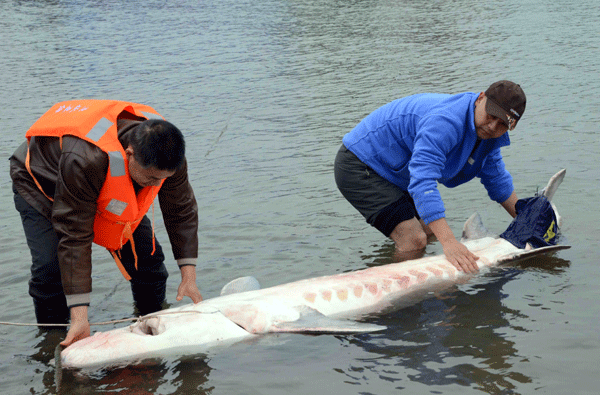
Experts attempt to rescue an injured wild Chinese sturgeon on the Yangtze River on Nov 25. Below: A 1.5meterlong wild Chinese sturgeon is pulled from the river in Nanchang, Jiangxi province, in May.CHENG LONGMEI / XINHUA AND LIU BAOPING / FOR CHINA DAILY |
Having spent more than three decades researching and protecting the wild Chinese sturgeon, Wei Qiwei can't stop worrying that this rare, ancient fish may become extinct in the coming decades.
In the past two years, researchers have discovered no evidence of natural reproductive activity in the Yangtze River for the first time since the species was first recorded in the 1980s, according to Wei, a researcher at the Chinese Academy of Fishery Sciences.
"If the wild fish cannot reproduce naturally, those currently alive will be the last of their kind," he said.
The academy's records show that before 2003, female sturgeons laid their eggs from late October to late November, but between 2003 and 2012, a number of factors resulted in the spawning season being delayed by a month, to later November and early December.
Although the researchers will continue to observe the fish, the chances of detecting sturgeon eggs in the section of the Yangtze River near Yichang, Hubei province - the site of the Three Gorges Dam - are slim.
"It's estimated that there are only about 100 sturgeons in the river now, compared with more than 2,000 in the early 1980s," Wei said.
Worsening environment
The Chinese sturgeon is one of the world's oldest living species, dating back to the days of the dinosaurs about 140 million years ago. But despite its long lineage, the fish may not survive much longer, according to Wei, who warned that its extinction may be one of the prices China pays for its rapid economic development, especially the surging dams and bridges built over the Yangtze River.
The optimum water temperature for the sturgeon to reproduce is between 15.3 C and 20.2 C, but as heated water stored in the Three Gorges Dam is released into the Yangtze River, the average temperature has risen and affected the reproductive cycle, according to Wei.
"The Three Gorges Dam and others built in the river system are affecting egg laying because the water discharged from them has absorbed heat during storage, and that's raised the water temperature downstream," he said.
Gao Yong, deputy director of the China Sturgeon Institute, said global warming has also contributed to the temperature change in the river.
The hydropower project, which started in 1993, includes a 185-meter-high dam, a five-tier ship lock, 26 hydro-powered turbo-generators, and six subterranean generators that were installed in 2012. The river's average water level was also raised, from 88 meters above sea level to 135 meters in 2003, and then to 175 m in 2010.
Wei said the dam-building projects have reduced the number of spawning sites: "Following the construction of the Gezhouba Dam in Yichang, only one spawning site is left for the sturgeons."
Ma Jun, director of the Institute of Public and Environmental Affairs, an NGO in Beijing, said in a previous interview that if the habitat continues to shrink, the aquatic ecosystem near the dam will be completely destroyed.
Jiang Wei, a researcher with the China Sturgeon Institute, said the destruction of the natural habitat and environmental degradation are making it hard for the sturgeons to survive.


Copyright 1995 - . All rights reserved. The content (including but not limited to text, photo, multimedia information, etc) published in this site belongs to China Daily Information Co (CDIC). Without written authorization from CDIC, such content shall not be republished or used in any form. Note: Browsers with 1024*768 or higher resolution are suggested for this site.
License for publishing multimedia online 0108263 Registration Number: 130349