 |
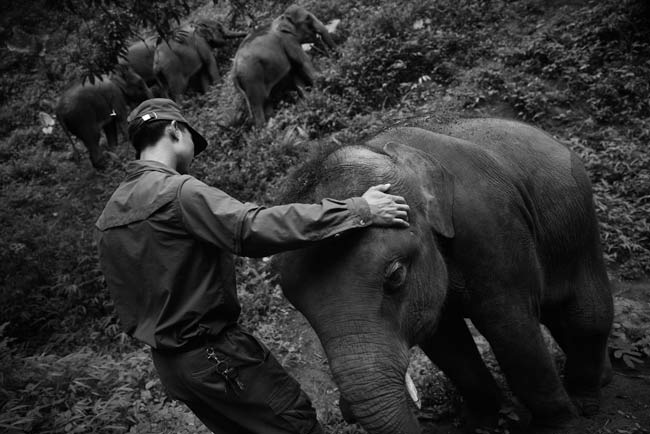
| A member of staff at an elephant breeding and research center helps an elephant calf return to the wild. WU HAO / FOR CHINA DAILY |
Elephants eat more than 160 types of plants, including corn, bananas, buckwheat, rice, sugarcane, bamboo, and plantains, but the lack of food in the wild has forced them to search for fodder in the local farms, where they can find sugar cane, pineapples and bananas by the hectare and gorge themselves, Zhang said.
He noted that the rise in the number of villages and farms has completely blocked the corridors that once connected different elephant reservations, making it difficult for the animals to migrate when they need to look for food during the dry season.
"Elephants in the wild have to go around all day long looking for food, but in the farms it is very easy for them to feast. They bring other members of their herd, and the family will stay around and harass the village for a long time," Zhang said.
Struggle for a solution
He Yong, Director of Communications and Campaigns with the International Fund for Animal Welfare, said: "You can't simply tell the villagers they should protect the elephants.
|
Ivory trade takes its toll The number of elephants without tusks is rising because of the ivory trade, according to wildlife experts, although a lack of samples means there are no exact figures. Unlike African elephants, only about 50 percent of male Asian elephants have tusks, while the same percentage of females have short tusks called tushes, which don't contain pulp. Xiong Chaoyong, manager of the Asian Elephant Breeding Center, located near the Wild Elephant valley in Xishuangbanna, Yunnan province, said that as the number of tusked elephants killed rises, tuskless elephants are becoming dominant and passing on their genes to new generations. Xiong has worked at the center, which aids sick and injured elephants and attempts to reintroduce them to the wild, for more than 14 years. During that time, he and his colleagues have rescued 11 injured or sick elephants and bred three calves. Every day, the staff sends the elephants to the mountains in search of food, but they also provide 20 kg of carrots, 20 kg of bananas, 10 kg of corn, and 160 kilos of grass as daily dietary supplements for the animals. |
"The peasants rely on the crops for their annual incomes. The elephants come and eat (the crops) and trample their fields, leaving nothing for the farmers to harvest. With the villagers' survival at stake, it's simply too much to ask for them to protect the elephants," he said.
In an attempt to resolve the problem, the local government has provided microloans to help the farmers diversify the types of crops they grow, urging them to plant crops the elephants won't eat, such as coffee, tea and nuts, so they will have a fallback option if their traditional crops are trampled.
"It works. At the very least, it reduces the local resentment toward the elephants," He said.
The fund has recently wound up three five-year elephant conservation projects. From 1999 and 2003, the organization started providing micro-financing in Pu'er to help the locals build an alternative economy, thus alleviating agricultural dependency in elephant habitats and reducing the impact of the damage the animals inflict on local communities.
From 2003 to 2008, the project was extended to the Xishuangbanna area, but the final phrase (2008-2013) was halted because banks and local rural cooperatives are now offering similar services and more money. The original microfinancing project was not index-linked to inflation, so the amounts on offer dwindled as the value of the money was eroded by rising prices. The fund will now explore other solutions, according to Cao Dafan, an officer with the fund's Asian Elephant Program.
The fund has also developed the Village Monitoring and Precautionary System in selected villages to help locals better protect themselves and their crops and, in turn, mitigate the conflict between humans and elephants.
In addition, the fund has cooperated with local governments and research institutes to conduct scientific research that helped the local nature reserve complete Geographic Information System mapping and design an elephant corridor to enable their habitat to be enlarged in Xishuangbanna, according to He.
Education programs have been put into place by the fund, too. The programs target communities, schools and tourists to help people gain a better understanding of the elephants and the rich biodiversity of the region.
However, this approach is not enough, said experts. Professor Zhang urged the local government to compensate the villagers for their losses.
However, the government says it lacks funds. Yin Ling, deputy head of Jiangcheng county, said the law on wildlife conservation says the local government should provide compensation for damage caused by wild animals, but the local authority's precarious finances mean the compensation plan has failed to satisfy the villagers.
In 2011, the county government paid out 692,000 yuan to the villagers. In 2012 it bought insurance, but the cover was inadequate, and although the total loss was 3.81 million yuan, the insurance company only provided compensation of 1.51 million yuan.
Although the government announced on its website that the level of compensation is expected to be higher this year, by the end of July that hadn't happened.
According to Yin, the compensation paid for damaged maize is 2.5 yuan per kilogram, and for sugarcane fields, it's 700 yuan per mu, or 10,500 yuan per hectare. "The level of compensation is less than half the market price," he said.
Locals such as Cai, whose farms were not allocated by the village, receive no compensation for their damaged crops. Cai was compensated for the loss of his wife, though, and received 70,000 yuan.
"I believe that protecting elephants and improving people's livelihoods are two completely different things," Yin said. "To solve the problem, we really need more help, financially and intellectually, from society as a whole."
|
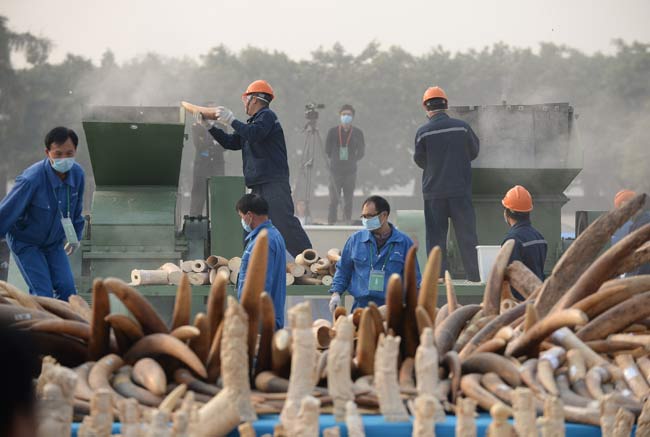 |
| The number of tusked elephants killed is rising because of the ivory trade. XINHUA |


Copyright 1995 - . All rights reserved. The content (including but not limited to text, photo, multimedia information, etc) published in this site belongs to China Daily Information Co (CDIC). Without written authorization from CDIC, such content shall not be republished or used in any form. Note: Browsers with 1024*768 or higher resolution are suggested for this site.
License for publishing multimedia online 0108263 Registration Number: 130349