|
| A farmer walks in front of the Danjiangkou Dam on Aug 7. The dam was raised in 2005 to store more water for the South-to-North Water Diversion Project HOU LIQIANG / CHINA DAILY |
Rising water levels in dam force residents in affected area to leave the comfort of their homes, report Hou Liqiang and Liu Kun in Danjiangkou, Hubei province.
|
Original project displaced 70,000
In 1966, more than 70,000 people moved out of Danjiangkou, which was called Junxian county then. Local resident Zhu Jiaqiu said that they had to make way for the construction of the Danjiangkou Reservoir. The reservoir would also help irrigate the area they were moving to. But this year, Zhu and other migrants in his village are experiencing a rare drought and they are expecting a poor harvest. Diversion canals for water from the reservoir were built after the major project was completed. But the operation of the canals had stopped in 1995, Zhu said. Zhu was 7 when they migrated from the reservoir area to Xizhou village of Huopai township in Xiangyang. "Our belongings were transported to Xiangyang by trucks before the villagers left for the relocation sites. All the villagers were unwilling to leave and many of them burst into tears. Some even cried all the way there," Zhu said. "Villagers reluctantly agreed to migrate only after the officials came to mobilize them several times. The villagers had no choice as the village would be submerged," he said. "Our village was near a river and the farmland there was fertile, but the relocation site was wasteland." Officials who came to mobilize the villagers said the migration was significant as the reservoir would offer irrigation water for farmland in Xiangyang and improve the condition of poverty-stricken areas there, Zhu said. The condition of the relocation sites did improve significantly after they moved, Zhu said. "Diversion canals were built after the impoundment of the reservoir to divert water from the reservoir to Xiangyang. The output of farmland increased greatly." Another villager, Zhang Hongcai, said they could harvest only a few dozen kilograms of grain from every mu (0.07 hectare) of farmland in the first several years after migrating. That changed with better conditions because of the canals. "We could harvest more than 750 kg of rice from each mu of farmland then as there was always enough water whether there was a drought or not," said the 65-year-old. But in 1995, the residents said they stopped receiving water from the reservoir. Zhang Bingshen, head of department of housing and urban-rural development of Shiyan, said the diversion canals built in the 1960s in Xiangyang are still in operation. Zhu said the authorities reinforced the diversion canals four years ago but they were never used again. A rare drought hit Xiangyang this year. As of last month, more than 147,600 hectares of farmland had been affected and 258,000 people lacked water. |
Less than a decade ago, Chen Lin spent about six hours a day tending to her vegetable garden.

She easily made about 3,000 yuan ($488) a month from the 0.3-hectare plot. She spent the rest of her time looking after her husband's parents, in their 80s, and her son, who was in high school.
But for the past few years, Chen has had to clock in more than 11 hours a day for significantly less wages. She has worked on construction sites, served in restaurants and labored in a food factory.
The changes for the 45-year-old occurred after the water level of the Danjiangkou Reservoir near her village, Caiwan, was raised to increase water supplies as part of a national water diversion project.
Chen is one of the 2,572 people from 642 families that had to move out of the dam area in 2005. Many have since found it difficult to adjust to their new homes and find suitable work.
The dam occupied Chen's vegetable plot and cut off the main source of income for her family of four. Her husband had to stop work earlier because of a waist injury.
"After we were relocated nearby, each member of the village was given only about 0.014 hectare of farmland. The land was newly reclaimed on the mountains and barren," she said.
Chen had to leave the area to look for jobs. In the past nine years, she has worked in Beijing, Zhejiang province, and Shiyan and Xiantao in Hubei province.
"I miss the days when I sold my own vegetables. I had more time to myself and I spent more of it with my family," she said.
"My son is still in college. We need at least 20,000 yuan a year for his school fees."
Losing ground
As the water level of the reservoir rises, more farmland is being submerged. That leaves thousands of farmers like Chen in a similar situation.
In 2010, a total of 182,000 people from 43,000 families had to leave the area. These included 155,600 people from rural areas. While 77,000 of those affected by the dam moved out of the area, 105,000 of them moved to higher ground near their original homes.
According to the government of Shiyan, to which Danjiangkou is subordinate, the water submerged farms and orchards covering 8,333.3 hectares, reducing the average farmland of the people in the reservoir area from about 0.07 hectare per capita to about 0.05 hectare.
The water also submerged more than 143 square kilometers in Nanyang, Henan province, forcing 162,000 people to move. The total area which the reservoir covers will reach about 1,000 square kilometers after its water level hits 170 meters.
To ensure the water quality of the Danjiangkou Reservoir, which is a source of the central route of the South-to-North Water Diversion Project, the city authorities shut many factories in the area. It is also clearing fish farms in the reservoir, which is expected to put thousands of people out of work.
Under the water diversion project, one of the country's largest infrastructure plans, the water from the reservoir is scheduled to be diverted to the drier parts of the country in the north, including Beijing, on Nov 1.
The project, when put into operation, will supply 44.8 billion cubic meters of water a year to the north.
Zhang Weiguo, mayor of Shiyan, said authorities began to clear fish farms in the reservoir in May and the work will be completed before Saturday. Zhang said there are 35,000 fishermen in the city, but he did not say how many of them work on fish farms.
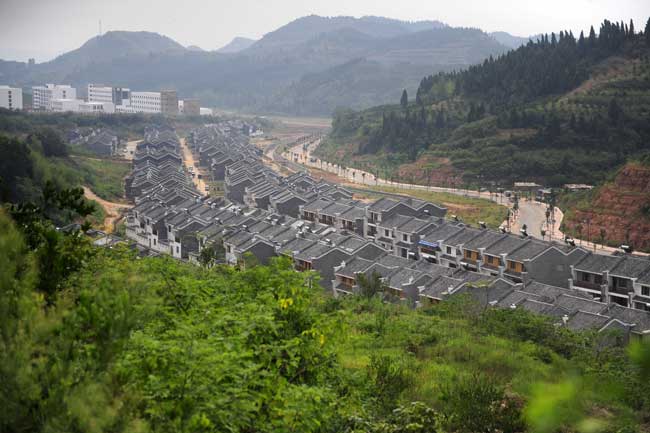 |
| A glimpse of a township in Danjiangkou, Hubei province in January that houses residents relocated by the South-to-North Water Diversion Project. HAO TONGQIAN / XINHUA |


Copyright 1995 - . All rights reserved. The content (including but not limited to text, photo, multimedia information, etc) published in this site belongs to China Daily Information Co (CDIC). Without written authorization from CDIC, such content shall not be republished or used in any form. Note: Browsers with 1024*768 or higher resolution are suggested for this site.
License for publishing multimedia online 0108263 Registration Number: 130349