 |
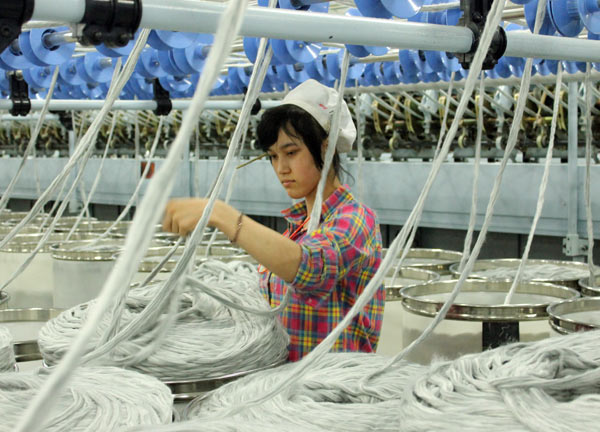
| A woman works at the factory of Huafu Top Dyed Melange Yarn Co in Aksu in southern Xinjiang. More than 95 percent of the workers on the production lines are from the Uygur ethnic group and most are recruited locally. GAO BO / CHINA DAILY |
Wasted effort
Wu said new workers are always being brought in because the factory loses 3 to 5 percent of its workforce every month. "More than 10 percent quit when the busy farming season begins. Many of them never return, which means the effort we put in to train them is wasted."
The plant mainly produces yarn, which is dyed a deep gray and then used in garments made by well-known brands such as H&M and Gap. "It's very likely that our Uygur workers have contributed to your gray clothing," he said, eyeing my T-shirt. According to Wu, the factory will eventually be expanded threefold, thereby creating more vacancies for locals.
Anargul Abudulkerem has decided to build a career in the factory. The 24-year-old from Wushi, who has been working for Huafu for three years, has also been promoted to line manager. Her family earns an annual income of about 8,000 yuan from growing and selling apricots.
"I want to learn more and become a senior manager one day," Anargul said. "I am here with six other girls from my village, and our families have been very supportive."
Having saved 20,000 yuan, Anargul has enrolled for lessons at a driving school in the city. "I go to the school in the morning when I'm working the night shift. More skills may lead to more opportunities."
After walking past basketball courts and a beach volleyball field filled with sand from the Taklamakan Desert, Pam finally got to see the dormitories, each of which contains two double-decker beds and a small bathroom. "The living conditions we provide for our workers are much better than those at any other factory," Tajigul told Pam, who looked very pleased.
Tajigul concluded the introductory tour by explaining the daily bus schedules, and then told the new workers to take a few days to get used to the tempo and routine of the factory before starting their training courses.
'Purchase and storage'
In the factory's loading area, workers were unloading a new batch of cotton. The packaging showed that some of the cotton came from Hotan, a prefecture in the south of Xinjiang, while some had been imported from India.
In 2011, the central government introduced a "purchase and storage" policy for cotton to ensure that farmers got a fair price for their goods and weren't affected by market fluctuations in the wake of the global financial crisis. About 90 percent of domestic cotton is now purchased and stored by the State, a move that has resulted in price stability, according to the China Cotton Association.
"Cotton from India is much cheaper than that held in the State reserves. We are awarded one ton of imported cotton for every three tons of Xinjiang cotton we purchase from the reserves," said Bai Pu, manager of Xinjiang Jinyu Textile Co in Alar city near Aksu. "Unlike textile companies based outside Xinjiang, we don't need to worry about the cost of transporting the cotton."
When the factory first began producing yarn in 2001, it employed dozens of Uygur workers. However, Bai discovered that the workers' poor level of education meant it took them a long time to master the skills required to operate the sophisticated machinery. Now he mainly employs people from Hunan province in central China.
"We hope the government will organize pre-work training programs tailored to the needs of the textile industry. That way, the locals will gain a better understanding of how a factory works before they arrive here," Bai said.
Policy changes
In April, the National Development and Reform Commission decided that it would abolish price controls on Xinjiang cotton from 2014 and set a reference price of 19,800 yuan per metric ton. Farmers will be able to sell their cotton at the market price, but will receive a government subsidy if it falls below the reference price.
"The new policy is definitely good news for textile factories in Xinjiang because we will be able to buy direct from the farmer and gain greater control over the quality of the cotton. The new trial policy is aimed at encouraging more people to set up textile factories in Xinjiang," Bai said.
Although Alar is a major production area, Bai prefers to buy cotton from Altay prefecture in the north of Xinjiang because the quality is superior. She said that when the new pricing system comes into operation, the farmers in Alar will have to understand the importance of improving the quality of their produce because factories may reject inferior quality goods.
Although the policy change may result in a drop in the price of cotton in Xinjiang when the crops are harvested later in the year, businesses still need to take factors other than cost into consideration before investing in the region, she added.
"Xinjiang doesn't have any upstream facilities for the industry, so manufacturers will still need to ship the yarn to southern China to be processed into fabrics. Also, the recent terrorist attacks have added extra risks to investment," she said.
Aksu prefecture has been the target of several attacks this year. The most recent, which occurred a week ago in the regional capital, Urumqi, claimed 39 lives and left more than 90 people injured.
On Sunday, the police said the public security forces in Aksu, Hotan and Kashgar have arrested 200 suspects since May. Many of the suspects were born in the 1980s and '90s, and the police said they have viewed terrorist-related material online and have also been influenced by religious extremists.
According to Ma Pinyan, a senior anti-terrorism researcher in Xinjiang, if more young people have jobs and a higher standard of living, they won't be so susceptible to extremist views.
In 2014, the regional government will plow 900 million yuan into programs to help locals set up small businesses related to ethnic handicrafts, farm produce and traditional Uygur medicines. The move is designed to create wealth and provide more jobs for locals.
That's a start, according to Aniwar Imin, director of Xinjiang Human Resources and Social Security Bureau, but more help is required. "In addition to creating jobs by expanding the textile industry in southern Xinjiang, the government also needs to provide support for people from different ethnic groups who are seeking employment outside the region. It's important to give people opportunities both in and outside the region," he said.
Contact the author at: cuijia@chinadaily.com.cn
Gao Bo contributed to this story.


Copyright 1995 - . All rights reserved. The content (including but not limited to text, photo, multimedia information, etc) published in this site belongs to China Daily Information Co (CDIC). Without written authorization from CDIC, such content shall not be republished or used in any form. Note: Browsers with 1024*768 or higher resolution are suggested for this site.
License for publishing multimedia online 0108263 Registration Number: 130349