|
 |
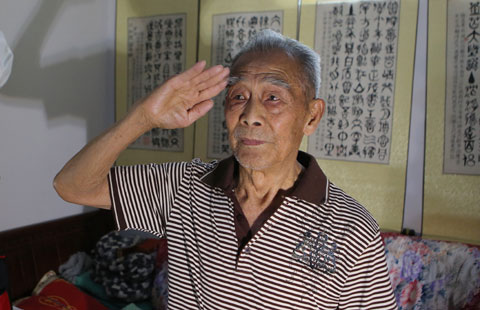
| The Medal of the Order of Merit for National Foundation and a certifi cate posthumously awarded to Yu Jin-dong by the Republic of Korea in 2007. GAO YUAN/FOR CHINA DAILY |
The history of the exiled Koreans who fought alongside the Chinese in the struggle against Japan is a compelling story, as Luo Wangshu, Ji Jin and Tan Yingzi report from Chongqing.
Liu Xiutong is a frequent visitor to the Museum of the Provisional Government of Korea in Chongqing, despite the 60-minute journey each way. He is drawn to the museum by family ties
"I can find my father's footprint and my family history here," said the 59-year-old retired leather worker. Liu's father, Yu Jin-dong, was the personal physician to Kim Gu (1876-1949) the last president of the provisional government, which was based in the city from 1939 to 1945.
"This is my father," Liu said, pointing at a photo and indicating a man wearing eyeglasses standing alongside Kim, who is often referred to as the "father of the nation" in the Republic of Korea. "And this is my uncle," he said, pointing at another young man in the photo.
Liu's family story provides a snapshot of the history of the putative government, and is a reminder of the Chinese and Korean people's long, combined struggle against the Japanese.
This year is the 95th anniversary of the establishment of the provisional government, and to mark the occasion, the outgoing South Korean Prime Minister Jung Hong-won visited Chongqing in April.
'A special city'
"Chongqing is a special city for Koreans. The sites of our provisional government and the Korean Liberation Army are both located in the city. The Korean government and people have always cherished the help given by the people of Chongqing during the war," Jung wrote in an e-mail to China Daily.
The provisional government was launched in Shanghai on April 13, 1919, shortly after the Samil Movement declared Korean independence from Japanese rule.
The exiled Koreans moved many times - to Hangzhou, Zhenjiang, Nanjing, Changsha, Guangzhou and Liuzhou, before finally settling in Chongqing in 1939. Following the Japanese surrender in 1945, the provisional government promptly returned to Korea.
However, because the provisional government had not been recognized by global powers, it did not return to Korea as a government entity, instead the members returned to Korea as individuals.
"The provisional government is an important part of the history of the Korean people and we celebrate the anniversary of its establishment on April 13 every year. Activities, including painting and an essay writing competition, are held in schools to cherish that history," said Kim Jin-gon, the South Korean consul in Shanghai.
"During the time of Japanese rule of the Korean peninsula, patriots could not act domestically, so most of their work was carried out overseas, especially in Shanghai and Chongqing. I have read many accounts of how China - both the Kuomintang and Communist governments - provided help to the provisional government. Without that help, the Koreans would not have been able to go to Liuzhou and Chongqing during their period overseas," he said.
Huang Youfu, a professor of Korean studies at Minzu University of China in Beijing, said textbooks written by both left- and right-leaning Korean academics acknowledge the importance of the provisional government. "The Korean government, scholars and ordinary people value the provisional government. There's no dispute about that period of history. The last president of the provisional government, Kim Gu, was a figure similar to China's Sun Yat-sen," he said, adding that the provisional government was a milestone in Sino-Korean relations during the struggle against Japan.
That opinion was echoed by Piao Jianyi, a researcher in Korean issues at the Chinese Academy of Social Sciences. "China and Korea have recently been working to avert Japan's militaristic reorientation. History is the basis of that work, and the provisional government is an integral part of that history," he said.
In Shanghai and Chongqing, the buildings occupied by the provisional government have been preserved as museums and are must-see sights for Korean visitors.
The Chongqing site is now hidden among the skyscrapers that dominate a hilly area in the downtown district. Ten of the museum's rooms are open to the public; some display photos and historical material while others remain as they were when the provisional government occupied the building.
Yun Su-kyung, from the Republic of Korea, who works for an electronics company in Chongqing, spoke about her visit to the museum. "I learned about the provisional government overseas in high school history class, but when I actually saw the site in Chongqing, I was sad because it's so shabby. But now I can understand how hard my ancestors worked for independence," the 36-year-old said.
"There is an emotional link between Chongqing and Korea," she said.
Annexation
In 1910, the signing of the Japan Korea Annexation Treaty resulted in the entire Korean peninsula becoming Japanese territory. It was a time of iniquity - Koreans were forbidden to speak their own language or practice traditional ceremonies. Schools were banned from teaching Korean, so children only learned Japanese, and people were forced to adopt Japanese names. The final indignity was that many Korean women were forced to act as "comfort women" - sexual slaves - for the Japanese soldiers.
Following the Allied victory in World War I, several European colonies claimed independence. Inspired by this, a group of activists known as the Samil Movement convened at a restaurant in Seoul on March 1, 1919, and read a notice declaring Korea's independence from Japan. The movement, which also inspired activists in China, was quickly suppressed by Japanese police and troops, prompting many key advocates of independence to move to China and form a united opposition to the Japanese.
Many ordinary citizens also fled the country. Yu Jin-dong was one of them. Born in 1908, Yu arrived in China with his family in 1910. After attending middle school in Jilin province, he entered Tongji medical school in Shanghai and gained his degree in 1934.
Yu then became an activist, working to free the Korean peninsula from the Japanese. He arrived in Chongqing in 1939 and began to work for the provisional government.


Copyright 1995 - . All rights reserved. The content (including but not limited to text, photo, multimedia information, etc) published in this site belongs to China Daily Information Co (CDIC). Without written authorization from CDIC, such content shall not be republished or used in any form. Note: Browsers with 1024*768 or higher resolution are suggested for this site.
License for publishing multimedia online 0108263 Registration Number: 130349